

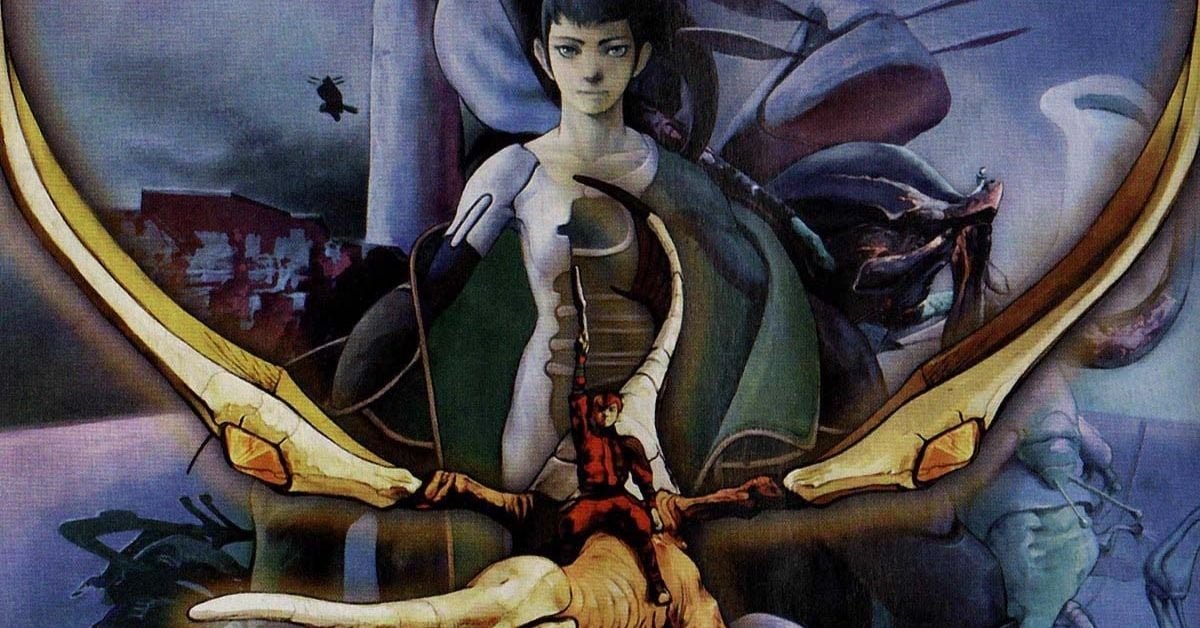
Though Sega intended for Panzer Dragoon Saga to compete with Final Fantasy 7, it feels like a game specifically engineered to dodge mainstream success.
Released in 1998 for the Sega Saturn, Team Andromeda’s final game was a bold, ambitious experiment, ahead of its time and out of step with console RPG conventions. Developed before Square’s blockbuster set the template for big-budget RPGs, but released about a year after, Panzer Dragoon Saga is a fascinating alternative vision of what a role-playing game could be.
Then and now, nothing else plays like Panzer Dragoon Saga’s unconventional hybrid of RPG and rail shooter mechanics. Its understated, small-scale narrative embraces ambiguity over anime and manga tropes. Its surreal visuals take inspiration from Mobius and Miyazaki to create a unique and forbidding vision of a crumbling world.
Part of Panzer Dragoon Saga’s mystique comes from the fact that most of us never got to play it. The Saturn was on its way out when the game left Japan, and Saga’s production run amounted to between 20-25 thousand copies in the US. Europe only got about a thousand copies. Panzer Dragoon Saga became a collector’s item well before the retro games craze kicked off. Used copies, if you can find them, typically go for well over a thousand USD. Panzer Dragoon Saga’s unavailability, combined with rave reviews from the western gaming press, gave it a reputation as something like a lost classic.
Despite all this, I found that the game itself is sometimes more interesting to think about than to play. Some of the levels are a slog to navigate, especially with random encounters and combat that can feel sluggish and repetitive. Despite these issues, Panzer Dragoon Saga is still a remarkable accomplishment that deserves a remaster or re-release so it can find wider appreciation.
Story
Panzer Dragoon Saga’s narrative follows Edge, the sole survivor of a mercenary team sent by the Empire to guard a mysterious archaeological dig. While fighting monsters in the dig site, Edge finds Azel, a mysterious girl entombed within a slab of ancient technology.
Craymen, a mutinous imperial commander, raids the dig site, kills the other mercenaries, takes Azel, and leaves Edge for dead. He wakes up deep within the ruins, befriends a mysterious dragon, and sets out to rescue Azel and get revenge on Craymen.
The characters don’t get a huge amount of development, though they were clearly designed with an eye toward avoiding JRPG trends and cliches. No character exemplifies this better than Azel. The game’s original title was Azel: Panzer Dragoon RPG, though Azel lost her spot in the title for the western release. An unconventional heroine, Azel is aloof and inscrutable, serving more as an antagonist than a love interest to the main character.
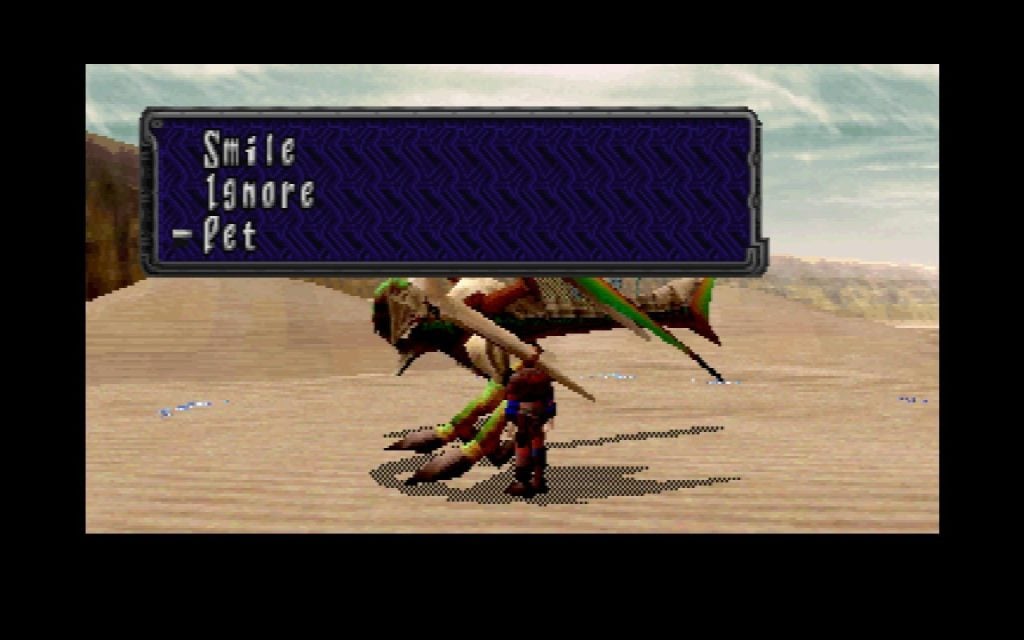
Compared to other RPGs, Panzer Dragoon Saga’s main cast is quite small, though perhaps a better word might be “focused.” There’s no player-controlled party, just Edge, the dragon, and the occasional non-combatant passenger. The dragon isn’t much of a conversationalist, though you can check on him at camp to see how he feels about things, which is a nice humanizing touch for both the dragon and Edge.
That’s right, you can, in fact, pet the dragon.
Series creator Yukio Futatsugi and his colleagues at Team Andromeda created a world that fans of Hayao Miyazaki’s Nausicaa may recognize with appreciation; a forlorn, ruined landscape where humankind huddles in isolated tribes for protection against the remnants of an ecological disaster only faintly recalled.
Informed by European comics, Studio Ghibli’s richest fantasies, and classic science fiction, Saga neatly sidesteps many well-worn fantasy gaming tropes.
Dragons in Panzer Dragoon’s world are alien beasts resembling crustaceans more than lizards. That motif is consistent across the rest of the series’ creature designs, with most enemies looking like shelled, insectoid monstrosities. The technology of their human antagonists follows a similarly bizarre, pseudo-organic design motif.
More than any of the characters, Panzer Dragoon’s strange and forbidding world is the real star. Saga takes players off the rails to explore the series’ unforgettable monster-haunted ruin of a world. Even as early as the first Panzer Dragoon, the setting stood out for its unique look and a sense of deep lore lurking under the surface of the game’s brief runtime. It’s a mysterious, barren landscape, studded with rusted bones of a forgotten high-tech civilization.
Audiovisual
Nothing else looks or sounds like Panzer Dragoon Saga. While its low-resolution, pixelated 3D models look charmingly retro today, they represent an impressive technical achievement. Even in the late 1990s, most big games used pre-rendered backgrounds due to technical limitations of early 3D hardware. With Panzer Dragoon Saga, Team Andromeda managed to build a fully real-time 3D world, a rare feature in RPGs of the time, and no easy feat on the Saturn.
The soundtrack, by Saori Kobayashi and Mariko Nanba and arranged by Hayato Matsuo, favors mood pieces over catchy melodies and themes, with a mix of brooding tracks that might have served admirably on many more conventional RPGs and ambient world music-inspired songs. On first listen, it might not strike as terribly memorable, but like much of the rest of the game, it feels perfectly of a piece with its tone, a sort of tribal-synth new age hybrid sound.
Another way in which Saga’s soundscape is ahead of its time is the inclusion of voice acting. Back in 1998, this was still relatively uncommon, especially in RPGs.
Panzer Dragoon also memorably includes an in-world fictional language, dubbed “Panzerese,” a constructed language synthesized from Latin, ancient Greek, and Russian. While the previous two games used Panzerese for the entirety of their relatively small scripts, Saga’s voices are in Japanese for most of the game aside from the opening and ending cinematics and the closing vocal track.
Gameplay and Mechanics
For Panzer Dragoon Saga, Team Andromeda used the Panzer Dragoon II Zwei engine. With such a drastic switch in genres, it’s a wonder that the game works as smoothly as it does, and a real testament to the team’s determination and skill.
They retrofitted mechanics and systems designed for fast, propulsive action to suit a slower-paced game focused on exploration and narrative. The result is an innovative and surprisingly elegant take on RPG navigation and combat.
The lock-on system from the rail shooter games returns here as your main means of interacting with the world. Talking to NPCs, picking up items, or even opening doors requires you to highlight a target and lock on. While it takes some getting used to, it’s a fairly elegant system that adds to the game’s unique identity.
Exploration and Level Design
In fairness to Team Andromeda, they made Panzer Dragoon Saga well before the games industry had determined best practices for third-person 3D movement. Like many other games of its era, the control scheme for navigating the world has not aged well.
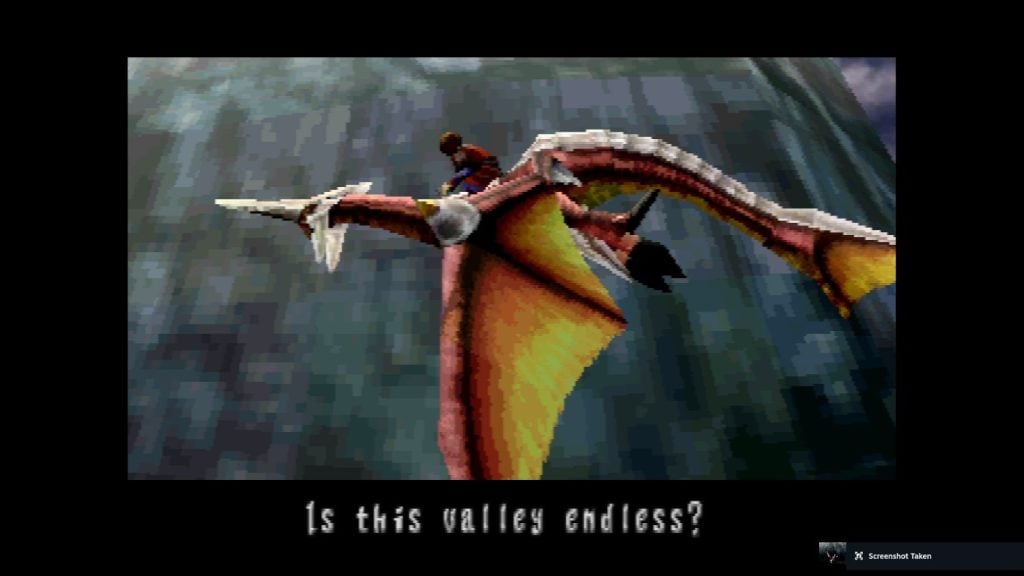
On the positive side, soaring over vast, desolate landscapes felt great in both previous Panzers Dragoon, and it feels great in Saga, even with the too-frequent random encounters.
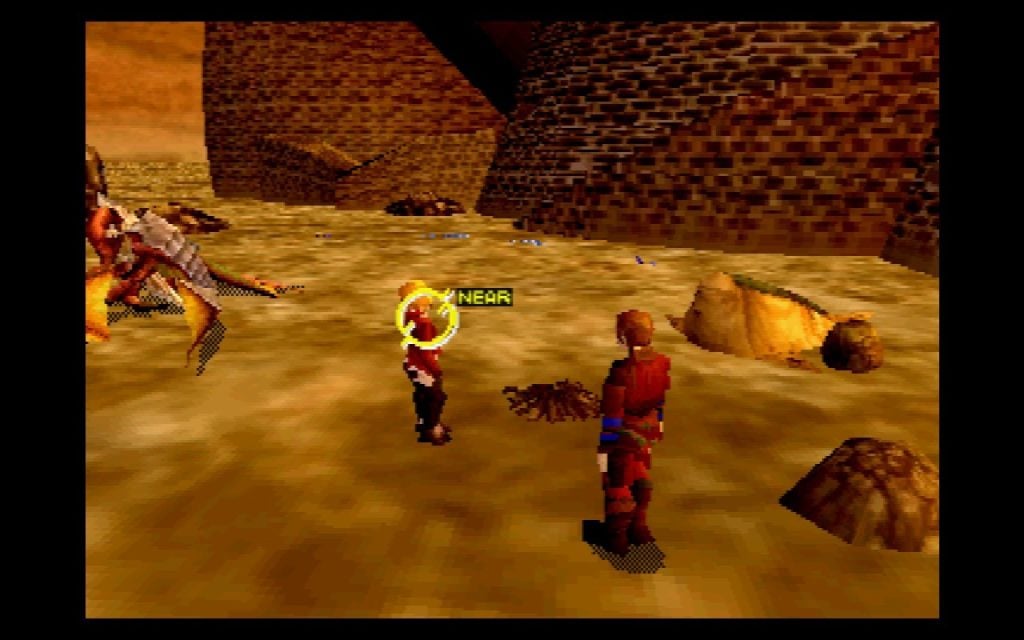
Panzer Dragoon Saga, even for its time, employs a greatest-hits collection of player-unfriendly layout choices. The layouts don’t always flow well; they hide important points of interest that require frequent visits behind long, snaky, and hard-to-spot paths. There’s not much in-game to clue you into your next objective, and it’s easy to get lost without a guide. If anything, the dungeons are worse, often consisting of largely featureless webs of repetitive corridors.
Combat
Panzer Dragoon Saga’s combat system manages to turn the lock-on shooting based combat of its predecessors into a unique and fun RPG battle system.
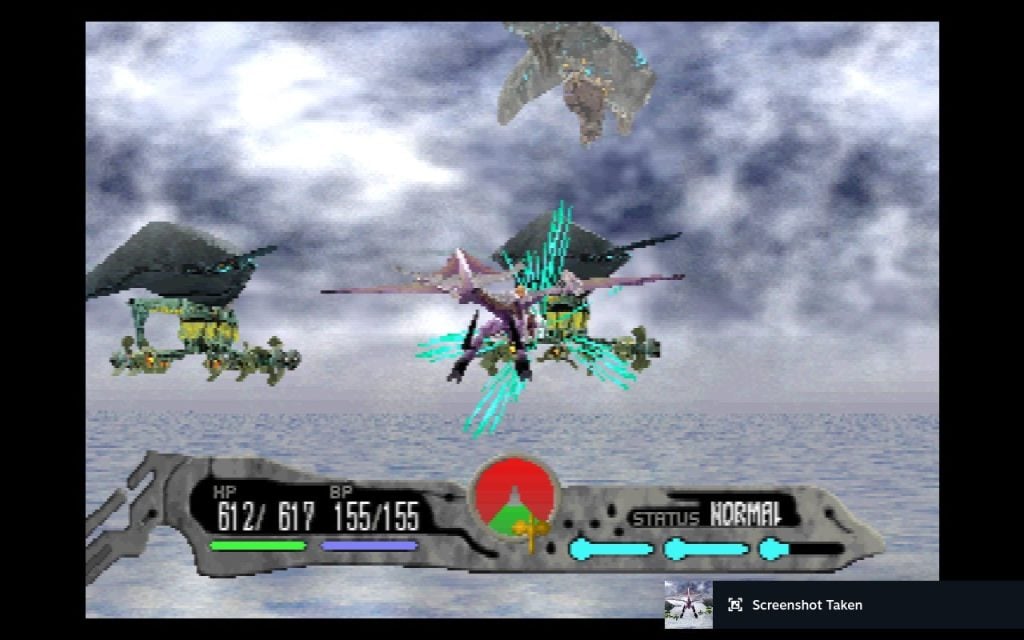
In combat, your dragon can move in a circle around the enemy group. The battlefield is divided into quadrants. You can fly your dragon between these zones to avoid enemy attacks or get at their weak points. Similar to early Final Fantasy games or Parasite Eve, you have to wait for an action gauge to charge before you can take action.
Your gauge has three segments, allowing you to save additional turns for later or use all three at once for a powerful special move. It’s a satisfying system that allows for some strategic choice, and a good balance of risk and reward.
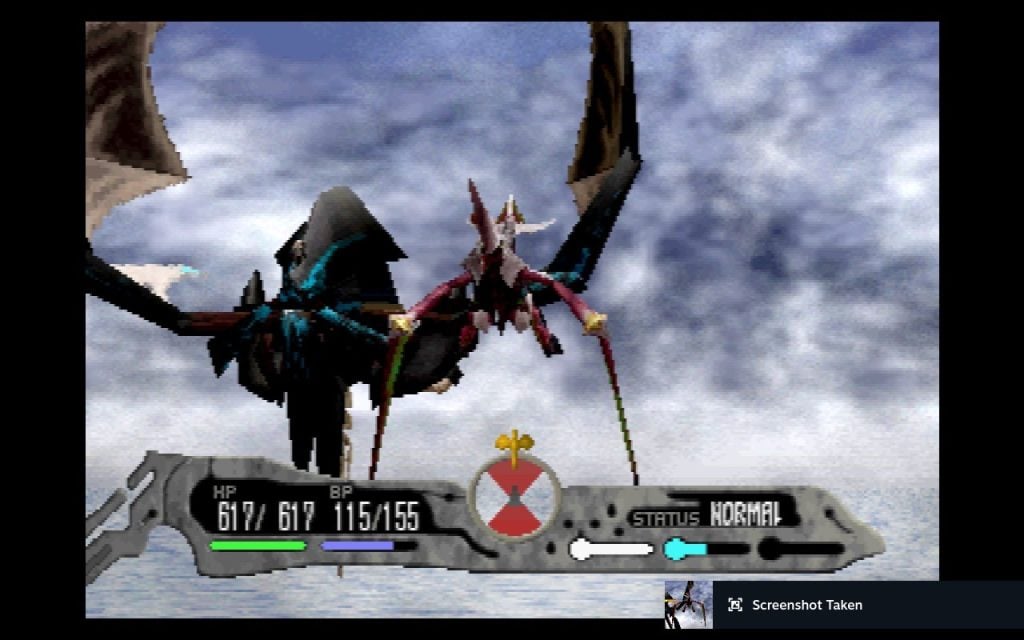
Your basic attack options are reminiscent of the previous games; Edge has a gun which is useful for taking out single targets, while the dragon has a homing laser attack that hits several enemies at once. You also have access to items and special “berserk” attacks that function like healing or attack magic in your standard RPG.
Unfortunately, the combat system isn’t without problems. As with many early 3D RPGs, the attacks, with their liberal use of special effects and dynamic camera angles, look impressive but take time to resolve, making combat feel slow. Aside from a few tricky boss fights, combat is also fairly easy, leaving little incentive to master all of the options available to you.
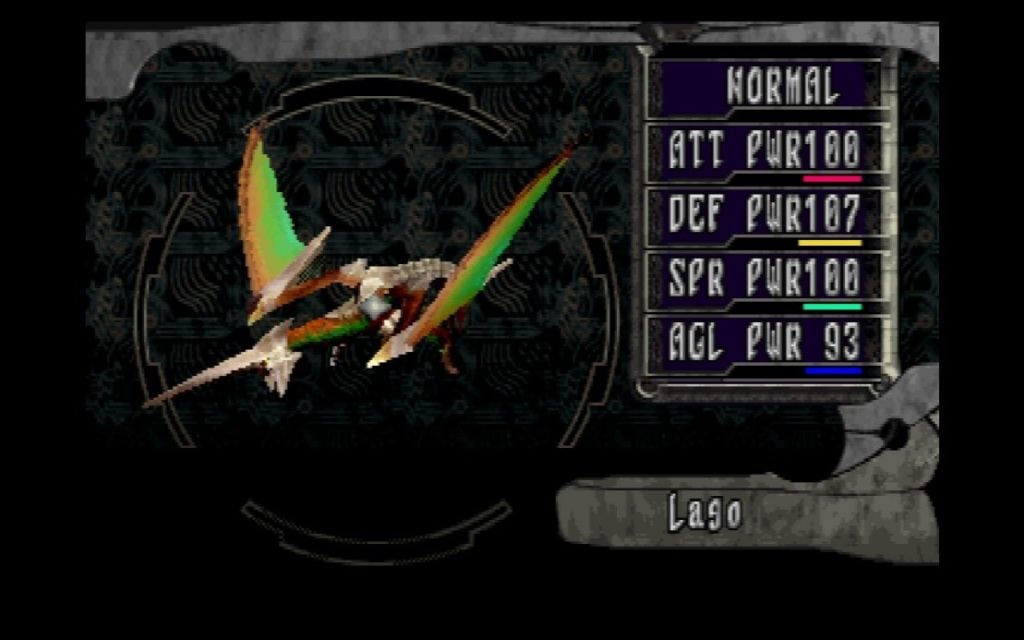
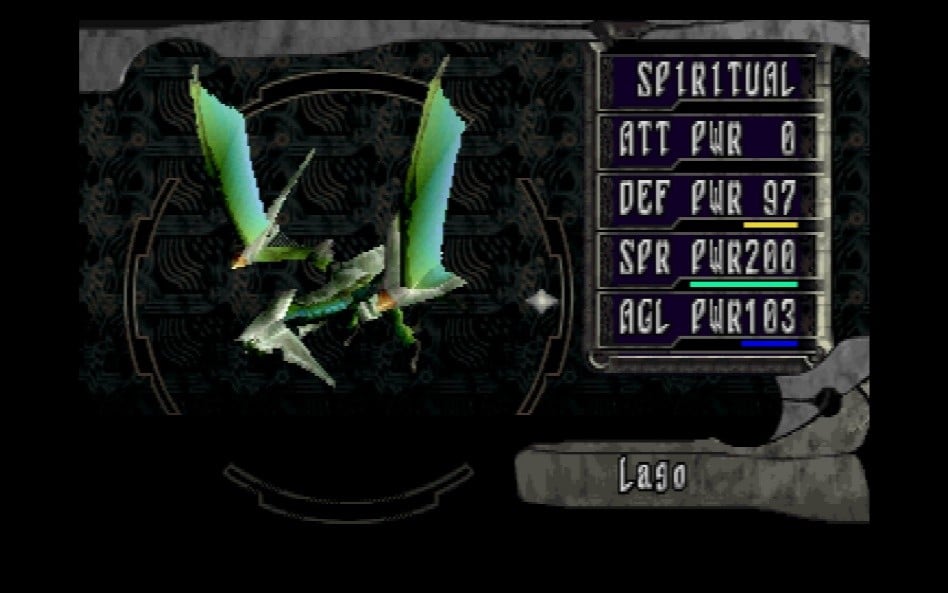
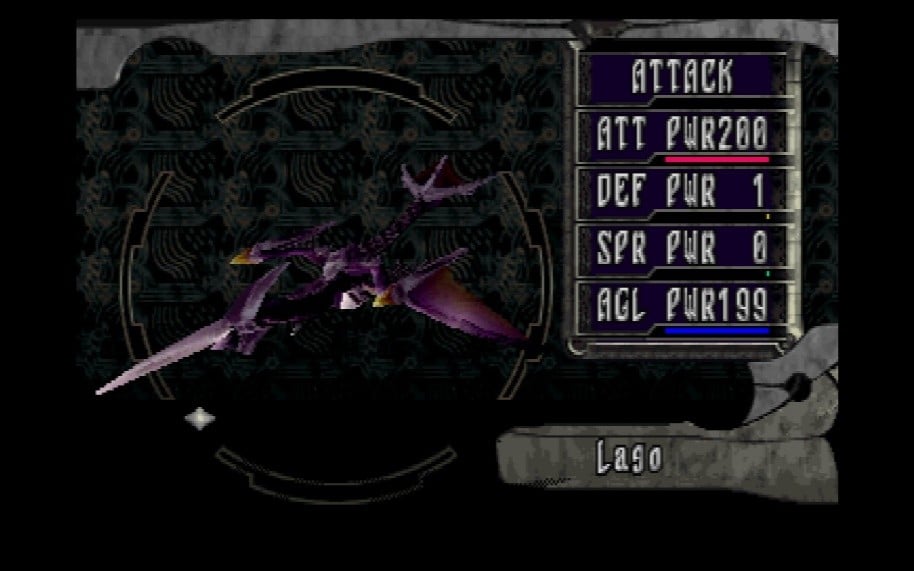
Instead of a standard character class system, Panzer Dragoon Saga has a feature where your dragon can change forms, focusing either on offensive power, defense, magic, or agility. What makes this system interesting is its analog nature: instead of selecting different dragon types from a menu, the game’s UI represents your dragon form as a radar graph. Along the edge of the graph are four axes labeled for your dragon’s four stats. Moving the cursor around within the circle takes points away from one stat and adds them to another. Your dragon’s appearance also changes to match the graph, which is a really cool visual effect.
This system allows for interesting choices. You can’t max your dragon out completely, since stats on opposing ends of the graph are mutually exclusive; upping your defense takes away from agility, and upping attack reduces your magic.
Since you can put the cursor anywhere within the circle, your options for combining dragon stats are nearly endless: you can go all-in on Attack, create a hybrid dragon that excels in both defense and magic, or stick close to the center for an all-rounder type. It’s as brilliant and elegant a system as I’ve seen in a game. As impressive as it is now, it must have seemed mind-blowing back in 1998.
Despite its flaws, Panzer Dragoon Saga is a fascinating piece of art that’s well worth playing. Team Andromeda took a bold swing at capturing the imagination of audiences hungry for cinematic greatness.
The world, and the industry, moved on in the footsteps of Square’s relatively conventional crowd pleaser. Team Andromeda disbanded soon after launching Panzer Dragoon Saga, and their would-be blockbuster instead became a cult classic. Panzer Dragoon Saga may not be a Final Fantasy 7 killer, but maybe it never had to be.
