

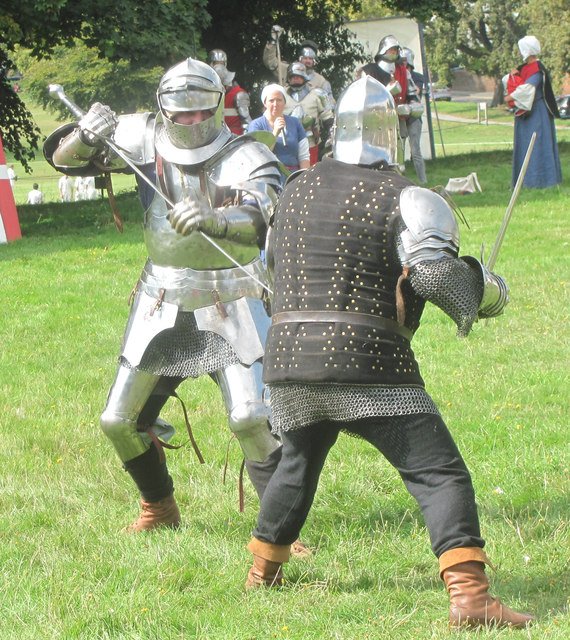
Feradach mac Tralin took interest in the Society for Creative Anachronism (SCA) in 2011, watching the combat portion of the community and felt that was what he needed in his life. He has yet to look back. Focusing on German longsword and Italian rapier, Tralin discusses how the SCA balances the historical and modern aspects of training, and where does a martial art begin and when sport begins.
MAYTT: You mentioned that the fighting the SCA does is like a sport as opposed to a martial art. I have talked to many HEMA people, where they say it is a martial art rather than a sport. Likewise, I have talked to kendo people, to which they say kendo is not a sport, but a martial art. Why do you use the term “sport” instead of “martial art” or “sword fighting?”
FT: So philosophically – and I’m a philosophical guy, so if you let me, I’ll wander off into some pretty thick weeds – I would say the dividing line between a martial art and a sport is that a martial art is fundamentally a study of how human beings can do harm to other human bodies. You’re really thinking about what damage a technique would do, what the most effective methods are, and how you would handle a real combat situation. That’s why a lot of martial arts, especially the more practical ones, do things like stress training. They’re trying to prepare you for situations where someone jumps you in an alley in the middle of the night. The goal is to make sure you don’t freeze up because this is, at its core, an art about fighting. Because of that, martial arts often encourage certain techniques because they’re martially sound – they would actually work and cause harm if necessary – while discouraging others that wouldn’t.
A sport, on the other hand, is where you have a set of rules and you’re optimizing toward those rules. You’re still pursuing physical performance, but that performance isn’t directly tied to the damage it could do to another person. I know HEMA is having a lot of discussions about this right now. Are we a sport? Are we a martial art? Where do we fit? In the SCA, I would say we’re strongly on the sport side of that spectrum. When I step onto the field, and when most people step onto the field, we’re not primarily thinking about how this technique would hurt another person. Our rules are still rooted in martial concepts, though. For example, in armored combat, the traditional calibration standard for a valid blow is whether it would penetrate chainmail.
Now, there’s plenty of debate about whether that’s actually realistic. That standard was developed back in the 1960s when very few people had access to chainmail or swords to test against it. But the important thing is that the people creating the rules were still trying to ground them in a martial context. They were asking, “How do we make sure this reflects a martially sound technique?” In that sense, we’re similar to modern Olympic fencing. Olympic fencers still use parries and sword-like implements, and their activity clearly comes from sword fighting. We’re probably more connected to our martial roots than Olympic fencing is, but culturally I don’t think we maintain a deep focus on the martial side of things.
Most people aren’t spending a lot of time asking, “How would this really hurt somebody?” Instead, they’re asking, “Which techniques are most effective on the tournament field?” We have internal debates about that as well. Some people are very focused on the sporting aspect and have developed techniques that don’t appear anywhere in the historical manuals. In an actual historical combat situation, some of those techniques would probably get you killed very quickly.
There was an interesting HEMA article I read that illustrated this well. The author basically said that if you’re in a tournament and you have a technique with a sixty percent chance of hitting your opponent and a forty percent chance of getting hit in return, you might think, “That’s a net positive. I’ll take that trade.” In a real sword fight, though, that same calculation becomes, “There’s a forty percent chance I die.” Suddenly it doesn’t look like such a good trade anymore. To me, that’s the dividing line. How much weight do you place on winning the game versus maintaining martial soundness? In a sport, you think, “If I lose, that’s okay, I’ll get another chance later.” In a martial context, you’re trying to practice only those things that make sense if the consequences are real.
There’s that old idea that under stress you’ll perform the way you practice. If you spend years throwing certain punches, kicks, or sword strikes, those are the actions you’re likely to fall back on when something dangerous happens. A martial artist is therefore concerned with doing only things that are martially sound, while a sport practitioner is concerned with doing things that are effective within the rules. Most combat sports try to bridge that gap. They’ll create rules that encourage martial behavior. They’ll penalize double kills, establish priority systems, or create incentives that reward realistic outcomes. For example, if you cut my hand and I cut your head, I win the exchange because I can survive without a hand, but I’m not surviving without a head. But at the end of the day, I think we focus more on how to play the game than on how to learn real-world sword fighting. Part of that is simply because real-world sword fighting isn’t especially applicable in modern life.
And I think of myself as a martial artist who plays a sport. When I’m fighting, I spend a lot of time thinking about what would actually be effective and what would be martially sound. I want to understand how these techniques would work in a real context. I was an infantryman, so that’s often the lens I look through. I’m thinking, “How would we actually fight this?” At the same time, I recognize that I’m participating in a sport. Most of the other people on the field aren’t approaching it from that perspective. They’re there to figure out how they can tag me as quickly and effectively as possible within the rules of the game. So, I see myself as someone who brings a martial mindset into a sporting environment.
MAYTT: It is difficult to find where that line is between sport and martial art. That was my initial issue with Olympic Fencing with its right of way.
FT: Right-of-way was invented because the ruleset encouraged people to just blindly charge forward. The idea behind it was actually to add some martial soundness back into the sport. It was a way of reminding people, “Don’t ignore hits. These are hits. This is a sword. Don’t get hit by a sword.” The concept is that if you fail to stop the incoming attack, then it doesn’t really matter what you did afterward; you still lose because you allowed yourself to be hit by a sword. The rule was designed to reinforce the idea that avoiding injury should matter, rather than rewarding people for simply rushing in and trading blows.
MAYTT: Where does the study of the manuals come into the combat sport events in the SCA?
FT: It’s a really interesting thing that I’ve had to work with a lot. I enjoy learning historical fighting, and I enjoy encouraging other people to learn it as well, but some things can be difficult to make work in practice. One of my touchstones, or guidestones, is that I tell people: if you’re attempting a historical technique and you’re not succeeding with it in our sport environment, you probably don’t understand the historical technique well enough yet. You need to go back, study it more, and figure out what’s really going on. After all, these techniques were designed to hit people with swords, often to kill people. If you understand them properly, you should be able to make them work at least a fair amount of the time.
At the same time, there are definitely things that don’t translate perfectly. One example I like is from Capo Ferro. In his first plate, he presents a very simple sequence: I take the sword offline, my opponent disengages to the other side, I take it offline again, and then I stab him. It’s a very straightforward action, and once you get it down, it almost feels like a cheat code because it works so well. What I had to learn, though, was how measure affects the technique. In our fighting, the goal is generally just to touch the other person. We’re not trying to drive through them. In the manuals, however, the assumption is that at the end of the action you’re putting one to three feet of steel into the other person. That changes the measure completely.
A good example is the stop thrust. Somebody comes charging at you, you poke them with the sword, and in a sport environment they go, “Oof,” and stop moving. With a real sword, that often wouldn’t happen. You’d poke them, they’d react, but their momentum would keep carrying them forward and they’d continue right into you. So there are definitely adaptations that have to be made when applying historical material in a sporting context.
Part of understanding historical techniques is understanding why certain things don’t work the same way under sporting rules. In my experience, that actually leads to a richer understanding of the material. For example, figuring out exactly what measure Capo Ferro’s first plate operates at forced me to develop a much deeper understanding of measure itself, as well as timing. I learned those concepts far more thoroughly than I would have if I had simply been able to apply the technique exactly as shown without any adjustments. Sometimes the challenge of making historical material work teaches you more than immediate success ever could.
MAYTT: Since you are describing an added layer of deciphering the historical manuals and putting it into the sport context, how important is to learn from the manuals for the average SCA fighter?
FT: I would say, and this is based on talking to a lot of people rather than any formal study, that I have some perspective on this. I’m one of the Masters of Defense, so I’m recognized as a master of steel fighting, and part of that role involves spending a lot of time talking with members of the community and learning about what they’re doing. Vaguely speaking, I’d guess that somewhere between one-third and two-thirds of SCA fighters have at least some interest in historical fighting and are trying to incorporate aspects of it into what they do. However, the number who really focus on it is probably closer to a quarter to a third. Most people can tell you, “I’m trying to fight in this style,” but many of them don’t spend a great deal of time deeply studying the historical material.
One thing I’ve done to encourage that focus is run a tournament at our July Fourth week-long event on the coast. I’ve been running it for about five years now, and I call it the “Master Style Tourney.” The idea is that competitors show up and say, “Here’s the historical master I’m studying. Here are the techniques and principles I’m working from. Now I’m going to demonstrate those techniques in combat.” We have judges who are familiar with the various styles, and competitors are scored on a ten-point scale. Only one point is reserved for whether or not they actually win the fight. The other nine points are based on how well they perform the techniques, how accurately they represent the style, and how effectively they embody the principles of the master they’re studying. It’s a very deliberate attempt to bring historical study into a tournament setting.
That tournament usually attracts somewhere between ten and fifteen participants. By comparison, the larger, more prestigious tournament at the same event – the one where fighters compete for the honor of the royalty – might attract around sixty participants. That gives you a rough sense of the spread. If it’s a high-profile tournament where people can earn recognition and praise for their fighting, you’ll often get fifty to a hundred participants. If it’s focused primarily on historical research and interpretation, you’ll usually get somewhere between ten and twenty people showing up.
MAYTT: How well have you seen those fighters fight within their selected styles, or their selective systems?
FT: I would say people are generally pretty good about it. One of the judgment calls I made relatively early on was recognizing that there are a lot of styles in the world, and I’m not an expert in all of them. Nobody can be. It’s literally impossible to be an expert in everything, that’s why we have division of labor and society and all that jazz. So the solution I came up with was to have each participant come in and identify three specific principles they’re focusing on.
For example, if I were fighting in a Capo Ferro style, I might tell the judges that one of his key principles is the stringere: always keeping your blade in a position that constrains your opponent’s blade so they have to take an extra action, such as disengaging, before they can hit you. I might also talk about how he emphasizes leaning the body to one side or the other to stay protected behind the blade. Then I’d tell them that Capo Ferro generally discourages feints. If you throw a feint, it should still be a real attack that you’re fully prepared to land if your opponent doesn’t respond appropriately. I would give the judges those three principles, and then they would evaluate me based on those three principles. It’s helpful because the fighters essentially get to choose their grading criteria. They build their own rubric and then perform against it. They’re not being judged on how perfectly they execute an entire style, which would be much harder to assess.
If a participant is studying a style that one of the judges knows particularly well, that can also lead to some really valuable conversations afterward. A judge might say, “I wouldn’t have chosen that principle,” or, “I think you’ve interpreted that principle differently than I would have.” Then they can sit down and work through it together. Overall, the tournament has been received very positively. I’ve definitely seen people improve, both in their technical understanding and in their ability to identify and express the principles they’re trying to embody.
Honestly, the most common problem is that people get into a fight, their opponent throws something unexpected at them, and suddenly all of their principles go out the window. They stop focusing on their chosen style and start fighting according to standard SCA habits because they want to win the bout. That’s why we constantly emphasize that this tournament isn’t about winning. I would much rather see someone lose a fight while faithfully fighting their style than win a fight by abandoning it.
MAYTT: What you are describing is a community-sponsored learning program on how to be better at your style.
FT: It’s my way of encouraging our community to highlight that side of the art. There are a lot of tournaments where you get praise for winning. If you’re a really good fighter, everyone knows you’re a really good fighter. People talk about how skilled you are, and they’ll want to come learn from you. This tournament is one of the ways I’m trying to encourage something a little different. I want to laud, praise, and give accolades to people who are studying historical styles and doing their best to bring those traditions to life. I want to recognize the people who are taking the actual manuals, digging into them, and trying to make them a living part of what we do. Because, as a community, we already place a lot of emphasis on simply being a good sport fighter. There’s plenty of recognition available for that. What I’m trying to do is create a space where people are also recognized for historical research, interpretation, and faithfully applying those historical systems in combat.
MAYTT: In the same regard, have you seen other kingdoms within the SCA do something similar to what you’re doing or has this kind of been something novel in the SCA?
FT: So, I actually got the idea from elsewhere. They run similar tournaments at some of the larger wars. There’s one at Gulf Wars in Louisiana – I think it’s in March, though I don’t remember exactly – and I believe they also run one at what’s now called War of the Phoenix down in Arizona. It had to change its name a few years ago. I’d heard about those tournaments at the big wars and thought, “I want that here as well.” So I can’t really claim credit for the original concept. I borrowed the idea from them.
What I think was more my contribution was the “build your own rubric” approach. I hadn’t heard of anyone else doing that, and it was really my solution to a practical problem: there’s no way I’m going to find judges who know every historical manual out there. Especially because I’ve had participants who seem to take it as a personal challenge to find the most obscure manuals possible and bring those to the tournament. The self-selected rubric lets people explain the specific principles they’re working from, and then the judges can evaluate how well they’re applying those principles rather than trying to be experts in every fencing tradition ever written.
MAYTT: It is great that you took the initiative within your own kingdom and had some positive reactions! How important is the combat aspect to the SCA experience?
FT: As a whole, the SCA has a structure that includes royalty, rank, and peerage. We determine our king and queen through armored combat. The winner of that combat tournament becomes king for six months. That means, at its most basic level, the leadership of the society is directly tied to fighting ability. The people in charge are always fighters—though they also have a consort who can be anyone they choose. Often, it’s their spouse, but sometimes it’s someone they feel would help lead the community well for a variety of reasons. In practice, at least half of the ruling pair is always a fighter.
That naturally makes combat central to the culture in one sense, because it directly connects to leadership and recognition. But at the same time, a lot of effort goes into making sure the Society doesn’t feel like only fighters matter. There are plenty of people who never engage in fighting at all, and plenty more who only participate occasionally without it being their focus. No one is treated as a lesser member of the Society for that. The armored combat – the steel fighting – is what ties into the crown, but rapier and cut and thrust don’t connect to that same path. Since those disciplines don’t lead to becoming crowned through combat, they sit alongside the broader community of arts, service, and other activities.
Overall, the Society has worked very hard over time to balance that dynamic. There have definitely been moments where it was a problem, but it has grown and matured in how it recognizes that everyone is part of the same community, and that everyone is welcome and valued, not just the heavy fighters who can become king.
MAYTT: Is there anything else you would like to add?
FT: I guess there’s one thing I was thinking about, sort of in the martial versus sport framing. It’s something I’ve thought about a lot, especially around judging in HEMA. It’s one of the things I’ve had to defend to people – this idea that HEMA uses judges at all. In the SCA, we’re very much an honor-based culture, and I’ve had people argue that once you introduce judges, it removes the necessity of being a good person and honestly taking your blows. The flip side is that it’s actually easier to cheat in the SCA in some ways, just saying, “yeah, I didn’t feel that, I don’t know what you’re talking about.” We do have strong social pressure against that, and we’ll sanction people or even remove them from tournaments if they keep doing it. But it’s still a real dynamic.
When I talk to new people looking at both systems, I usually explain that in the SCA, you call blows on yourself. On one level, you’re always looking for the opportunity to lose cleanly and say, “yep, you got me.” That creates a very different psychological focus in the fight. In a more sport-focused system, like parts of HEMA, the judging structure can allow for a different mindset. You can focus more purely on hitting your opponent, because you’re not simultaneously managing every exchange through self-reporting. In that sense, it can feel more martial; like “I don’t care what happens to me, I’m here to land the strike.” In a real fight, of course, it’s different again. If I’m truly in danger, my instinct isn’t “you tagged me, good job,” it’s “I’m going to keep going and survive this.” So, there’s a constant tension between training habits and survival response.
I actually think one of the advantages of HEMA’s judging structure is that it can support that more continuous, forward-driving mindset. You don’t have to split your attention between fighting and self-adjudication, so in some ways you get to stay more locked into the opponent and the action. At the same time, I’ve had fights where something happens, and I genuinely have to pause internally and reconstruct what just occurred. Adrenaline does funny things; you get pulled into a survival state and you have to consciously sort out your sense memory afterward. With judging, that burden is reduced, because the responsibility for tracking exchanges is externalized.
MAYTT: Speaking of judging, is there any initiative or feeling within the SCA that there needs to be judging, or at least a judge, present in the tournaments, or is it such an honor-based culture that it is not really coming up in their thought process?
FT: I think for the most part, nobody really wants judging as a default; it’s not something we’re aiming for as a community. That said, there are situations where individuals will abuse the system. If that happens repeatedly over a couple of events or tournaments, you’ll start to see what we call “active marshalling.” That’s where we put a lot more emphasis on the fighter who may have been wronged and ask directly, “How did you really feel about that fight? Do you want to contest this?” In some rare cases, leadership may step in more forcefully and say, “That fight was not valid,” or even shut it down entirely, “you lose, please get off the field, you’re not allowed to fight anymore.” But that kind of intervention is extremely rare. It really only shows up when there’s what you might call a “problem child” situation. And once that person is dealt with, the push for formal judging or heavier oversight basically disappears again.
MAYTT: So, is it as an at-need basis?
FT: Yeah, and it’s considered a pretty extreme step, which makes us hesitant to use it in the first place. In practice, we might know we should act when things are at a “five,” but we often don’t move until it’s closer to a “seven,” just because there’s a strong social pressure not to escalate. And then once the issue is actually addressed, the reaction is pretty clear-cut; everyone essentially agrees, “okay, definitely don’t do that anymore, that’s not who we are as a society.”
MAYTT: Thank you for this great conversation!
FT: It was a good time.
