

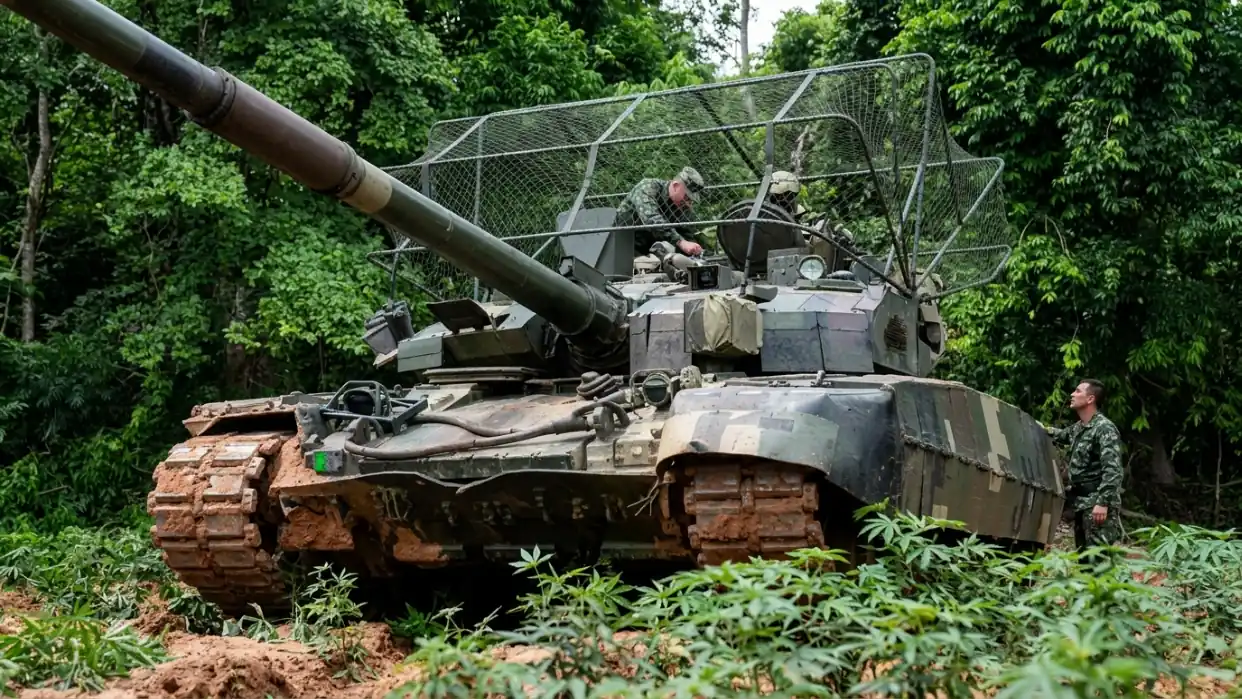
Defense Feeds, Bangkok – The Thai T-84 Oplot-T tank adopts anti-drone mesh, illustrating how lessons from recent conflicts are influencing armored vehicle protection worldwide. The addition of foldable anti-drone mesh to the Royal Thai Army’s main battle tanks reflects the growing recognition that unmanned aerial systems have fundamentally changed the threat environment facing armored formations.
As drones become increasingly capable and widely available, militaries are reassessing how tanks and other armored vehicles can improve survivability against aerial threats that were once considered secondary on the battlefield.
Thai T-84 Oplot-T Tank Adopts Anti-Drone Mesh
The decision through which the Thai T-84 Oplot-T tank adopts anti-drone mesh introduces an additional layer of passive protection intended to reduce vulnerability to attacks from small unmanned aerial systems.
Installed above the turret, the foldable structure is designed to provide standoff protection against certain aerial threats while maintaining the vehicle’s mobility during transport and routine operations.
Unlike permanent armor modifications, foldable mesh systems can be deployed when operational requirements demand additional protection and folded when greater vehicle clearance or transportation efficiency is needed. This flexibility allows armored units to adapt their configuration based on mission profiles and expected threat conditions.
The growing adoption of such protective structures reflects changing battlefield realities rather than a replacement for traditional armor or active protection systems.

Drone Warfare Is Reshaping Armored Vehicle Protection
Recent conflicts have demonstrated that commercially derived drones, loitering munitions and first-person-view (FPV) systems can pose significant challenges to armored vehicles. These threats often approach from above, targeting areas that have historically received less armor than the front or sides of a tank.
As a result, armed forces around the world are exploring multiple approaches to improve survivability. Passive measures such as anti-drone mesh are being combined with electronic warfare systems, improved situational awareness, active protection systems and enhanced crew training to create layered defenses against evolving aerial threats.
No single solution provides complete protection, but combining complementary technologies can increase the resilience of armored formations operating in drone-rich environments.
Thailand Reflects a Broader International Trend
Thailand’s adoption of anti-drone mesh mirrors a broader trend among militaries seeking practical and cost-effective methods to improve existing armored fleets without undertaking extensive redesigns. Rather than waiting for entirely new vehicle generations, many operators are introducing incremental upgrades that can be implemented relatively quickly across vehicles already in service.
This approach allows defense organizations to incorporate operational lessons while preserving the long-term value of existing armored platforms. Foldable protective structures are particularly attractive because they can often be integrated without fundamentally altering the vehicle’s primary systems or combat role.
The modification also demonstrates how battlefield observations are increasingly shaping procurement and modernization decisions well beyond the regions where those lessons first emerged.
Layered Protection Defines the Future of Armored Warfare
The addition of anti-drone mesh to the T-84 Oplot-T highlights a wider evolution in armored warfare, where survivability depends on integrating multiple defensive measures rather than relying solely on thicker armor.
Modern tanks are increasingly expected to operate alongside electronic warfare assets, air defense systems, reconnaissance drones and networked command-and-control capabilities to reduce exposure to emerging threats.
As unmanned aerial systems continue to evolve, armored vehicle protection is likely to advance through a combination of passive defenses, active protection technologies and software-driven threat detection. Future modernization programs are expected to place greater emphasis on modular upgrades that can be adapted as new challenges emerge.
The fact that the Thai T-84 Oplot-T tank adopts anti-drone mesh demonstrates how the global spread of drone warfare is reshaping armored vehicle design and operational planning.
By incorporating practical protective enhancements into existing platforms, the Royal Thai Army is following a broader international effort to improve battlefield survivability while adapting to the rapidly changing character of modern land warfare.
