

Abstract
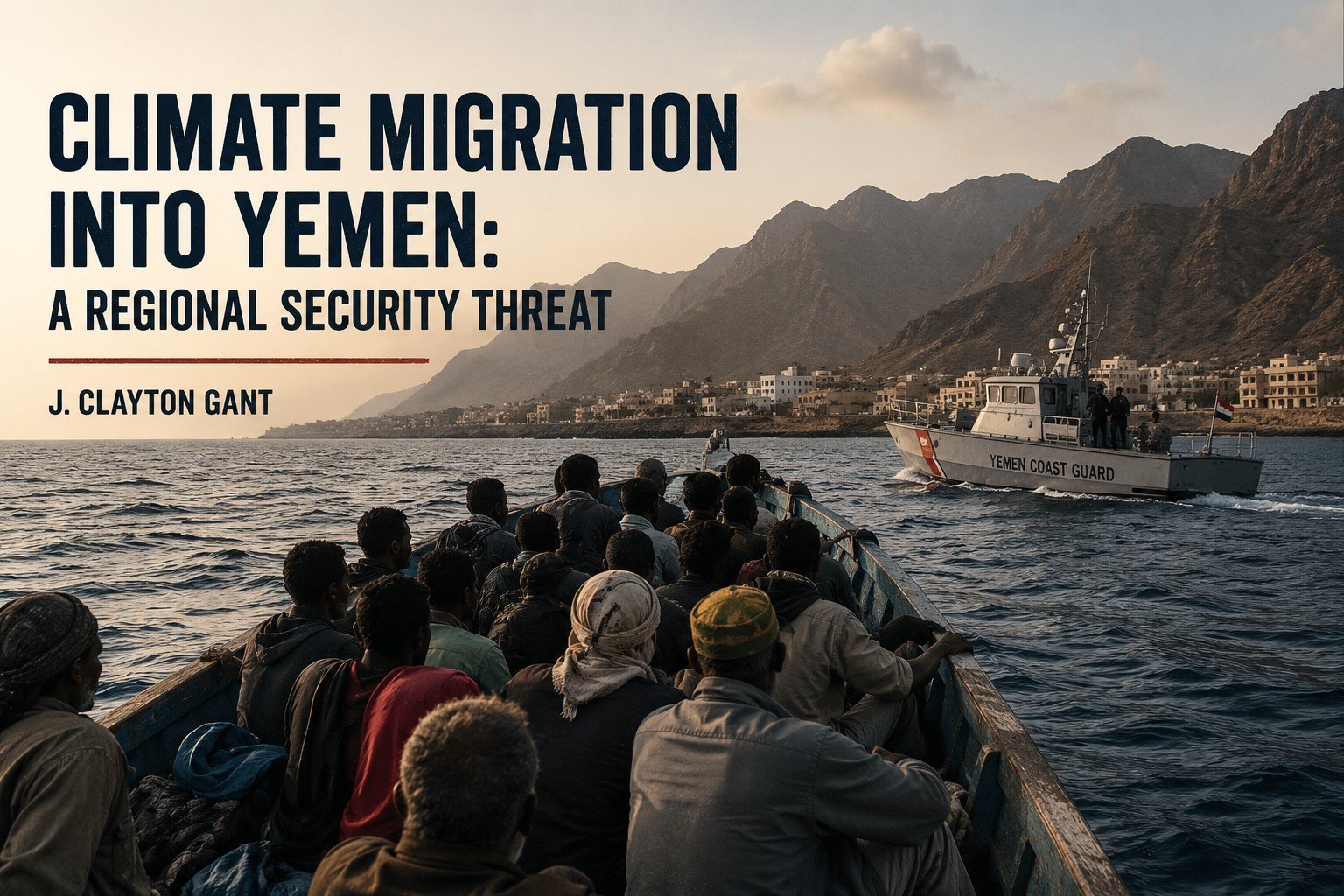
While often overshadowed by its civil war, Yemen faces another destabilizing threat from climate-induced migration from the Horn of Africa. Between one to two hundred thousand people enter Yemen each year. Climate migration creates a vicious climate-violence cycle, where climate migrants move to new locations that presumably offer better economic opportunities. Unfortunately for those who seek to enter Yemen on their way to Gulf States, they are entering a resource-constrained environment home to violent extremist groups and militias. While many migrants will continue onwards, some will be recruited into those organizations, further destabilizing Yemen, and potentially the greater Middle East. This paper finds that through increased maritime interdiction, infrastructure development, and improved HOA governance this risk can be mitigated.
Introduction
While generally unnoticed, migration into Yemen has reached unprecedented levels. This migrant wave represents a new destabilizing force that can cascade beyond Yemen and upheave the Middle East. These migrants are not an existential threat to Yemen, but they represent a challenge that it, home to one of the worst humanitarian crises, is not fit to handle. This crisis, induced by Yemen’s ongoing civil war, weak governance, and limited natural resources leave it structurally unable to ensure its citizens’ human security or absorb large-scale migration. Over half of its population requires humanitarian assistance, over 45% face food insecurity, and a third lack water security. Government services have been greatly reduced due to the war’s demands. Even worse, only 59.3% of its medical facilities are fully operational. This rendered Yemen a fractured landscape of marginalized people, which perpetuates the conditions for more conflict. Climate migrants represent another marginalized group that can be compelled to fight for the competing factions, radicalized by terrorists, or push Yemen’s infrastructure beyond its carrying capacity. This will further destabilize Yemen and bring more chaos to the region.
This paper uses Yemen as a case study to show how climate migration disrupts fragile states. It discusses the historical drivers of climate migration between the Horn of Africa (HOA) and Yemen, and how this relates to US national security. Afterwards, it outlines the vicious climate-violence cycle, which perpetuates the means, motivations, and opportunities for violence. Then, Yemen’s systemic hurdles highlight how it is ill-suited to protect climate migrants and its people. Finally, this paper concludes with recommendations for how the international community and Yemeni state can address these challenges, demonstrating that opportunities exist to stem this influx to ensure better regional security.
International Horn of Africa Migration
Climate migration is a climate change adaptation people undertake to improve their lives. While there is no internationally agreed-upon legal climate migrant definition, for the purposes of this paper, a climate migrant is someone forced to leave their home due to sudden or progressive environmental changes that adversely affect living conditions. Climate migrants relocate either permanently or temporarily, both of which increase resource demand. In resource constrained environments, like Yemen, this increased demand can create instability as more people compete for fewer resources. Additionally, migrants can relocate either internally, or abroad. The near-constant wars, resource shortages, and economic collapse following the Saudi-led, anti-Houthi blockade since 2015 have generated millions of internally displaced persons (IDP), creating the world’ fifth worst IDP crisis. This paper focuses on how international climate migrants entering Yemen exacerbate this crisis.
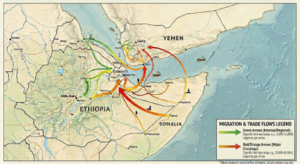
Yemen, an incredibly poor, arid, mountainous, and war-torn country, is not an appealing destination for climate migrants. Rather, it is an intermediary migrant destination into the Gulf Cooperation Council (GCC) states – Bahrain, Kuwait, Oman, Qatar, Saudi Arabia, and the United Arab Emirates. Yemen never experiences fewer than a thousand migrants each week, with recent trends closer to two thousand. Due to climate change-induced droughts and floods, large HOA savannah swaths have experienced desertification, forcing climate migration abroad. Furthermore, Ethiopia’s and Somalia’s recurrent conflicts compound this migration. Ethiopians account for 98 percent of those migrants, with Somalis making up the rest. Additionally, 73 percent of migrants are adult males, without families, who relocate for economic reasons.
Poor governance within the HOA and Yemen created the porous borders that allow such migrant flows. Migrants into Yemen flee approximately 300 kilometers across the Gulf of Aden (GOA) and the southern Red Sea. The only Republic of Yemen Government (ROYG) force capable of intercepting migrants at sea is the Yemeni Coast Guard (YCG). The Houthi coup and governmental split severely degraded the YCG’s interdiction capabilities, yet it continues daily maritime patrols. However, the YCG’s fleet composition is fewer than fifty vessels, often augmented by fishing boats. This does not provide sufficient coverage for Yemen’s 2500-kilometer coastline. Compounding this, it lacks a Maritime Operations Center (MOC), which limits its ability to monitor migrant patterns. These factors create a highly porous border that requires external assistance to fix.
American Interests
The United States government has several security interests at stake related to migration into Yemen. According to the National Security Strategy (NSS), America’s core national interests include preventing adversaries from contesting freedom of navigation through crucial chokepoints and sea lanes, like the Red Sea. The Houthis challenge this freedom because migrants contributed to Yemen’s instability, providing them with a recruitment pool to continue their access denial operations. Additionally, the NSS identifies burden shifting as the primary U.S. goal in the Middle East. For the Red Sea crisis, burden shifting can only be accomplished through a robust YCG capable of countering the Houthis. The State Department’s Integrated Country Strategy for Yemen (ICS-Y) reiterates this and identifies Yemen’s stability as a key U.S. national security interest. Additionally, the ICS-Y’s 4th Mission Goal is to enable Yemen to secure its borders so that it can contribute to regional security and prevent ungoverned space exploitation. These interests cannot be achieved with a porous Yemeni border that allows the Houthis to be resupplied, and migrant exposure to terrorist network recruitment.
The Vicious Climate-Violence Cycle
In 2007, Sherri Goodman conceptualized climate change as a “threat multiplier” that underlies, connects, and exacerbates all other threats. Migration is the most visceral example of this climate change function. This function creates a feedback loop between violence and migration. Any conflict, whether interpersonal, intrastate, or interstate, requires three variables: motivation, opportunity, and means. Climate change directly influences motivation and opportunity.
Conflict motivation revolves around identity. These identities can be racial, ethnic, tribal, ideological, religious, or economic class based. Ambitious actors use threatened collective identities to mobilize people towards violence. Climate change, particularly in fragile ecosystems like Yemen and the HOA, sharpens identity divisions as resources become more constrained and collective action becomes increasingly important to ensure individual survival.

Climate change creates a vicious cycle between migration and violence because it creates the opportunity for both. First, it disproportionately impacts societies’ marginalized groups, which exacerbates pre-existing resource, economic, and sociopolitical inequality; increasing alternative social network recruitment and violence. Within Yemen, these alternative social networks are primarily terrorist groups, or militias. As these groups grow, people, particularly families, are forced to migrate to safer locations or areas with better economic prospects, typically cities. There, climate migrants often reside in urban slums or tent cities, isolated from traditional support networks and economic prospects. This increases the gap between resource supply and demand. Migrants and native inhabitants face increased food, water, housing and job scarcity which foments desperation, and incentivizes violence when governance is weak and people have general anonymity. This violence creates a new cycle of security and scarcity-induced migration further abroad. While family responsibilities often make older migrants less susceptible to alternative social network recruitment, their male offspring, due to constant ostracism and limited job opportunities, are the most vulnerable. These young adult males have few opportunities outside Yemen’s terrorist groups or armed militias; therefore, their only way to ensure survival is to join these groups.
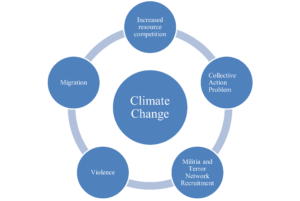
This situation has played out repeatedly within Yemen and will only worsen as climate change progresses. That is because Yemen provides the means for continued conflict: weapons. Yemen’s pre-unification and internecine conflict history supply non-state actors access to vast caches of light and heavy weapons. Since 2015, the internationalized civil war aggravated the situation through the proliferation of advanced conventional weapons like anti-ship missiles and drones. These platforms enabled the Houthis to effectively stop Red Sea shipping since 2023. Therefore, climate migrants into Yemen enter a situation that meets every conflict variable.
Climate change-induced conflict is not limited to Yemen; the HOA is also impacted by migrant departure’s ripple effects. It creates a brain drain, as skilled labor leaves. This decreases origin countries’ tax revenues, resulting in increased tax rates on remaining labor, while skilled labor accumulates more wealth. This generates increased income inequality in the origin country, which fosters conflict there as economic identities become entrenched. Furthermore, the HOA is experiencing some of the highest urbanization rates in the world. This fuels the vicious climate-violence cycle since conflict’s prerequisites also exist there.
Systemic Hurdles
The first systemic challenge Yemen faces dealing with migrants is its lack of effective governance. The Houthi Movement has consolidated control over the north. The internationally recognized government, the Presidential Leadership Council (PLC), often faces infighting from the Southern Transitional Council (STC), which controls crucial southern provinces. This creates a politically tumultuous environment for migrants to enter. Poor governance allows opportunistic actors to exploit the system and consolidate power for themselves. Al Qaeda in the Arabian Peninsula (AQAP) and the Houthis have already done this.
Ineffective governance is not Yemen’s only major systemic challenge; non-existent infrastructure is an even more pressing concern. Yemen’s energy grid is in tatters. Electricity often functions for two to three hours a day, reducing economic productivity and everyday livelihoods. The ROYG cannot address current energy demands without further revenue and infrastructure development. As climate migrants enter the country unimpeded, energy demand rises to meet their additional needs. This will further fuel the climate-violence cycle.
In addition to energy grid issues, Yemen faces another energy-related challenge: oil production plummeted after the civil war began. Prior to this war, oil exports accounted for approximately 75% of ROYG revenue. After 2015, oil production decreased to the point that Yemen now imports oil, due to competing factions targeting downstream oil-related infrastructure. This destroyed Yemen’s economy and fractured its political system as factions vie to control oil fields. Without this revenue, the ROYG could not sustain its pre-war patronage system, shattering Yemen’s governance model.
Beyond energy concerns, Yemen faces one of the world’s worst water security crises. It holds less than 100 m^3 of available water per person; 95% of which goes to agriculture. Increased desertification resulted in further groundwater depletion as aquifers are drawn from faster than they are replenished. Potential solutions like water imports and desalination plants are nonviable options. The civil war’s extensive port damage has eliminated water imports. Furthermore, desalination plants are unrealistic investments since recent events show they make attractive targets in modern Middle Eastern warfare. This makes Yemen’s water security a constant issue with pessimistic prospects.
Recommendations
Interdiction – The Combined Maritime Forces’ (CMF) CTF-153 can incorporate migrant interdiction into its operational portfolio. This standing task force would then be able to prevent migrants from entering Yemen. Additionally, US CENTCOM can implement a Title 10 Section 333, Building Partner Capacity (BPC), program with the YCG to improve its Visitation, Boarding, Search and Seizure (VBSS) training. This training would be provided by US Coast Guard and Marine Corps personnel outside Yemen while the Houthis are still active. This will deepen America’s ties with regional partners and ensure they are trained to interdict migrants without direct American participation. This will increase the number of forces available to CTF-153, who would then coordinate interdiction with the YCG. To better facilitate this, a MOC should be constructed for YCG. This will enable the YCG to lead this force and better monitor migrant vessels. With these recommendations implemented, it is possible to quell migrant flows into Yemen, allowing further ROYG political consolidation.
Infrastructure Development – The Yemeni government and international donors should invest in large-scale port infrastructure development projects within ROYG-controlled areas. This will provide jobs that reduce people’s opportunities to choose violence. To incentivize this, Yemen should be integrated into the India-Middle East-Europe Economic Corridor (IMEC). Yemen lies along the traditional maritime route between these regions. While such investments are currently risky, it is likely that those risks will decrease as Operation Epic Fury dismantles the Houthis’ primary external supporter, the Iranian regime. Once Iran no longer threatens the region, the United States should aggressively seek to actualize IMEC. Such a public works program will directly benefit migrants through employment and local integration. This will reduce their radicalization vulnerability and better incorporate them into Yemeni society. Furthermore, this reincorporates Yemen into the global economy, providing the ROYG with much needed revenue streams, and external oversight that will improve institutional capacities.
Root Cause Mitigation – Beyond Yemen, climate migration’s root causes must be addressed. Ethiopian and Somali governance must be improved to rectify the conditions that generate migration. This is the only way to viably address long-term HOA climate migration and foster greater regional stability. Given these countries’ extensive international involvement, the approach must drastically change. The United States should follow Israel’s lead and recognize Somaliland as an independent government. Somaliland contains the exit ports that most climate migrants use to enter Yemen. This would allow the US to work with a better functioning regime than the central Somali government and bolster its institutions. Somaliland’s Coast Guard receives training from Taiwan; additional US training through a BPC program would enable more robust operational capacity to reduce migrant outflows. This BPC would also have American military trainers work with Somaliland’s land border guards to limit Ethiopian migrant inflows. Recognition also allows American aid to go directly to Somaliland, instead of being siphoned off by Mogadishu. This will allow better institutional development within Somaliland and stem the flow of Yemen-bound migrants.
Conclusion
Climate migration into Yemen represents a long-term vulnerability for the entire Middle East. Yemen is experiencing a humanitarian disaster that will only worsen as time progresses and climate change ravages the region. As the conflict in Yemen enters a new phase, it will only exacerbate this situation and drive more people through Yemen. Its resources are already strained to the breaking point. Additional inflows exceeding 100,000 persons each year will only fuel the resource competition there and send incoming climate migrants and disgruntled Yemenis further abroad. The Ethiopians and Somalis, leaving their war and climate-ravaged homes for Yemen, are some of the most desperate people on earth. Their home countries must be improved to reduce the risk of violence.
The vicious climate-violence cycle will only get worse as climate change continues. It is the embodiment of climate change’s threat multiplier function. As migrants move into Yemen, and they and the Yemeni people increasingly move into urban areas, they are more likely to be recruited by the faction that controls whichever city they move into. This will perpetuate the cycle. Given the weapons available in Yemen, and this migration pattern’s transitory nature, this cycle will spread beyond Yemen’s borders to encompass the entire region and threaten America’s core national interests. That is, unless the above recommendations are taken.
Yemen is not the first country to fall victim to this cycle, and it certainly will not be the last. Yemen is simply one of the most vulnerable countries to this cycle. The NSS makes clear that the US seeks to establish an international effort to stem migration. Yemen is the best place to test such an effort at, since it only requires minimal investments into a BPC effort and using already established organizations. This will provide a template for future actions that will improve international climate change resilience.
