

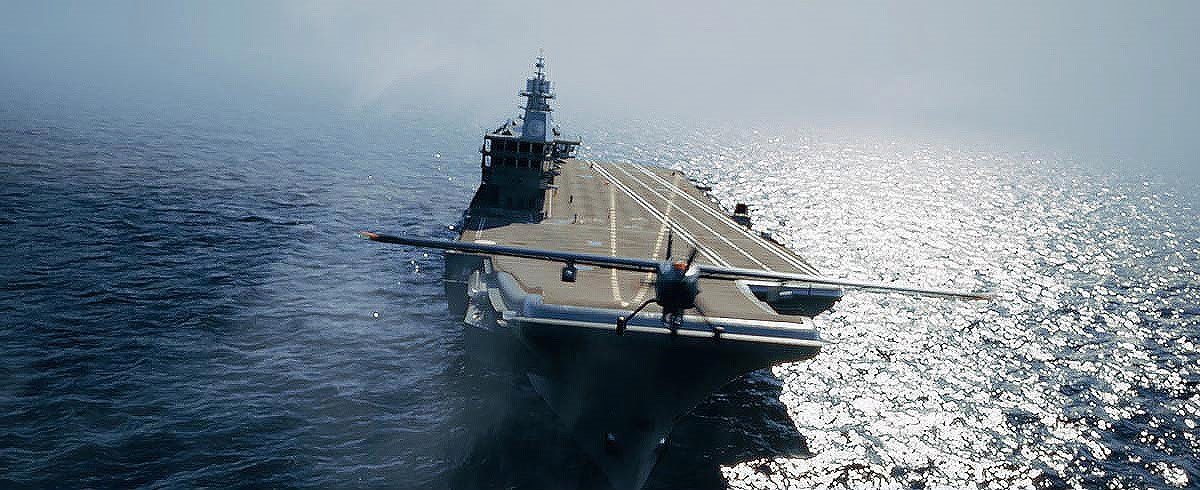
Unmanned aerial vehicles (UAV) of all sorts are playing a greater role in combat. This has been driven by the ongoing war in Ukraine and the recent war with Iran. Looking to expand the UAV envelope, Israeli company Elbit Systems unveiled a maritime concept that converts civilian/commercial cargo ships into dedicated UAV-launching platforms, centred on the Hermes 650 Spark fixed-wing UAV systems. According to company sources, each converted vessel would carry 9–12 Hermes 650 Spark UAVs, plus deck infrastructure, control systems, and mission support.
The ship acts as a remote launch/recovery site, managed from the same land-based ground control station used for the larger Hermes 900, therefore reducing manpower and control station requirements. Designed for ISTAR (Intelligence, Surveillance, Target Acquisition, Reconnaissance) beyond the radar horizon — with greater endurance and payload than VTOL UAVs, plus strike support.
Deck motion, turbulence, and deck obstacles make fixed-wing landings on merchant ships hazardous. Elbit’s solution integrates AI and laser-detection systems that predict deck movement during landings, with drones stored in climate-controlled, salt-resistant containers. The Hermes 650 supports autonomous take-off/landing, autonomous taxiing, short-runway operation, and is STANAG 4671 (NATO) compliant; on land it needs less than 200 metres to take off, though ship-based launch/recovery distances and sea-state limits haven’t been published.
The concept has a notable precedent: Iran’s Shahid Mahdavi proved that a civilian cargo ship can be converted into a forward-operating drone base. Elbit is taking that idea significantly further. This is still a concept, not a programme. Elbit has not named a customer, conversion partner, flight-test schedule, or service-entry timeline.
Arie Egozi
