

Key Points
- Rafael Advanced Defense Systems delivered its 1,000th TYPHOON naval weapon station, now in service with 25 navies including the United States, Canada, and Australia.
- Rafael recently delivered additional TYPHOON Mk-30c systems to the Israeli Navy’s Sa’ar 6 corvette fleet, with more systems planned in coming years.
An Israeli defense company just shipped its 1,000th version of a gun system that has become one of the most common ways navies around the world shoot down small boats and drones without putting a sailor’s life on the line to do it.
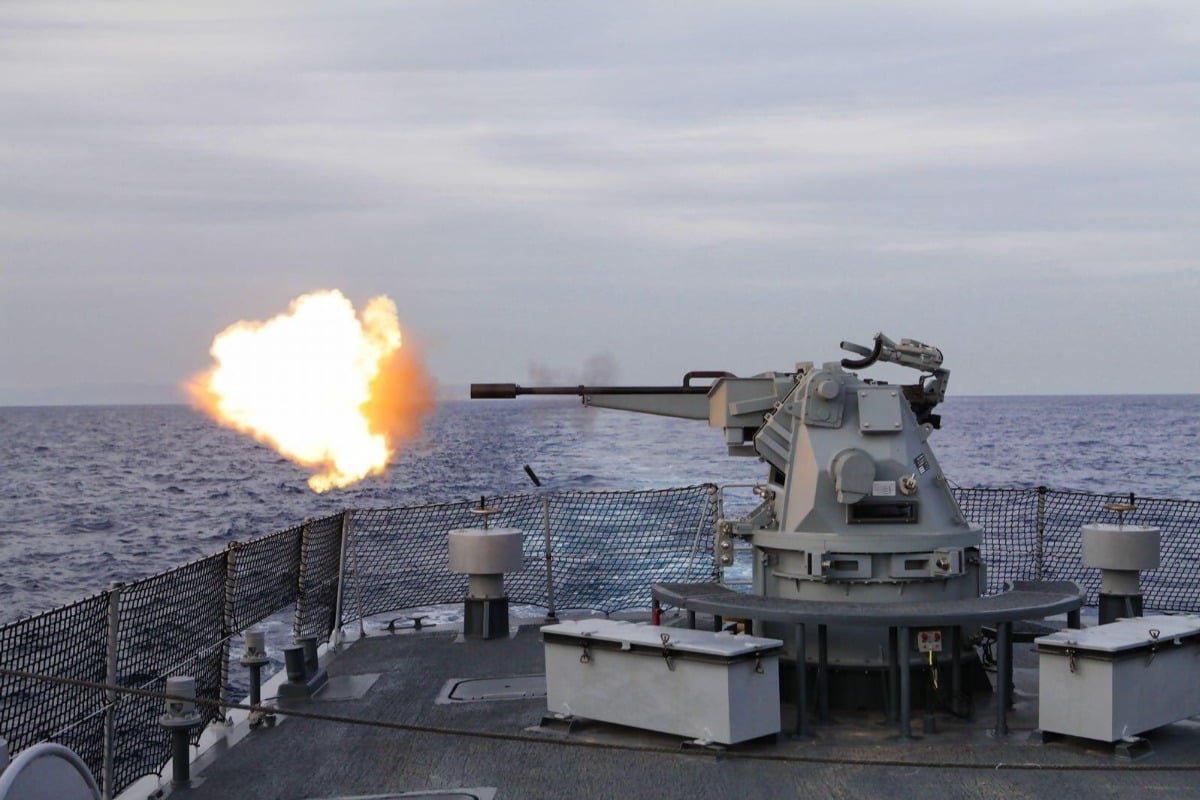
Rafael Advanced Defense Systems, an Israeli state-owned defense contractor, announced the delivery of the 1,000th TYPHOON naval weapon station, a stabilized, remotely operated gun mount the company describes as the most widely deployed system of its kind anywhere in the world. TYPHOON systems are currently integrated on naval platforms across 25 navies and maritime forces, including the United States, Canada, and Australia, giving crews a way to engage threats ranging from small attack boats to incoming drones without a gunner having to stand exposed on deck.
Instead of a sailor manually aiming and firing a deck gun in the open, exposed to enemy fire and weather alike, an operator sits inside the ship at a console and controls the weapon remotely, using electro-optical cameras, radar inputs, and a stabilized gimbal mount that keeps the gun steady on target even as the vessel pitches and rolls in rough seas. The system typically carries a medium-caliber automatic cannon in the 20 to 30 millimeter range, with some configurations built around the ATK Mk44 Bushmaster II cannon firing standard 30mm by 173mm NATO ammunition, while a lighter variant called Mini-TYPHOON uses a .50 caliber (12.7mm) heavy machine gun for smaller patrol boats and coast guard vessels that don’t need or can’t carry the weight of a full medium-caliber mount.
– ADVERTISEMENT – CONTINUE READING BELOW –
The United States Navy adopted the system years ago through a partnership between Rafael and British defense giant BAE Systems, fielding it under the American designation Mk 38 Mod 2, a weapon station now mounted on a range of surface combatants and amphibious ships for close-in defense against fast boats and low-flying threats. That American adoption alone speaks to how thoroughly the underlying TYPHOON design has proven itself across different navies, different ship classes, and different threat environments over more than two decades of operational use.
In Israel, TYPHOON and Mini-TYPHOON systems have served with the Israeli Navy since 2000, and Rafael recently delivered additional TYPHOON Mk-30c naval weapon stations to strengthen the Sa’ar 6 corvette fleet, a class of German-built missile corvettes that entered Israeli Navy service starting in 2020 and now serves as one of the country’s primary tools for protecting offshore natural gas platforms and critical maritime infrastructure in the Eastern Mediterranean. Rafael said additional TYPHOON systems are expected to enter Israeli Navy service in the coming years, replacing older, legacy weapon systems currently installed on the fleet’s vessels, alongside a parallel push to integrate newer Mini-TYPHOON units across the operational array.
What has kept TYPHOON relevant for more than two decades, rather than fading as older naval gun technology eventually does, is the system’s demonstrated ability to adapt to threats that barely existed when it was first fielded. Rafael says the system has proven capable of defeating small, fast, low-signature threats, including drones and unmanned aerial vehicles, a capability that has become increasingly critical as militaries worldwide confront the reality that a cheap, hard-to-detect drone can pose as serious a threat to a warship as a much more expensive missile or attack boat. That shift matters enormously in waters like the Red Sea and Gulf of Aden, where Houthi forces in Yemen have repeatedly targeted commercial and military vessels with drones and missiles since late 2023, forcing navies worldwide to reckon with exactly the kind of fast, low-signature threat TYPHOON is designed to counter.
TYPHOON’s technical answer to that evolving threat picture includes high-capacity ammunition magazines that allow sustained engagement without frequent reloading, the ability to switch quickly between different ammunition types depending on what kind of target the crew is facing, and automated targeting features designed to shorten response times and reduce the cognitive burden on a human operator during a fast-moving engagement. The system also supports advanced munitions including Air Burst Munition rounds, which are programmed to detonate at a specific point in flight near a target rather than requiring a direct hit, a capability particularly useful against small, agile drones that are difficult to strike with conventional ammunition, along with High-Explosive Proximity rounds effective against both aerial and surface threats.
Yoav Tourgeman, CEO and President of Rafael, framed the 1,000th delivery as a reflection of the trust the system has earned across a naval security environment he described as increasingly crowded and dangerous.
“The delivery of the 1,000th TYPHOON system reflects the continued trust of navies and maritime forces worldwide in Rafael’s operational capabilities,” Tourgeman said. “At a time when the naval arena is becoming more congested, contested, and relevant than ever, from the protection of vital shipping lanes to countering advanced aerial and naval threats, the ability to provide operational vessels with a precise, rapid, and multi-layered response is a strategic necessity. The TYPHOON system, which has been operating for years in multiple operational arenas, demonstrates Rafael’s commitment to continue developing solutions that strengthen the freedom of action, protection, and superiority of naval forces in Israel and around the world.”
Like most Rafael naval systems, TYPHOON is built on a modular, mission-oriented design that lets the same underlying platform adapt to wildly different vessels and customer requirements, from a small coast guard patrol boat needing only a lightweight machine gun to a corvette requiring a full 30mm cannon integrated with a ship’s broader combat management system. That flexibility, more than any single technical feature, may be the real reason a weapon system first fielded a quarter century ago is still being delivered by the hundreds today. Navies rarely commit to a single piece of hardware for that long unless it keeps finding new ways to stay useful, and Rafael’s four-digit delivery count suggests TYPHOON has done exactly that.
