

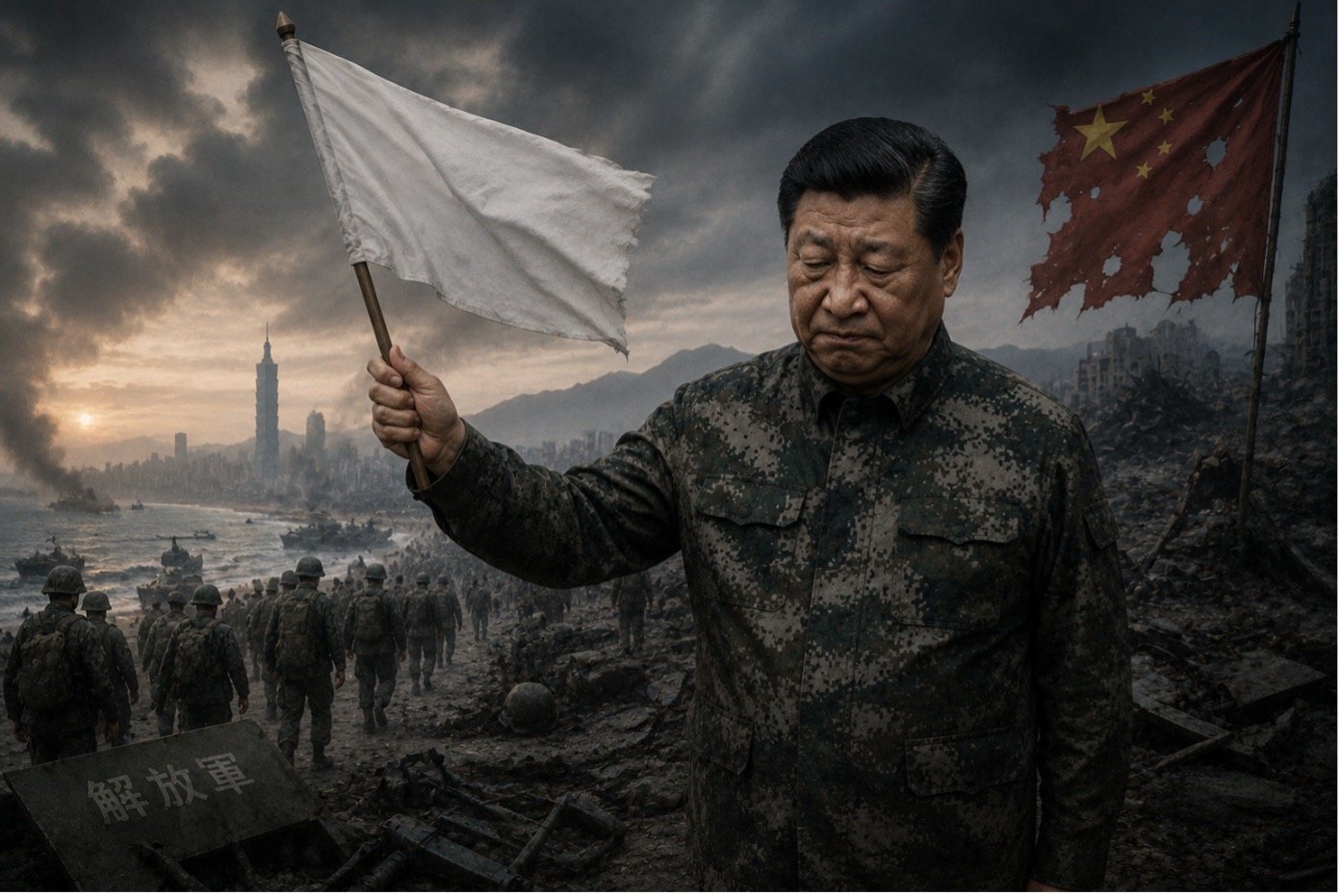
Xi Jinping has always told the world he wanted to annex Taiwan peacefully. He lied. Now, in late 2027, after a failed invasion, he stands before the Politburo Standing Committee and says words no Chinese Communist Party general secretary has ever uttered about a war he launched: unification will not come by force this year. He calls it a pause. His generals call it something else, quietly, of course. For now.
The scenario follows a pattern old enough to have broken Napoleon in Spain and the Soviets in Afghanistan, and, as of this writing, continues to grind down Vladimir Putin in Ukraine year after year. A plan built for rapid conquest meets a society that refuses to be conquered.
Xi has three weeks to take Taiwan. Week one is decapitation and lodgment: kill or capture government leaders, land enough force to hold a perimeter, and make the world believe the outcome is already decided. Week two is consolidation, the difficult work of rolling up the military units and resistance members still fighting, securing ports, airports, and power grids, and installing administrators who can start issuing orders that people actually follow. By the end of week three, the occupation has to look like governance. Courts open. Trains run. Local officials, whether coerced or willing, are back behind desks, answering to Beijing rather than Taipei. The occupied get a vote on when this fight is over. If things are not going to plan by day 21, there is no good-news ending for the Chinese communists. In this scenario, Taiwan has not fallen.
The invasion begins the way most planners expected. Missile and cyber strikes hit Taiwanese command nodes, air defenses, and ports in the opening hours. Subsea cables are cut. Beijing imposes a blockade. People’s Liberation Army (PLA) amphibious and airborne forces attempt landings on the western beaches near Taichung and around the Tamsui approaches to Taipei. Beijing’s suppression model, built on studying its own occupations in Xinjiang, Tibet, and Hong Kong, assumes that decapitating the government and seizing key cities will produce compliance in whatever population remains.
The people of Taiwan do not comply.
Years of quiet preparation change what the first PLA units find ashore. It’s not just a conventional battle. Civil defense training is real. There is dispersed command authority. Hardened communications. Anti-armor weapons are in the hands of reservists trained by American special operators. Human sensors are reporting every movement to both the Taiwan military and self-activated resistance cells. The invaders find a population organized for this contingency. Everything is contested, from beachheads to 7-11s. PLA logistics, strained by an assault with no modern historical precedent comparable to that of the Taiwan scenario, begin to break down within the first week. By the third week, fuel and ammunition meant for a short campaign are either running thin or being interdicted or slowed at every turn by a creative, insurgent population.
Outside the island, the response is faster than Beijing’s planners forecast. The “Squad” – the United States, Japan, Australia, and the Philippines – moves from the ambiguous posture of the pre-war years to direct material support, and in certain areas, surgical kinetic support. Submarines and long-range fires complicate PLA Navy resupply across the strait. Australian and American intelligence sharing gives Taiwanese commanders and resistance groups armed with clandestine communications equipment a clearer picture of PLA troop concentrations than Beijing expected the defenders to have.
Japan’s decision to open its ports and airfields to allied logistics, a question left deliberately ambiguous for years, resolves itself within the first seventy-two hours. Japanese planners conclude that a Chinese victory in the strait threatens their own security more than the political cost of involvement. The Philippines, whose northernmost island, Itbayat, sits closer to Taiwan than to Manila, opens Batanes and its northern Luzon bases to allied aircraft and surveillance flights within days, a decision that Chinese coast guard harassment in the South China Sea has been quietly building toward for years. Friendly governments made diplomatic, informational, military, and economic investments in Taiwan to varying degrees long before the war. Just as Taiwan’s own resistance was the product of choices its government and society made long before the first PLA soldier came ashore.
The foreign invaders do hold some ground at the end of the third week, but they have lost the one thing Xi’s war plan desperately depended on. Speed. Every day that passes without stability on the streets and the mountains is a day that prevents the Chinese Communist Party (CCP) governance.
This is the most important requirement for any invading force: the ability to govern effectively and legitimately in the eyes of the people. It is not happening.
All of those polls indicating that the people of this island identify more as Taiwanese than Chinese are proving true in real time, with and without violence, overtly and covertly, from the beaches to the hills.
Nobody wants to bet on a loser. Everyone thought Russia would take Ukraine in a few days or weeks. But when the global audience sees what’s happening in Taiwan after week two, and realizes that the islanders might just have a chance, support rapidly accelerates. Xi’s position starts to erode. Global sanctions are coordinated faster than the sanctions regime built against Russia in 2022 because governments had years to learn the mechanisms. The effects immediately cut into China’s financial system, worsening a domestic economic picture already strained by years of property-sector stress and slowing growth. Shipping insurers quickly pull coverage from vessels transiting near the strait. Foreign firms that spent years reducing their exposure to China are accelerating their exit or just abandoning assets. Factory workers in Guangdong province feel it. So do the families of the conscripts dying on Taiwanese beaches. The mainland middle class that watched its property wealth evaporate once already this decade now watches its portfolio and its currency absorb a second shock.
This is where the Ukraine model is most telling.
Putin launched his war believing it would be short. When it wasn’t, he refused to cut losses. He gambled that Western resolve would fracture before Russian society did. That gamble has failed, the war grinds on, and Ukraine remains armed and resupplied by partners whose support has proven more durable than Moscow’s planners expected. Putin’s calculus, reinforced by “yes-men” who feared being disappeared, kept producing the same answer: continue. That answer has cost Russia a generation of young men and a decade of economic isolation, for territory that does not equal what was lost. There are countless other examples where leaders should have cut their losses early.
Xi reluctantly but smartly avoids that mistake.
He knows the potential cost of his folly, but he’s also acutely aware that his legitimacy rests on a different bargain than Putin’s: relative prosperity and stability delivered to the Chinese population in exchange for the absence of political voice. That bargain is more fragile than the nationalist mythology Putin has spent years building around his war. When the PLA invasion fails to deliver a fast, low-cost victory, and the economic and diplomatic costs begin to threaten the prosperity half of the CCP’s bargain, the Politburo’s calculus shifts. Xi has spent his career consolidating power so that no one below him can force a course correction. Here, it is Xi himself who makes it, because an open-ended war that a resistant Taiwanese society and an assembling coalition make impossible to finish threatens the Party’s hold on power more than admitting failure does.
He does not call it defeat. He couldn’t survive calling it that. He calls it a strategic pause, a recalibration made necessary by foreign interference, and state media folds the war into the ongoing narrative of national rejuvenation: paused rather than lost, with the blame assigned to Washington, Tokyo, and Manila rather than to the CCP’s own miscalculation.
The domestic reckoning of this scenario inside China is the part Beijing fears most, and the part outsiders are least able to see. An authoritarian regime that has spent three decades delivering growth in exchange for silence has no ready explanation for a war that produced neither. Censors work overtime scrubbing global footage of returning coffins and burned armor from Chinese social media. The scale of the mobilization makes total control impossible anyway. Local party cadres, the officials who answer to angry families, report friction upward that a system built on managed information was never designed to deal with. Admittedly, this failure may not guarantee instability at the top in Beijing, but it changes what Xi’s inner circle will tolerate.
Transport ships that carried troops across the strait now carry them back. Ten days after Xi’s speech, the amphibious force meant to take Taipei is sitting in Fujian. No announcement is made inside the Great Firewall.
Resistance planning, organizing, resourcing, and rehearsing are what make a fictional scenario like this one possible. Whether this is how the real war unfolds depends on choices made today.
(The views expressed here are the author’s alone and do not reflect the official policy or position of the US Government or the Department of War)
