

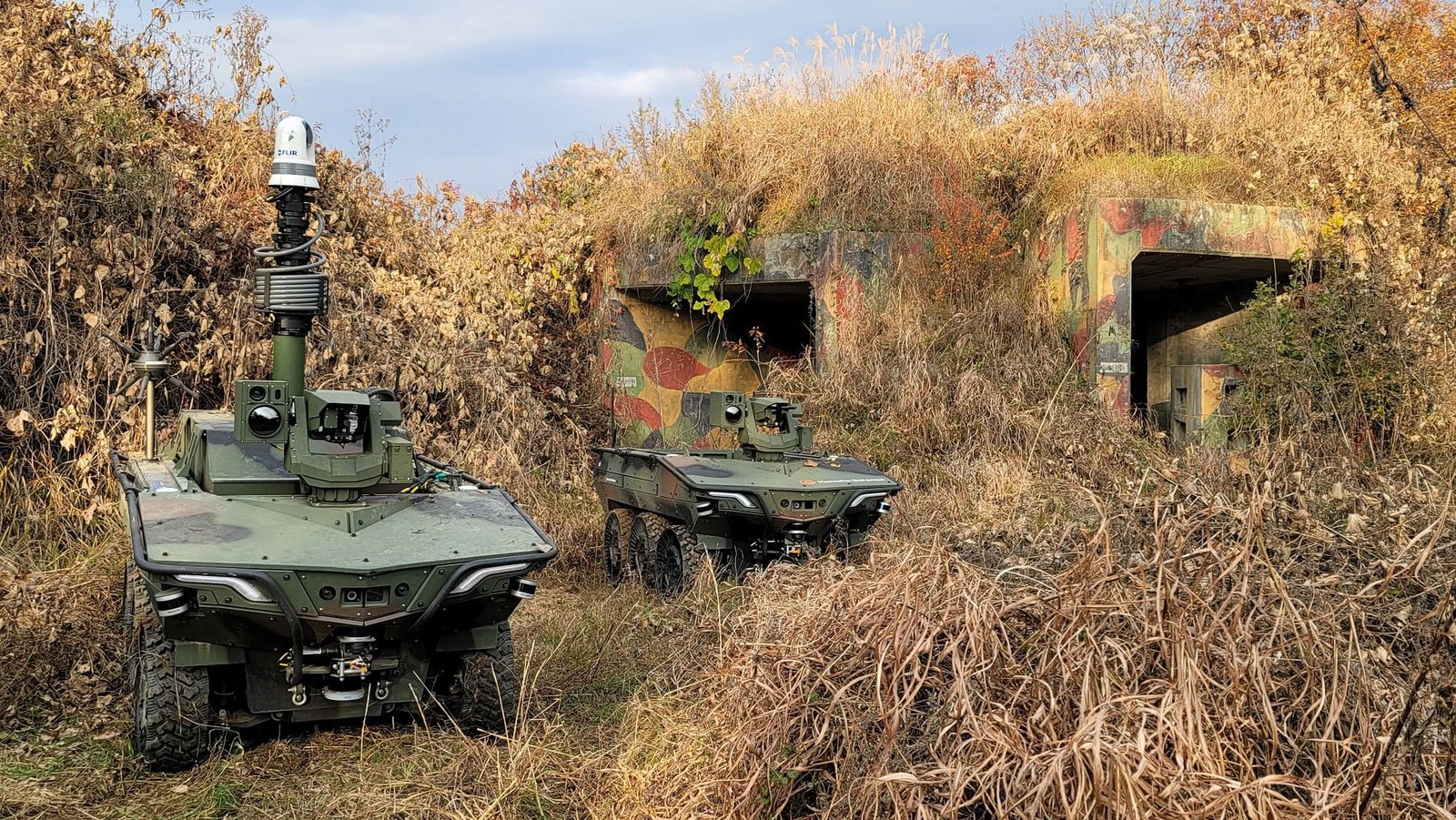
According to an announcement by the South Korean government on 16 July 2026, a future contract for new unmanned ground vehicles (UGV) is to be awarded to Hanwha Aerospace. The unmanned platform selected as preferred bidder is the ARION-SMET.
This name is an acronym for Autonomous and Robotic Systems for Intelligence Off-road Navigation – Small Multipurpose Equipment Transport. It is a 6×6 UGV weighing 1.8 tonnes and its batteries permit a road range of 100km.
This news relating to the Republic of Korea Army (ROKA) was revealed after a meeting of the 142nd Defense Acquisition Planning and Management Subcommittee.
This Multipurpose Unmanned Vehicle Domestic Purchase Project will deliver UGVs for “surveillance, reconnaissance, combat support, materiel transport and casualty evacuation,” according to the Ministry of National Defense (MND).
The MND added that these unmanned platforms, core assets of the ROKA’s Tiger 4.0 modernisation effort, are “expected to resolve the issue of shrinking troop resources and strengthen the combat efficiency of the military”.

The tender had been issued on 4 April 2024 with a budget of KRW49.63 billion (US$36.6 million).
Despite being designated a rapid acquisition back in 2024, this programme was mired in controversy and delayed for more than a year. Indeed, the chosen UGVs were all supposed to be in service by December 2026.
This was due to allegations over fairness in the selection process. Government officials had said in April 2025 that they would prioritise document-based evaluations instead of field trials. This triggered the dispute, with Hyundai Rotem initially refusing to participate.
Hyundai Rotem’s HR-Sherpa was competing against Hanwha Aerospace for the privilege of supplying these UGVs to the army. A spokesperson had told Asian Military Review, “Hyundai Rotem’s UGV is the only vehicle that has been in actual operation for more than two years in various terrains in Korea.”
The representative added that, based on Korean army requirements, its 1.5-tonne design has been repeatedly improved to achieve “the most optimised unmanned vehicle technology”.

The MND said the selection “was deliberated and resolved by comprehensively reviewing proposal contents, test evaluations, negotiations and performance verification results”. It added that “all bidding procedures were conducted fairly and lawfully”.
The MND stated a contract should be signed in the third quarter of 2026, with vehicles fielded in 2027-28. It is unknown how many UGVs will be manufactured, but the order is significant because it is the ROKA’s first series-produced induction of such platforms.
The winner will certainly gain advantages in follow-on awards, and gain valuable experience that will assist in exports as well.
A follow-on contract for the ROKA, perhaps worth KRW500 billion, could be pursued as early as 2029. This depends on a requirement to be issued by the ROKA, and the conduct of a feasibility study.
by Gordon Arthur
