

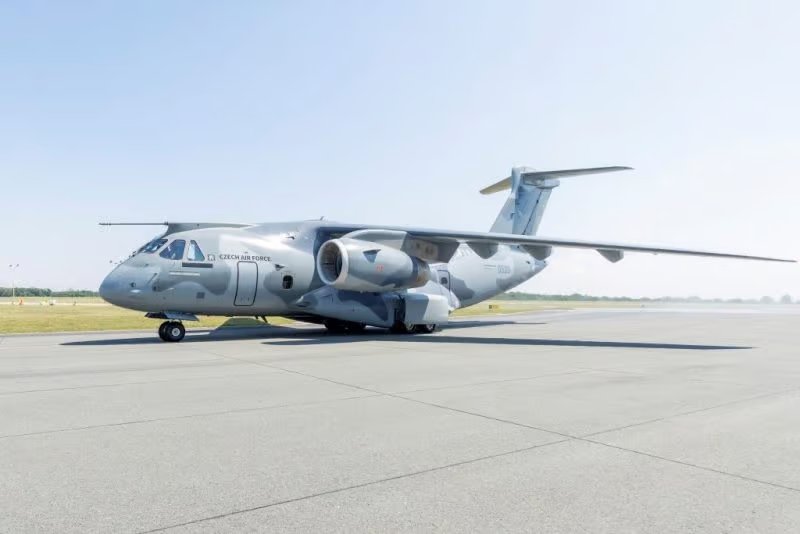

The Brazilian aircraft manufacturer Embraer delivered the first of two C390 Millennium multi-mission transport aircraft ordered by the Czech Air Force at Prague Kbely Air Base on 16 June. At the Farnborough Airshow, the aircraft was officially named “Karel Toman-Mareš” on 20 July, paying tribute to one of the nation’s most distinguished wartime leaders.
Embraer also announced an agreement at Farnborough to supply C-390 Millennium training devices to the air forces of Sweden and Austria. The Swedish Air Force will receive a comprehensive training package, including a Full Flight Simulator (FFS), a Cargo Handling Station Trainer (CHST) developed in partnership with Rheinmetall, and a Computer-Based Training (CBT) solution developed with ETI. The Austrian Air Force will receive a Computer-Based Training (CBT) solution to support theoretical instruction and crew qualification. The training packages will provide pilots, loadmasters, crew members, and maintenance personnel with modern, high-fidelity training environments designed to maximise operational readiness and mission effectiveness across their C-390 Millennium fleets.
To enhance the operational capabilities of the C-390 Millennium, Embraer, and the US-based technology company Anduril announced at the Farnborough Airshow the signing of a Memorandum of Understanding (MoU) to jointly explore the integration of Anduril’s pallet-launched Barracuda-500M (B-500M) stand-off cruise missile into the C-390 Millennium.

The Barracuda-500M is an affordable, mass-producible lightweight cruise missile designed to rapidly rebuild and improve U.S. and allied munitions inventories. The company further underscores that the palletised variant would allow the C-390 Millennium aircraft to launch dozens of munitions simultaneously, unlocking new operational concepts based around cost-effective, large-scale employment.
According to Embraer, the collaboration with Anduril marks a significant step in the C-390’s development as a multi-mission platform and force multiplier, supporting agile combat employment and meeting the operational needs of US and allied forces through improved interoperability and mission effectiveness.
by David Oliver
