

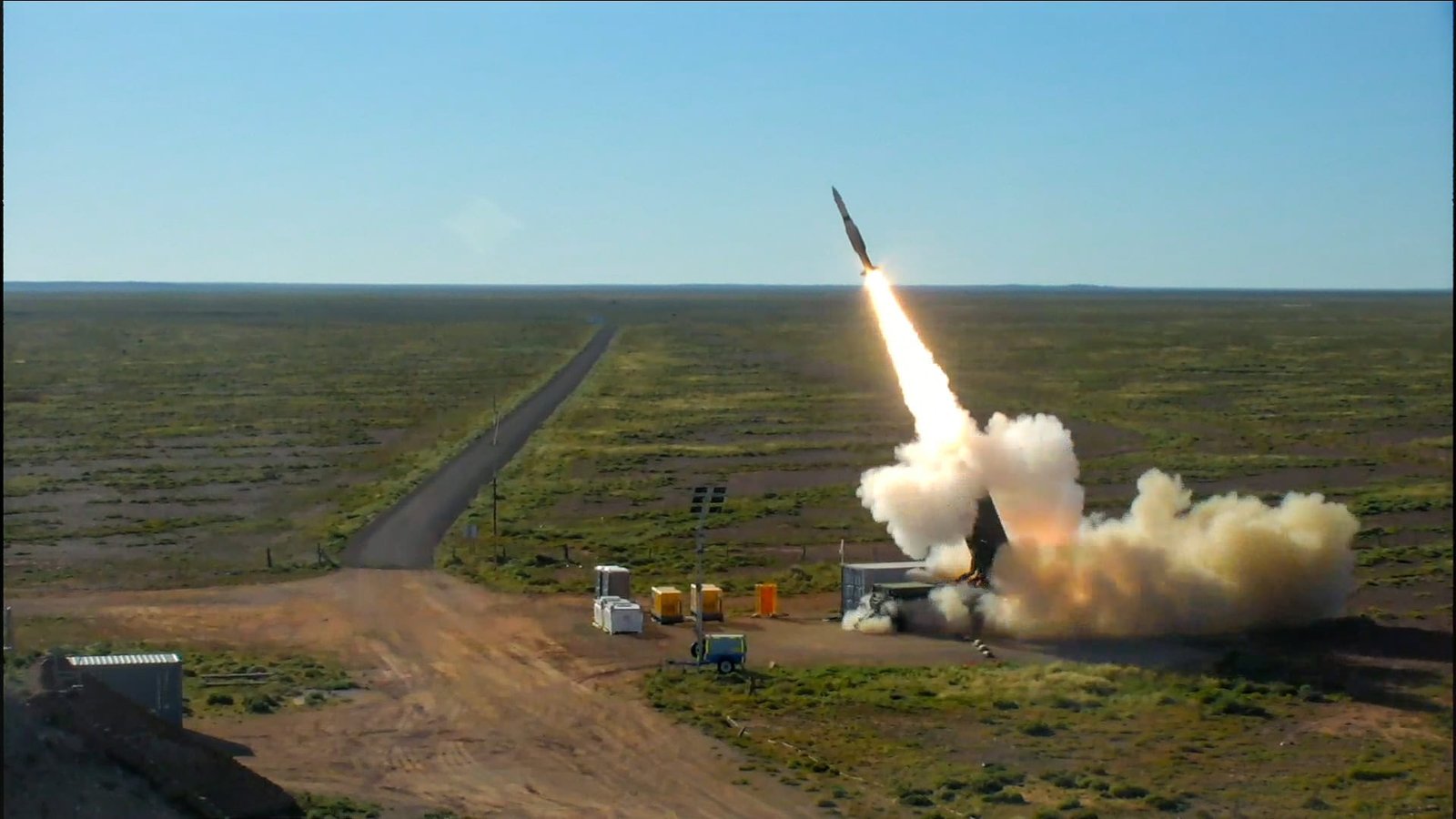
Australia’s successful engagement of an airborne target using a prototype ground-based air defence (GBAD) system, armed with Raytheon’s Standard Missile-2 (SM-2), marks a significant step towards fielding a medium-range GBAD capability.
The test was conducted at the Woomera test range in South Australia during Exercise Taipan Strike 26 in June.
The SM-2 missile was drawn from Royal Australian Navy (RAN) stocks, and it was launched from a Derringer trailer-mounted Expeditionary Launch System against a US Navy (USN)-supplied BQM-74E target drone.
The demonstration also featured what the Australian Department of Defence described as “first-of-type integration” between a radar developed by Australian company CEA Technologies and Lockheed Martin’s virtualised Aegis combat system.
The latter is a software-defined version of the USN’s Aegis combat system that has been decoupled from its legacy hardware.
This allows its core command, control and weapon functions to run on standard, commercial, off-the-shelf servers, enabling installation aboard smaller and mobile platforms. The architecture also enables more rapid software and capability upgrades.
Air Marshal Stephen Chappell, Chief of Air Force, said of the live-firing: “Taipan Strike 26 is an air force-led integrated air and missile defence activity designed to explore medium-range air defence capability options to inform capability acquisition decisions.”
A Defence statement that accompanied images from the exercise also stated the test event reduced technical and integration risks, validating performance of a candidate option for a future, medium-range GBAD solution.
The Australian government’s 2026 National Defence Strategy identifies missile defence as a priority, highlighting the need to protect critical defence infrastructure and facilities from long-range and high-speed missile threats.
It called for the “accelerated introduction of medium-range, ground-based, active missile defence through investment in missile launchers and munitions and integrating them with the Australian Defence Force’s (ADF) command-and-control systems”.
The strategy’s accompanying Integrated Investment Program also stated that the programme to develop such a capability will commence as a priority from this year, and will form part of a national integrated air and missile defence system.
Currently, the ADF’s only GBAD system is the army-operated National Advanced Surface-to-Air Missile System (NASAMS), which provides short-range air defence out to ranges of around 25km using AIM-120 AMRAAM and AIM-9X Sidewinder missiles.

The live-fire trial indicates a possible pathway for the ADF’s medium-range GBAD requirement. The demonstration also employed systems already familiar to Australia, with the ADF operating numerous variants of CEA Technologies’ active phased-array radars across its services.
The SM-2 has been in RAN service for nearly two decades, equipping its surface combatants with an area air defence capability through successive missile variants.
The SM-2 Block IIIA variant equipped now-retired Adelaide-class frigates, while the Block IIIB remains in service aboard Hobart-class air warfare destroyers. In 2024, orders for the SM-2 Block IIIC, along with the SM-6 – which has a terminal ballistic missile defence (BMD) capability and significantly expanded engagement envelopes – was announced.
Notably, the SM-2 does not possess a BMD capability. Should this be a requirement, a potential solution would be to procure additional SM-6 missiles, although doing so would necessitate the use of the strike-length variant of the Mk 41 Vertical Launching System on the Derringer launcher.
Of interest, Australia’s announcement of the live-fire trial was made just days after China fired a submarine-launched ballistic missile deep into the Pacific Ocean on 6 July.
by Roy Choo
