

Abstract
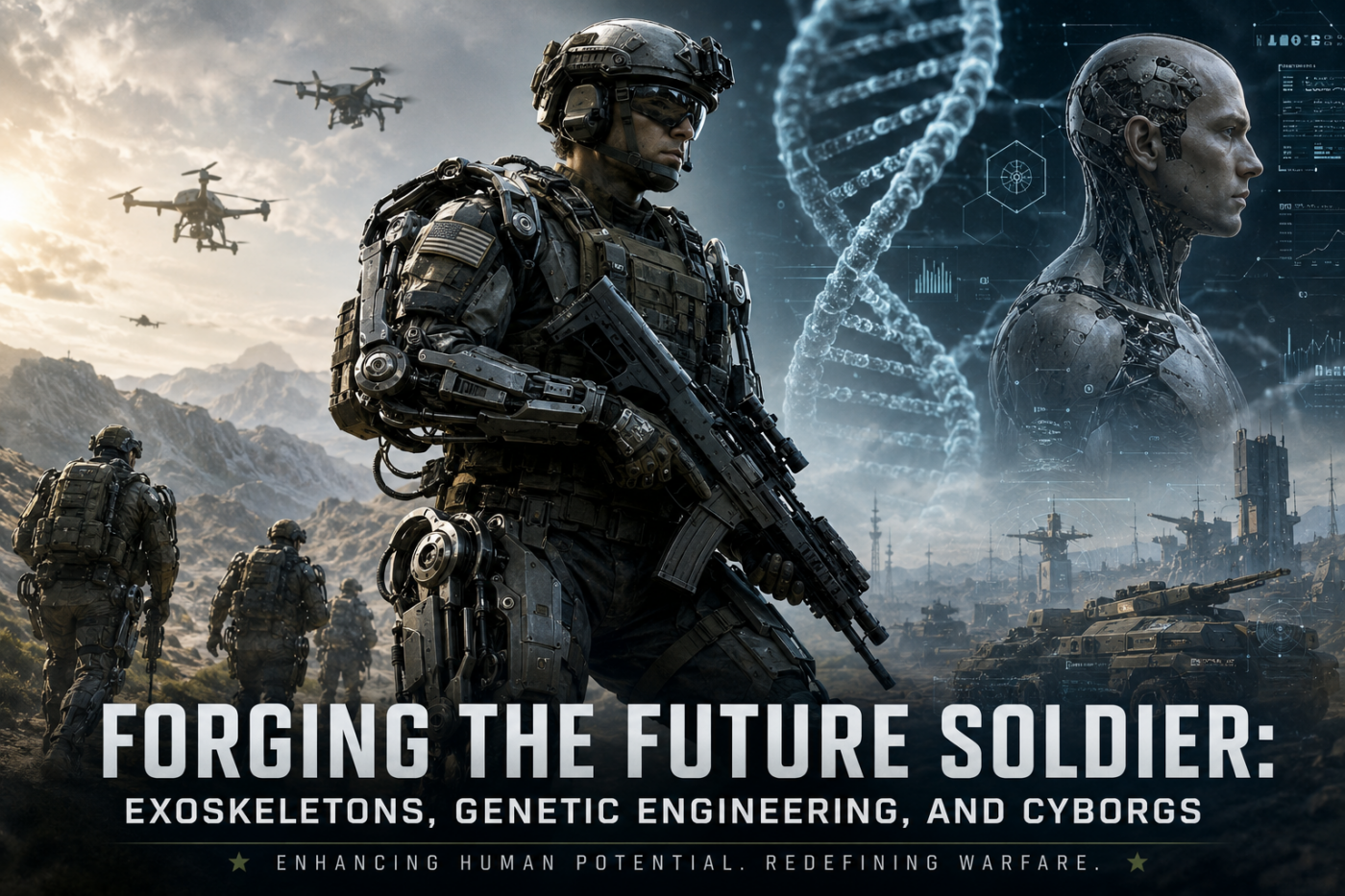
The accelerating convergence of exoskeletons, genetic engineering, and cyborg technology is fueling a global military race to create biologically and technologically enhanced soldiers. While these innovations promise to revolutionize warfare by offering unprecedented human capabilities, they also introduce profound ethical dilemmas and critical security risks that could reshape the future of global conflict. To maintain a strategic advantage, military forces must adopt a forward-thinking framework of robust cybersecurity, international policy collaboration, and adaptive counterstrategies.
Forging the Future Soldier: Exoskeletons, Genetic Engineering, and Cyborgs
Warfare is being profoundly transformed by an increasingly complex operational environment (OE), characterized by high-threat battle dynamics and the widespread adoption of disruptive technologies. Continuous advancements in human-machine interfaces, such as exoskeletons, genetic engineering, and cyborg enhancements, present both opportunities and challenges. While these innovations can enhance soldier performance across all five domains (land, sea, air, space, and cyberspace), they also introduce significant ethical and security risks, including the potential for cyberattacks. To maintain their strategic advantage and effectively respond to evolving threats, the Armed Forces must adapt to these changes.
Exoskeleton Race
Exoskeleton technology is rapidly advancing, with the United States, China, and Russia all developing military-grade suits to enhance their soldiers’ capabilities. These powered suits aim to increase mobility, strength, and endurance, allowing soldiers to carry heavier loads, move faster, and operate for longer periods.
From TALOS to a New “Warrior Suit”
The US has been a key player in exoskeleton development. The most well-known project was the Tactical Assault Light Operator Suit (TALOS), also known as the “Iron Man suit.” Initiated in 2013, TALOS aimed to provide special operations forces with a full-body, armored exoskeleton with integrated life support, communications, and enhanced strength. However, the project was officially terminated in 2019 due to challenges with power sources and the integration of its complex subsystems. Despite the termination of the TALOS program as a single integrated suit, the research spurred the development of numerous individual technologies. These include new lightweight armor, advanced night vision, and load-bearing exoskeletons, which are being integrated into other military programs. The US Army is now pursuing a new “Warrior Suit,” with the goal of developing a functional exoskeleton by 2040 in incremental steps. One of the first steps is to field a lower-body exoskeleton to reduce the strain of carrying heavy loads.
China’s Exoskeleton Advancements
China has also made significant strides in exoskeleton technology, with a focus on load-carrying and high-altitude operations. The People’s Liberation Army (PLA) has been testing powered exoskeletons designed to help soldiers carry heavy supplies in challenging environments like the Himalayas. These suits can reportedly reduce the metabolic cost of physical activities and enhance combat capabilities. China has showcased various exoskeleton prototypes, from those designed to help artillery loaders to more streamlined second-generation models with improved batteries and actuators.
Russia’s Ratnik and Sotnik Combat Systems
Russia has been developing its own “future soldier” combat systems, known as Ratnik and the next-generation Sotnik. The Ratnik system includes dozens of components, from body armor and helmets to communication and navigation devices. While the initial Ratnik suits featured a passive exoskeleton to help distribute weight, the upcoming Ratnik-3 and the more advanced Sotnik are expected to include powered exoskeletons. The Ratnik-3 is a combat suit designed to improve mobility and survivability, and it is said to integrate an automated C2 system and even a micro-swarm of drones. The Sotnik system is even more ambitious, with claims of being able to withstand .50 caliber bullets and incorporating “mine-proof” boots and a suit that conceals the soldier from infrared sensors. Russia has reportedly tested its exoskeletons in Syria, particularly with demining units.
Challenges and the Future of Military Exoskeletons
Despite the rapid advancements, several challenges remain in the development of military exoskeletons. A major hurdle is the power source, as current batteries are often heavy and have limited operational time. The integration of various complex systems into a single, seamless suit is another significant challenge. Furthermore, the vulnerability of these systems to electronic warfare and cyberattacks is a growing concern that requires robust defensive measures. The development of military exoskeletons is an ongoing race, with each nation striving for technological superiority. While the “Iron Man” suit of science fiction is not yet a reality, the incremental progress in exoskeleton technology is poised to have a significant impact on the future of warfare.
The Double-Edged Sword of Genetic Engineering in Warfare
Genetic engineering, particularly with the advent of CRISPR-Cas9 technology, is poised to revolutionize numerous fields, and the military is no exception. The potential to enhance human capabilities and create “super soldiers” presents both tantalizing prospects and profound ethical dilemmas.
The Promise of Enhanced Soldiers
The core appeal of genetic engineering for military applications lies in the capacity to create soldiers with abilities that surpass normal human limits, manifesting in various ways. This includes superior physical prowess, such as enhanced endurance for prolonged operations, heightened strength to carry heavier loads, and accelerated healing to recover quickly from injuries. Genetic modifications could also boost cognitive functions like memory, focus, and decision-making, giving soldiers a crucial edge in high-pressure combat situations. Furthermore, soldiers could be engineered to resist infectious diseases, radiation, and extreme temperatures, increasing their survivability in harsh environments; a Chinese military experiment, for instance, involved inserting a tardigrade gene into human embryonic stem cells to enhance radiation resistance. Finally, these modifications could target stress response pathways, mitigating the risk of post-traumatic stress disorder (PTSD).
The US’ Pursuit and DARPA’s Role
The US has been actively exploring the potential of human performance enhancement. The Defense Advanced Research Projects Agency (DARPA) has several programs aimed at optimizing warfighter performance through biological and genetic modifications. These programs, such as the “Warrior Web” project, focus on creating technologies to reduce injuries, and fatigue, and improve mission performance. DARPA is also researching non-invasive brain-machine interfaces and technologies to enhance cognitive performance after sleep deprivation. The agency’s interest extends to using CRISPR for creating genetically enhanced soldiers who could act as “antibody factories” against biological or chemical attacks.
The Global Arms Race
The US is not alone in this pursuit. China, in particular, is seen as a major competitor, with its “military-civil fusion” strategy blurring the lines between civilian and military research. Recent strategic assessments indicate that China is leveraging its military-civil fusion framework to advance dual-use biotechnologies, specifically targeting human performance enhancement and military applications for brain-computer interfaces through collaborations between PLA medical institutions and commercial industry. Chinese military leaders have openly discussed the potential of biotechnology, including “specific ethnic genetic attacks,” and have identified CRISPR as a key technology for boosting troop combat effectiveness. Russia is also a player in this field, with reports of developing “genetic passports” to assess soldiers’ predispositions for certain military roles.
The Pandora’s Box of Ethical and Strategic Concerns
The pursuit of “super soldiers” could trigger a new and dangerous arms race, with nations competing to develop increasingly powerful and destabilizing biological enhancements. Furthermore, the long-term effects of such genetic modifications are unknown, posing a risk of unintended and harmful side effects for the soldiers themselves and for future generations. This leads to concerns about the devaluation of human life, where creating genetically modified soldiers could foster a society that views human life as a product to be manufactured, eroding our appreciation for its intrinsic value. The high cost of these technologies could also create a new form of social stratification, a “genetic divide” between the enhanced and the unenhanced. Finally, there is a significant dual-use dilemma, as the same technologies developed for therapeutic purposes can be weaponized; the ease of access to CRISPR technology, in particular, raises concerns about its potential misuse by rogue states or terrorist organizations to create novel biological weapons.
The development of genetic engineering for military applications presents a complex and multifaceted challenge. While the possible benefits for soldier performance are undeniable, the ethical and strategic risks are equally profound. The world is on the cusp of a new era in warfare, one where the very essence of what it means to be human is at stake. The decisions made today regarding the regulation and application of this powerful technology will have far-reaching consequences for the future of humanity.
The Rise of the Cyborg Soldier
Cyborg technology, the integration of electronic and mechanical components with the human body, is rapidly moving from science fiction to a tangible reality on the battlefield. Nations like the US and China are heavily investing in research to create “super soldiers” with enhanced abilities, heralding a new and complex era of warfare. This human-machine fusion promises significant advantages in intelligence gathering and combat efficiency but also introduces a host of vulnerabilities and profound ethical questions.
The American Cyborg: Augmentation by 2050
The US Department of Defense has been actively exploring human-machine fusion technologies, with a 2019 report titled “Cyborg Soldier 2050: Human/Machine Fusion and the Implications for the Future of the DOD” predicting that such enhancements could become widespread by 2050. The report outlines four key areas of development, starting with ocular enhancements to create cybernetically enhanced eyes that allow soldiers to see across different light spectrums. It also details advancements in muscular restoration through an “optogenetic bodysuit sensor web” to program muscular control. Furthermore, the report discusses auditory enhancements for a networked communication system between soldiers and, most revolutionarily, direct neural implants. These brain-computer interfaces (BCIs) would enable a two-way data flow between the human brain and machines, allowing for seamless control of drones and weapons systems. DARPA is at the forefront of this research, developing programs like the Neural Engineering System Design which aims to create a high-bandwidth, implantable neural interface. The goal is to move beyond the current limitations of human-computer interfaces to a future where individual neurons can be connected to computers, offering fine control and rapid communication.
China’s Pursuit of Hybrid Intelligence
China’s PLA is also heavily invested in biosensing and biotechnologies, foreseeing the weaponization of these advancements to create a new form of “hybrid intelligence” by fusing human and machine capabilities. This ambition is not limited to land-based soldiers; Chinese scientists have even created cyborg bees that can be controlled like drones for espionage and reconnaissance missions. This highlights a strategic focus on leveraging biotechnology to bolster military might, raising concerns about a potential arms race in human augmentation.
The Double-Edged Sword: Vulnerabilities and Ethical Dilemmas
The integration of electronic components into the human body, however, creates a new set of vulnerabilities. These technologically enhanced soldiers become susceptible to cyberattacks, with adversaries potentially able to compromise their systems, leading to mission failure or even turning the soldier’s own enhancements against them. As AI-driven cyber threats become more sophisticated, the risk of hacking and loss of autonomy becomes a critical concern. Critical questions remain unanswered regarding the risk for coercion of soldiers into adopting these invasive technologies and the degree of autonomy an individual will retain over their own augmented body. Finally, the question of whether a soldier should be allowed to keep their enhancements after leaving the military, and the implications for civilian life, must be addressed. As this technology continues its rapid evolution, it is imperative for both military and civilian sectors to proactively address these complex challenges, ensuring that advancements enhance capabilities without compromising security or fundamental ethical standards.
How Enhancement Technologies are Reshaping Modern Warfare
The rapid integration of human enhancement technologies is fundamentally reshaping the OE. This transformation introduces new strategic considerations, vulnerabilities, and imperatives for military doctrine at every level of warfare.
Redefining Doctrine Across All Levels of Warfare
The emergence of technologically augmented personnel necessitates a complete overhaul of traditional military doctrine. At the strategic level, the potential for genetic engineering to create soldiers with superior endurance, cognition, and resilience is shifting military planning toward long-term human enhancement programs. This creates a new dimension of the arms race, focused on biological and cybernetic superiority. At the operational level, these technologies will revolutionize mobility, endurance, and logistics. Neural interfaces integrated with AI will vastly improve situational awareness and command and control capabilities, requiring entirely new training paradigms. At the tactical level, human-machine integration will redefine combat itself. Soldiers equipped with enhancements will possess accelerated reaction times, speed, and accuracy, while advanced combat suits will offer greater protection and mobility, fundamentally changing the dynamics of direct engagement. The disparity in capabilities between enhanced and non-enhanced forces will demand new strategies to address this asymmetry.
New Vulnerabilities and Ethical Dilemmas
This technological leap forward is not without significant risks. The network connectivity of exoskeletons and cyborg systems dramatically increases the digital signature and attack surface on the battlefield, making cybersecurity a paramount concern. Furthermore, unlike conventional heavy weaponry, the manufacturing infrastructure for bioengineering and cybernetic enhancements may be more accessible, raising the threat of proliferation to competitors and even non-state actors. Beyond technical vulnerabilities, these technologies introduce serious moral and ethical debates. Public perception, along with concerns about coercion and the long-term implications of human augmentation, could significantly impact military recruitment and retention, challenging the social contract between armed forces and the societies they protect.
The Imperative of Human-Centric Design
In this ultra-complex OE, it is critical that advanced systems are designed to adapt to human operators, not the other way around. Engineers require robust analytical models to develop human-centric technology that respects the biological and cognitive limits of soldiers. Ignoring the human element in the design process risks creating systems with diminished performance that require expensive redesigns. Ultimately, only properly generated, soldier-centric systems will enhance the agility, competitiveness, and effectiveness required for future military operations.
Adapting to Emerging Technological Challenges
To counteract the threats posed by exoskeletons, genetic engineering, and cyborg technology, military doctrine, policy, and countermeasures must evolve rapidly. First, to secure friendly systems, engineers must integrate robust cybersecurity defenses, such as advanced encryption and anomaly detection, directly into military networks and augmented hardware to prevent cyber intrusions. Concurrently, international agreements and military policies must establish clear guidelines for the use of genetic modifications and cybernetic enhancements in warfare. Ethical oversight committees are essential to evaluate the long-term impact of human augmentation, ensuring these technologies adhere to legal standards and do not compromise human rights or military ethics. Furthermore, military forces must proactively develop counter-technologies, including EMP weapons, to neutralize adversary exoskeletons and implants, while training programs must instill adaptable, asymmetric tactics to effectively overcome enhanced soldiers. Finally, international cooperation is crucial; allied nations must collaborate to monitor and regulate the spread of these emerging technologies through intelligence-sharing agreements that enhance threat detection and prevent adversaries from gaining a strategic advantage.
Exoskeletons, genetic engineering, and cyborg enhancements represent a transformative shift in military capabilities. While these technologies offer significant advantages, they also pose substantial threats to global security and the OE. Addressing these challenges requires a multifaceted approach, including enhanced cybersecurity, regulatory oversight, counter-technologies, and international cooperation. As these advancements continue to evolve, military forces must remain adaptive and forward-thinking to maintain strategic superiority in an increasingly complex battlefield.
