

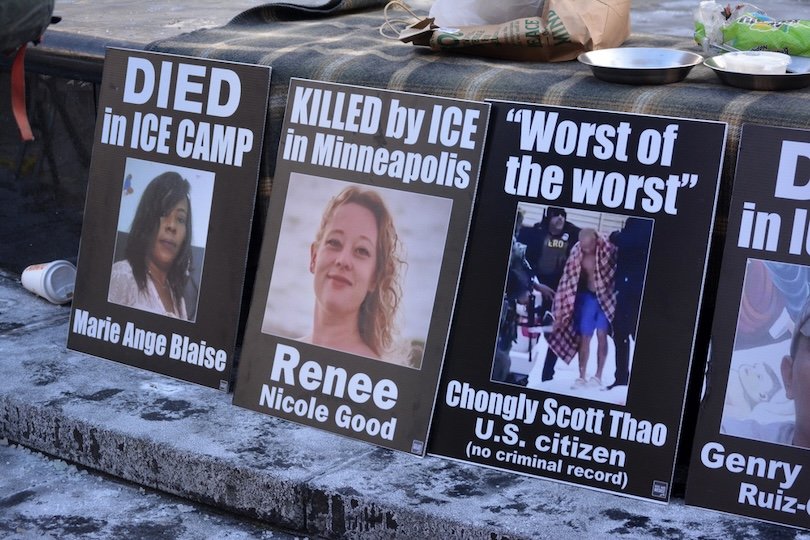
Renee Good was murdered by Johnathan Ross, an Immigration and Customs Enforcement (ICE) agent, on the 7th of January 2026 (Thomas, 2026) when attempting to flee ICE agents. Ross’s role as an ICE agent – an arm of the state—classifies this event as an act of state violence (Wertheimer, 2026). Through the case study of Good and the State narratives created around her murder, this essay seeks to demonstrate how state violence is fiercely legitimated through the state’s creation of narratives. Furthermore, the essay contends that the state’s monopoly over the use, designation, and definition of violence gives it a disproportionate ability to create narratives legitimating state violence, as demonstrated in Good’s case. In the wake of her murder, Good’s actions were discussed, deconstructed and interrogated to shift focus from Ross’s lethal use of force, a deliberate method of legitimation to discredit the victim. Only once Good was portrayed as extreme and violent did the state narrative shift towards Ross: his actions were then constructed as self-defensive and driven by fear. The Trump administration’s language choices were purposeful, aiming to protect its agent and legitimise the use of state force to murder a civilian. Therefore, this essay hopes to lay bare the harmful narratives which seek to legitimise state violence.
Understanding Violence and the State
Violence has been consistently linked to the state; Weber’s conception of the state centres on its “monopoly over the legitimate use of force”, positing that the state’s true power is underpinned by its ability to gatekeep legitimate violence and to delegate this legitimate violence to its extensions, such as the police (Weber, Gerth and Mills, 2009). However, this monopoly is not absolute; it is a claim to the use of force that must be constantly asserted and enforced (Anter, 2019). Consequently, to assert this monopoly, states must also claim the power to designate what counts as violence and when such violence is legitimate (Dos Santos, 2022). In this context, legitimacy refers to the empirical “acceptance of a discourse of legitimation” rather than to a normative conception of what is just or rational (Herzbrun-Dayan, Lowy and Varikas, 2022). The ability to shape these legitimating narratives is unequally distributed, concentrated in the hands of the state because of its monopoly over violence (CrimethInc, 2012). Therefore, to maintain this monopoly, the state must work to manufacture fitting narratives that frame specific instances of state force as acceptable. As the state has significant influence over the narrative through which its own force is understood, it is often able to manufacture a context that enables its force to be seen as acceptable amongst enough of the public, affording the violence it commits legitimacy. This essay seeks to highlight the methods and language used to build these legitimating contexts for state violence.
ICE is a federal U.S. law enforcement agency tasked with enforcing immigration law; it receives an average of $37.5bn annually (RepresentUS, no date). Its standing as an extension of the state and its powers must be considered in understanding Ross’s murder of Good as an act of state violence. Ross, as an ICE agent, was acting on behalf of ICE and, in turn, the federal government. This also contextualises the Trump administration’s systematic legitimation of Good’s murder. If state power relies on the monopoly on legitimate violence, then the American State and the Trump administration can be understood as holding a vested interest in constructing Ross’s actions, understood as a form of state violence, as legitimate to reiterate the wider legitimacy of state violence, re-securing their monopoly (Anter, 2019). The Trump administration sought to legitimate this use of state force by constructing a narrative of self-defence, beginning with the victim’s apparent violence.
Emphasising the Victim’s Violence
The groundwork of the American state’s legitimating narrative of Good’s murder was to shift focus away from Ross’s actions and towards Good’s. U.S. Homeland Security Secretary Kristi Noem claimed that Good had “weaponised her car”, and President Trump labelled her actions as a “moment of violence” (Zurcher, 2026). This language, provided by arms of the state, emphasises that the victim’s actions must be considered in our understanding of the use of state force, clouding responsibility. Donegan (2026) succinctly expressed that federal authorities were “eager” to demonise Good rather than investigate Ross’s lethal shooting. The claim that she “weaponised her car” can be proven false; the SUV’s wheels turned away in an attempt to flee the ICE agents, not to attack them (Hjersted, 2026). Regardless of the facts, the Trump administration’s narrative focused on framing Good negatively, a well-utilised tool to legitimise state violence.
As Hjersted (2026) articulates, police killings often become a “referendum on the victim’s character” with intense discourse surrounding factors ranging from their clothing to compliance. However, whilst Good was subject to this victim-blaming, it is important to note that this construction was likely tempered by Good’s position as a white woman. Victim-blaming is most prevalent when victims of state violence are African American. Black criminalisation—the over-perception of Black people as criminals—means that the accusation of Black people as criminals is more easily accepted, underpinned by powerful, racist notions of criminality (Cheek, Bonam, Langhout, 2025). That said, negative portrayal of a shooting victim, regardless of race, can lead people to sympathise with the shooter rather than the victim (Jones, 2017). Thus, the negative portrayal of Good and her actions casts the narrative against the victim, implicitly discrediting her and lending the perpetrator understanding.
Victim-blaming not only deflects focus away from the shooter and demonises the victim, but also distorts responsibility. In Goods’ case, this manifested as demonising her final actions and implying she was responsible for Ross’s response (Ball, 2016). As the state claims a monopoly over legitimate force, any state accusation of violence initiated by a non-state actor is automatically coded as illegitimate (CrimethInc, 2012). Thus, by constructing Good’s behaviour in her final moments as violence, the Trump administration works to instantly delegitimise her actions. Once Good’s illegitimate violence is established within the state narrative, ICE agents become the bringers of justice, protecting other citizens from the “rebellious”, the “criminal”, the “violent” to maintain social order (Vitale, 2017; Ball, 2016). Ultimately, for the state to define a civilian and their actions as illegitimately violent is to pre-justify the use of “legitimate” state force against them (CrimethInc, 2012). Thus, the state’s language shifts focus away from the perpetrator of Good’s murder to Good and her purportedly illegitimate actions and behaviour. This, then, builds the foundation for the justification of Ross’s violence: that he simply responded to Good’s illegitimate violence, fulfilling his state-delegated role of maintaining social order through legitimate, reciprocal violence.
Weaponising Terror
The American state deepened its demonisation of Good’s actions through their construction of her actions as terrorism, deflecting focus away from its agent who enacted lethal force. When discussing Good’s “weaponisation” of her car, Noem chose to describe Good as a “domestic terrorist” (Zurcher, 2026). Labelling Good as a “terrorist” works to construct her as more than just violent. The labels ‘terrorist’ and ‘terrorism’ have come to refer to a specific and heightened form of illegitimate violence (Perdue, 1989). Its invocations signal an inherently illegitimate, exceptional violence that requires an exceptional response (Huff and Ketzer, 2018), such as Ross’s shooting of Good. Similarly to the broader category of illegitimate violence, what constitutes an act of terrorism is deeply contested; terrorism is a concept that is often used subjectively and pejoratively to condemn violence the speaker dislikes or seeks to delegitimise (Richards, 2014). This heightened status is visible in prosecution; terrorism is prosecuted in federal courts, while most other violent crime is prosecuted at the state level (Huff and Ketzer, 2018,p. 56).
Given the state’s monopoly on legitimate violence and discursive power, it holds a disproportionate ability to apply accepted ‘terrorist’ labels to acts it dislikes, implicitly delegitimating any act (Richards, 2014). Noem, as U.S. Homeland Security Secretary, uses the state’s defining power to construct Good as a “domestic terrorist”, emphasising not only her extreme violence, but implicitly signalling that lethal force was proportional and legitimate; after all, ideas of terrorists are extreme and thus they should be “hunted” rather than “managed” (Huff and Ketzer, 2018, p.56). Given the understanding that terrorism creates a heightened impact on the popular imagination compared to other forms of violence, Noem’s purposeful escalation of Good’s violence can be read as a further attempt to blame the victim and construct her as deserving of the murder at Ross’s hands, as an arm of the state (Huff and Ketzer, 2018). Through this language, the state creates a layered narrative of Good’s violence, not solely illegitimate, but also exceptional; this escalation seeks to justify Ross’s exceptional use of force in his lethal shooting. Thus, by appealing to value-loaded, pejorative language such as ‘terrorist’, the state constructed a victim of state violence as exceptionally, incomprehensibly violent, seeking to legitimate a lethal state response.
Notions of terrorism also often rely on framing the perpetrator as an outsider, their extreme violence seen as targeting innocent figures representative of the nation and its values (Stampnitzky, 2017). This construction is succinctly summarised in politicians’ frequent claims that terrorist attacks are “attacks on our way of life” (Stampnitzky, 2017). Thus, Noem’s framing of Good as a terrorist seeks to position her as an outsider to the nation, affirming the narrative that Good’s violence was unacceptable and illegitimate, and that Ross was protecting the nation and its values, performing his duty to the real civilians, the innocents and non-violent around her, through legitimate force. As Hjersted (2026) articulates, the state required the public to identify “with the badge”, rather than with Good; by contextualising Ross’s violence and dramatizing Good’s actions, the state is encouraging the average U.S. citizen to understand his violence over hers, and to perceive his violence as necessary in protecting their nation and values against Good’s constructed aggression.
Importantly, the state’s use of labels of terrorism is again likely limited by Good’s standing as a white woman. Acts of violence involving Arabs or Muslims are more frequently labelled as terrorism. Thus, this language is much more effective at building narratives when perpetrators belong to these identity groups (Onwudiwe, 2005). Social identity theory stresses that differences in identity lead to less trust and/or tolerance. Importantly here, the American state has historically aligned itself with whiteness (Murakawa, 2019); therefore, Good’s whiteness positions her within the “in-group”, working to counteract some of the consequences that otherwise may be emboldened by the racist connotations within the language of terrorism (Kalkan, Layman, and Uslaner, 2009).
Despite this, the subjectivity of what constitutes a terrorist act, alongside the states’ disproportionate discursive power, allows Ross’s act of state violence to be legitimated through a narrative of Good’s extreme, exceptional and illegitimate violence, and the agent’s necessary, protective response through lethal force.
The Double Standards of Fear
Finally, building upon the existing narrative of Good’s murder, the state uses purposeful discursive choices to unevenly distribute the role of fear in Good’s and Ross’s decision-making. Noem argued that Ross fired “defensive shots” because he was “fearing for his life” (Robertson, 2026). Here, the state once again demonstrates its disproportionate discursive power by turning to “cop talk”, euphemisms and official language used by police and other state institutions to justify or obscure the harm they cause (Blanchfield, 2020). “Cop talk” often invokes notions of rationality, allowing the state and its agents to maintain control over what constitutes rational behaviour and what does not, and over whether fear is understood as a factor in decision-making. The state’s claim that Ross was “fearing for his life” provides an acceptable, justifiable reason for lethal force, strengthened by the construction of a narrative of Good’s extreme violence.
The state’s ability to manufacture the narrative means the agents’ role in creating fear is not considered; instead, the agents’ fear is emphasised alongside Good’s constructed extreme violence. His lethal force, therefore, becomes an acceptable, fearful reaction to a dangerous woman acting violently for reasons we do not understand, because any context has been obscured. This narrative highlights the state’s power to discursively legitimise state violence; the monopoly on rationalisation means that a state agent can enact lethal force due to a purported fear for their lives, while acting out of fear as a non-state actor (hesitating, moving the wrong way, making any gesture) can be cited as proof that the state had no choice but to react with violence, and in the most extreme cases, such as Good, to murder (Blanchfield, 2020).
Conclusion
This essay has demonstrated a range of techniques used to construct a legitimating narrative of lethal state violence against a civilian, through the murder of Renee Good. The state’s monopoly on legitimate violence affords it control over defining what counts as violence and which violence is legitimate; thus, it has a unique, disproportionate power over manufacturing narratives of violence. Its legitimacy relies on a social perception of state force as acceptable, and the state uses its disproportionate discursive power to create narratives surrounding its use of force to maintain this legitimacy. The U.S. administration directed intense focus towards the victim, labelling her as violent and a domestic terrorist; this worked to mute interrogation of Ross’ actions and to blame Good’s death on her own illegitimate, violent actions. By framing Good as exceptionally violent, the state not only implicitly delegitimized her actions but also portrayed Ross’s response as a necessary, defensive use of force to protect the nation, other innocents, and civilians. This, in conjunction with the omission of the ICE agent’s escalatory actions, removed any consideration of Good as a victim and instead constructed her as the aggressor, building a resolute legitimating narrative for the use of state violence that ended her life.
Bibliography
Anter, A. (2019) ‘The Modern State and Its Monopoly on Violence’ in Hanke, E., Scaff, L., and Whimster, S. (eds), ‘The Oxford Handbook of Max Weber’. Oxford Handbooks. Available at: (date accessed 10th January 2026).
Ball, P. (2016) ‘Violence in Blue’. Granta. Available at: (date accessed 10th January 2026).
Blanchfield, P. (2020) ‘Policing and the English Language’. The New Republic. Available at: (date accessed 10th January 2026).
Cheek, J., Bonam C. M., and Langhout, R. D. (2025) ‘Cultural violence in news coverage of the George Floyd murder: Exploring media depictions of police brutality toward Black-Americans’. Analyses of Social Issues and Public Policy, 25, e70036. Available at: (date accessed 10th January 2026).
CrimetheInc (2012) ‘The Illegitimacy of Violence, the Violence of Legitimacy’. CrimethInc. Available at: (date accessed 9th January 2025).
Donegan, M. (2026) ‘ICE agents have killed – again. The Trump administration blames the victim’. The Guardian. Available at: (date accessed 9th January 2026).
Dos Santos, E. S. (2022) ‘Violence’. The Philosopher. Available at: (date accessed 9th January 2025).
Feinberg, W. (2026) ‘Before and After the Trigger Press that Killed Renee Good’. Lawfare. Available at; (date accessed 15th January 2026).
Herzbrun-Dayan, S., Lowy, M. and Varikas, E. (2022) ‘Max Weber, victim of police violence’. Translated from the French by Fernbach, D. Verso.Available at: (date accessed 12th January 2025).
Hjersted, T. (2026) ‘The Pathology of Power: How America Learned to Love State Violence’. Films For Action. Available at: (date accessed 10th January 2026).
Huff, C. and Kertzer, J.D. (2018) ‘How the Public Defines Terrorism’. American journal of political science, 62(1), pp. 55–71. Available at: (date accessed 10th January 2025).
Jones, A. (2017) ‘Negative Portrayals of Shooting Victims Lead to Victim Blaming’. Duke Today. Available at: (date accessed 12th January 2026).
Kalkan, K.O., Layman, G.C. and Uslaner, E.M. (2009) ‘“Bands of Others”? Attitudes toward Muslims in Contemporary American Society’. The Journal of Politics, 71(3), pp. 847–862. Available at: (date accessed 12th January 2025).
Murakawa, N. (2019) ‘Racial Innocence: Law, Social Science, and the Unknowing of Racism in the U.S. Carceral State’. Annual Review of Law Social Science, 15(1), pp.473–93. Available at: (date accessed 1st July 2026).
Onwudiwe, I. (2005) ‘Defining terrorism, racial profiling and the demonisation of Arabs and Muslims in the USA’. Community safety journal, 4(2), pp. 4–11. Available at: (date accessed 12th January 2025).
Perdue, W.D. (1989) ‘Terrorism and the state: a critique of domination through fear.’ Westport, Conn: Praeger. Available at: (date accessed 11th January 2026).
RepresentUS (no date) ‘ICE is now the largest federal law enforcement agency in the country. And it has the fewest checks on its power’. RepresentUS. Available at: (date accessed 10th January 2026).
Richards, A. (2014) ‘Conceptualizing Terrorism’. Studies in conflict and terrorism, 37(3), pp. 213–236. Available at: (date accessed 10th January 2025).
Robertson, L. (2026) ‘Politicians Reach Different Conclusions on Minnesota Shooting Video’. FactCheck. Available at: (date accessed 12th January 2026).
Stampnitzky, L. (2017) ‘Can Terrorism Be Defined?’. In Stohl, M., Burchill, R. and Englund, S. (eds.), Constructions of Terrorism: An Interdisciplinary Approach to Research and Policy. University of California Press. Available at: (date accessed 10th January 2026).
Thomas, E. (2026) ‘Why is Stephen A Smith blaming Renee Good for her own death?’. The Guardian. Available at: (date accessed 15th January 2025).
Vitale, A. S. (2017) ‘The End of Policing’ Verso. Available at: (date accessed 9th January 2026).
Weber, M., Gerth, H. and Mills, C.W. (2009) From Max Weber: essays in sociology. Milton Park, Abingdon, Oxon ; Routledge. Available at: (date accessed 10th January 2026).
Wertheimer, T. (2026) ‘Who was Renee Nicole Good, the woman killed by ICE?’. BBC. Available at: (date accessed 14th January 2025).
Zurcher, A. (2026) ‘Two starkly opposed Americas laid bare by deadly ICE shooting’. BBC News. Available at: (date accessed 9th January 2026).
