

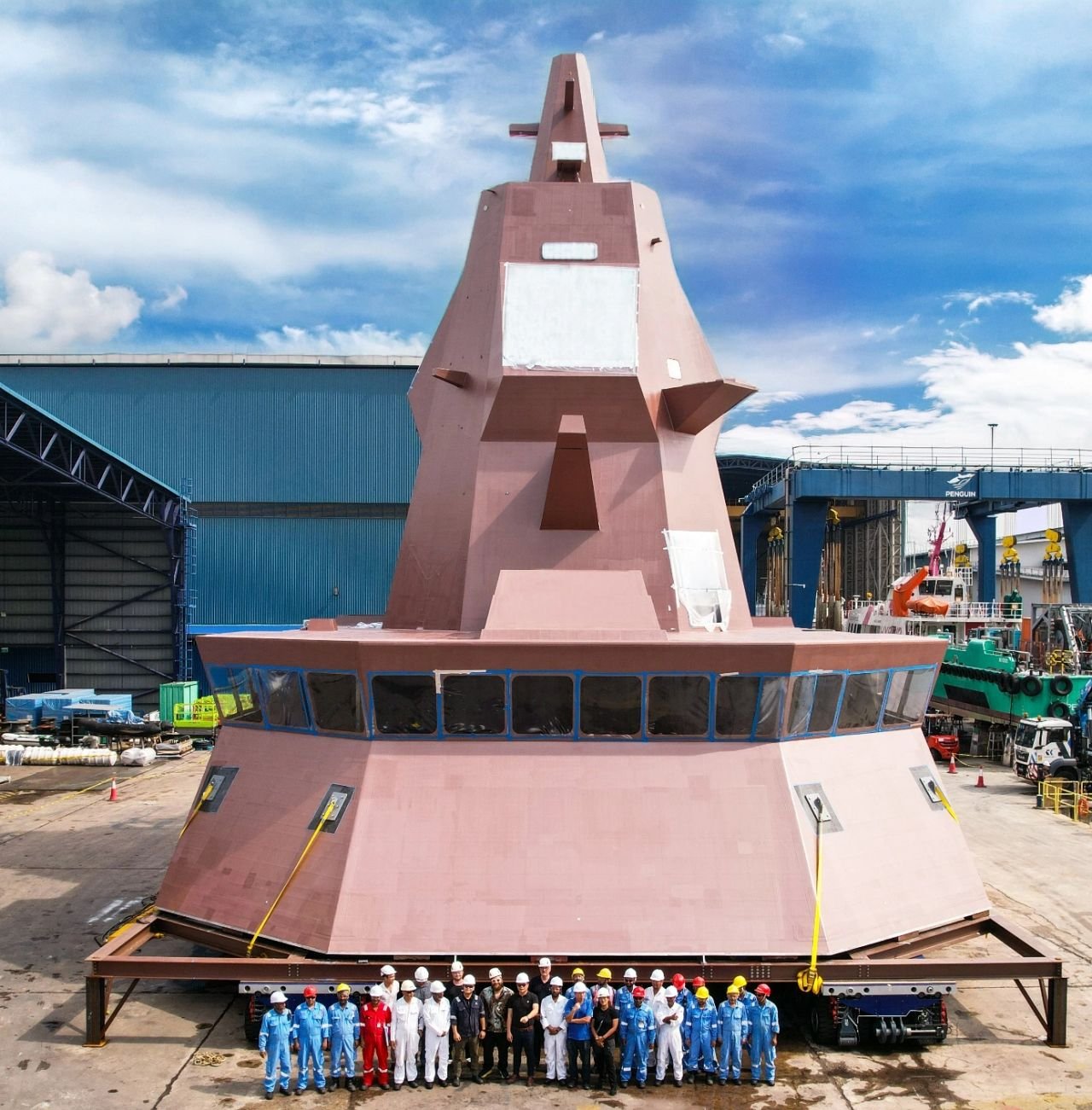
Saab, through its Singapore-based contractor Penguin Shipyard International, has delivered the first composite superstructure for the Republic of Singapore Navy’s (RSN) new Victory-class Multi-Role Combat Vessel (MRCV). This marks a major milestone in the programme.
The superstructure will be integrated with the hull of the lead ship, which was built by ST Engineering at its Benoi shipyard.
The first-of-class was launched in October 2025 before the composite section had been installed. An undated RSN video shows the lead ship departing the slipway before being towed to another ST Engineering facility where the superstructure is expected to be installed.
Saab said the project marks Penguin Shipyard’s first composite shipbuilding programme and its first naval defence contract. It is also the first time Saab has assembled prefabricated composite naval structures outside Sweden.
Penguin Shipyard has extensive experience in aluminium vessel construction, having built more than 400 high-speed craft for commercial and government customers worldwide.
The Victory-class MRCV was designed jointly by Saab, ST Engineering and Denmark’s Odense Maritime Technology.
Construction of the second ship is also progressing, with its keel laid in late January 2026.
Speaking to Asian Military Review in late 2025, Saab said the composite superstructure provides a lightweight yet rigid platform capable of supporting the large fixed-array surveillance and fire control radars supplied by Thales.
The material avoids excessive topside weight or structural deformation, plus it contributes to the vessel’s reduced radar signature.
At approximately 150m in length and displacing around 8,000 tonnes, the Victory class will become the RSN’s largest and most capable surface combatant. In fact, the MRCVs approach the size and capability of a modern destroyer.
Photos of yard workers standing in front of the composite superstructure further accentuate the large scale of these MRCVs.
The ships are designed from the outset to operate as command platforms for future manned-unmanned teaming, with the capacity to deploy and control a range of uncrewed surface, underwater and aerial systems.
by Chen Chuanren
