

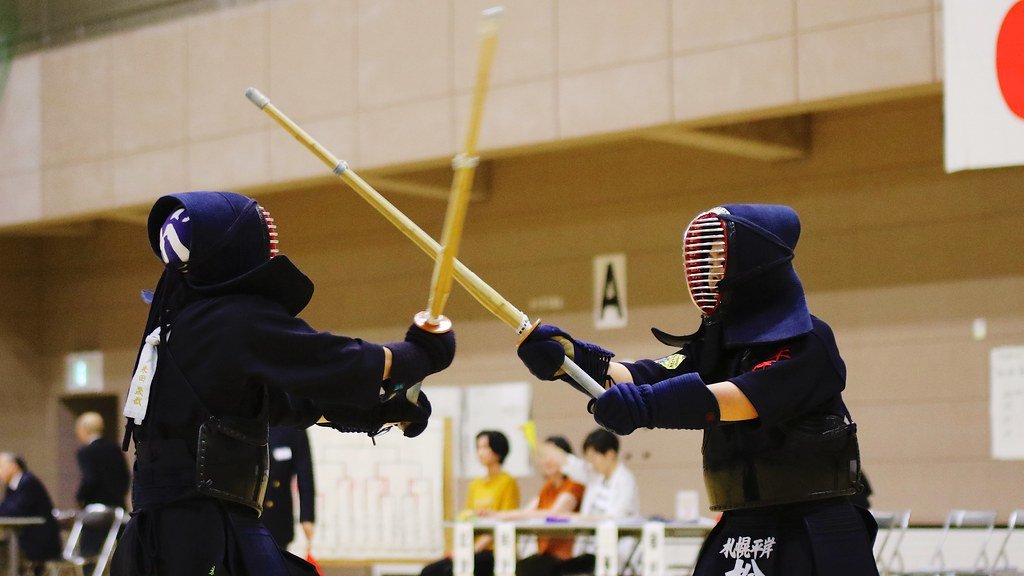
A foreign exchange student invited Ronald Fox to a kendo practice while on the Michigan State University campus and he was immediately hooked on the experience. After completing graduate school at UIUC and finding a job at MSU, Fox became the consistent instructor of the MSU Kendo Club. Since then, Fox has helped maintain the club’s presence on campus, assisted in national political discussions in the American Kendo community, and continued to spread the holistic benefits of kendo. This is the first part of a two-part interview. Read the second part here.
Martial Arts of Yesterday, Today, and Tomorrow: Welcome, Fox Sensei! Thank you for taking the time to speak with us today!
Ronald Fox: Thank you for having me!
MAYTT: You joined the MSU Kendo Club during your sophomore year in college. What was it specifically about that training session you saw that hooked you on maintaining such consistent practice throughout the years?
RF: No idea. I was in a dormitory that had a Japanese ESL student that practiced kendo in Japan. He hauled me along to a practice, and I just kept doing it ever since. I really can’t tell you what hooked me on it. What keeps me going is; it is something you can do as you grow old. It, I think, is good for me in terms of helping me stay calm, and stay focused, and stay in the moment.
MAYTT: What was the year your officially started kendo?
RF: Boy, that would probably be 1977.
MAYTT: From what I have read, the MSU Kendo Club was founded in 1972.
RF: That’s correct.
MAYTT: Could you tell us, since you were there from almost the beginning, the history of the MSU Kendo Club and how it has maintained its place within the University?
RF: The MSU kendo club is what MSU calls a club sport.We were founded in 1972 by Furiichi Kenzo, who was an ESL student from Waseda University. There was a pipeline of Waseda University students who came through to help teach up until midway through my undergraduate career. The last Waseda instructor was Matsumitsu Wake who left around 1978. The instructors from Waseda included Tatsuo Hayashi Sensei, who passed away last year over the summer, and who I formed a relationship with after the fact, as well as Matsumitsu Wake, one of my original teachers. That pipeline gradually dried up over time. One difficulty kendo as a university club has is that it’s a martial art that not a lot of people start as kids in the U.S., at least not in the Midwest. So as people graduate, clubs tend to dry up and blow away, with a few exceptions.
I went off to graduate school in 1981 at the University of Illinois in Champaign-Urbana, and then later took a job back at MSU. I went looking for the kendo club there and found that it was kind of drifting without anyone really teaching them. I didn’t feel fully comfortable as a teacher, but I did feel I at least had a concept of what kendo was, so I reluctantly stepped in as head instructor, and I stayed in that role until maybe three or four years ago. Around that time, MSU hired a Japanese language instructor named Takuma Miura, who, I think about two or three years ago, earned his godan. He then married a woman named Ayana Nakamura, now Ayana Miura, who is a former French national team member and holds renshi rokudan. So, I’ve reached a point where I can step back from club leadership and have some confidence that MSU kendo will continue after me. I’m almost seventy, so that feels like a natural, and important transition.
MAYTT: Since your assumption of the club’s head instructor since about 1981, how have you essentially maintained the club’s presence on the university campus for almost forty years?
RF: I think it’s… if you go back to ’72, it’s over fifty years now. MSU has an event, called Sparticipation, in the fall that showcases registered student organizations, which includes the sports clubs, and we participate in that every year. We usually get a typical surge of thirty or forty new members in the first two practices, which then tends to dwindle down to something more manageable. We’ve definitely had ups and downs over the years. When I took over, around ten to fifteen people were practicing, and at one point it even dwindled further from there. I was honestly worried when COVID hit, and we had to shut down, that we wouldn’t really be able to restart. But, in fact, we came back strong. Now we have something like twenty-five members and, outside of finals week, we’ll see about fifteen to eighteen people on a regular night. I don’t know if that fully answers the question, but every year we still have to re-register as an RSO, registered student organization, and re-register as a sports club. I think we’ve maintained our presence on campus through yearly recruiting at Sparticipation. Additionally, the Detroit Kendo dojo, and Great Lakes kendo dojo both have strong youth programs and we are starting to see college freshmen in the club that have come through their programs.
MAYTT: When teaching college students, what is your approach compared to that of standalone dojos?
RF: Yeah, I don’t have any experience with standalone dojos, so I really couldn’t compare directly, but what I can say is we kind of get two tiers of new students. Michigan kendo is pretty dynamic and pretty well populated now for the U.S., so we get people who have already graduated from high school and are doing kendo at one of the other dojos, typically Detroit Kendo Dojo or Great Lakes, which is also in Detroit; those students come in with experience. And then we also get total beginners. We keep everybody practicing together. I think if we didn’t do that a separation would develop between members with experience and our beginners.
In the beginning of the fall semester, our goal is to get the new members able to fully participate in kendo practice, which means wearing the equipment and being able to whack each other with shinai without killing each other. We have two official two-hour practice slots, and then we kind of steal another two-hour period by grabbing some space on a third evening. Until the beginners can participate fully, we divide the official practice into two roughly hour long sections. The first hour is focused on the beginners, where the experienced students help the newcomers with footwork, gripping the shinai, swinging properly, making strikes – all that basics needed to get them ready to put on equipment. The second segment is focused on the experienced group, where typically people with more than a year of experience go off to one side of the gym, and one of us instructor-level people, either myself or one of the Miuras, stays with the beginners and keeps them working. The unofficial third practice is focused entirely on the experienced members. By the end of the first semester, pretty much everyone is able to join in, and the practices become fully uniform and unified for the rest of the academic year. We’ve had some success with that approach, and the retention rate recently has actually been quite good compared to earlier years, when we took a slightly slower approach with the students.
MAYTT: So, it sounds like your program speeds up the process a little bit so that the students can to “hitting each other with sticks?”
RF: Right.
MAYTT: Do you present kendo more as a sporting activity, since the goal is by the end of the first semester to get them into bogu, or is it more of a balanced approach, like a budo?
RF: The answer’s yes, both. Yeah, kendo is as much a sport as it is a budo. We do also try to teach the values of kendo as well as the sporting aspects. From a sporting point of view, there’s a very large tournament in Michigan in the spring, and that’s also coupled with a promotion exam the previous day. Our goal is to have the first-year people take their first promotion test then and to participate in that tournament. That’s kind of the target we set for them. But we also want them to understand that there’s a lot more to kendo than just whacking people on the head with sticks, as they say. We want them to understand that kendo is supposed to emphasize straightforwardness, honesty, and living a good life and having good relationships with people. And we succeed and fail at different levels depending on the individuals, because for all that martial art is about character development, you really do get out what you put in.
MAYTT: How do you go about discussing the points of kendo – straightforwardness, honesty, fostering good relationships with everyone – to college students who may be more in it for the sporty aspect?
RF: It’s not something we discuss so much as something we try to provide through example: living by example. And we’re all flawed, of course, but we do try to show through our own lives what we mean by that. There is the purpose and concept of kendo that the All Japan Kendo Federation put out in 1972. We point to that and say, “Hey, see, this is what kendo is about,” and notice it doesn’t really say anything about winning or losing or even competing. So that’s kind of the core of the textual or explanatory part. But the rest of it, we just try to demonstrate through how we live. Just like in the physical side of kendo, we have to demonstrate with our bodies. Traditionally, kendo isn’t taught with a lot of verbal instruction; it’s taught more through observation and absorption. My sensei always said that what they had to do was “steal technique.” In other words, while they were waiting for their turn to get “beat up by sensei”, they would watch carefully, try to understand what was happening, and then bring that into their own kendo. We’re a little less traditional in that respect. We do explain things, we teach and break down techniques and describe when to use them, we do talk to students, we do correct them and say, “You’re doing this, and I think if you do that it will be better,” and so on.
MAYTT: Between the two forms of instruction, less and more verbal instruction, which approach have you seen better retention and sustainability for your students?
RF: Well, I feel that coaching for people in the U.S. works better. Because I feel like if you force them to “steal” things, then they don’t feel appreciated, and they don’t feel like anybody is really caring about them. I mean, I’ve practiced in Japan, and there’s kind of a principle: don’t get pissed off when the sensei is yelling at you; when he’s not yelling at you, that’s when he’s given up on you. But we don’t really operate that way. We don’t yell at students.
I don’t know if you know the Bennett brothers, Alex and Blake. Blake, in particular, has a very interesting background. He has degrees in sport coaching and tries to bring elements of sport coaching into his presentations. He introduced a really nice framework that I’ve tried to use, not always successfully, called the “rose, thorn, bud” approach. The idea is: you look at what someone is doing, and you say, “This thing you’re doing – that’s really, really good” (that’s the rose). Then you say, “But this thing over here is a problem” (that’s the thorn). And then the bud is: “If you change it to this, it will open up this part of your kendo for improvement.” So, I try to structure feedback that way. The Miuras are also very good at expressing verbally what people should do and pointing out what they’re doing wrong. And again, none of us are strict in the old-fashioned sense of Japanese sensei that I dealt with when I was practicing with university students. That said, over the years I think instruction in Japan has moved more and more towards a coaching approach.
MAYTT: With kendo being introduced into the college campuses – and there are a good number of them in the Midwest Kendo Federation – how have you seen their presence help raise awareness for the art?
RF: It did help. MSU is an enormous university; we have about 40,000 undergraduates. So, you can figure maybe 10,000 new people come onto campus every year. Some fraction of them sees us at Sparticipation, and out of that fraction we’ll get maybe a couple hundred people putting their names and emails on the sign-up sheet. We use that just to gauge interest, and then we send out follow-up e-mail reminding those who signed up, of our practice times. Typically, we end up with about forty to fifty people in the fall, so that’s certainly helped us. The University of Michigan at Ann Arbor has also done a lot to raise awareness. In the Midwest, the other groups I know of are Purdue and Wisconsin. Wisconsin, I think, still runs something similar. For a while we also had a one-credit class in kendo as well. I believe Wisconsin still has that too.
The class was another way we reached out. I actually taught that class myself. It had a cap of forty students, and it filled up every time. So, there’s definitely interest in kendo. The sad thing was, my original purpose for that class was to use it as a pipeline to bring people into the club, and very few actually transitioned from the class into the club. So, in that sense, while it showed there was interest in trying kendo, it was a failure from the standpoint of building the club. In terms of giving people a taste of what kendo is, I think it was very useful. And who knows, maybe some of those students referred other people to the club later on.
MAYTT: It is difficult to tell with that sort of thing, especially in the world of martial arts, where it is kind of loosey-goosey at times.
RF: One of the things I always ask new students is, “So how did you find us, and what got you into it?” And there’s a wide variety of answers, and the median answer, if you will, has changed with time. For example, when the Star Wars movies came out, people would say, “Oh, this is cool,” and then there was the anime surge as well. But the bulk of the people say, yeah, we saw you at that fall event, and we thought that’d be cool. They no longer, for liability reasons, allow us to actually do demonstrations at Sparticipation, so we’ll see how that affects things in the future. We used to just kind of get out there and just do stuff. And as of last year, they informed us that if any club did demonstrations they’d be summarily ejected from the event. There are also people who’ve seen it on YouTube, they’ve just come across it, and those vary from people who’ve seen serious kendo to people who’ve seen what I call the “Backyard Samurais,” beating each other up with bokken. I think it’s hard to say how people actually come to us other than, yeah, they saw it at Sparticipation. And that ranges from, “Oh yeah, I always wanted to do kendo, I didn’t know MSU had a kendo club,” or, “It seemed like it was cool from your pamphlet, so I thought I’d give it a try.”
MAYTT: Speaking about the kind of clubs in colleges, how has the MWKF really pushed, helped, or assisted in any way, shape or form, to expand their reach through the colleges?
RF: Not much. The MWKF has a mentoring program which provides visits by sensei to groups that do not have at least a 4-dan. Purdue makes use of that program. I served a term as Midwest Kendo Federation Vice President of Education, and the budget we had was used to organize things like seminars for the whole federation. MSU has been organizing a college student tournament since last year. We kind of modeled that after a student tournament that has been organized by Case Western Reserve University. But yeah, we get varying participation. Last time, last year, we had groups from Ohio State, Case, MSU of course, and this year it was mostly University of Michigan and MSU. Unlike the football teams, we have a pretty close relationship with the University of Michigan. We do a joint practice per semester with them. Rivalries don’t really bother us.
MAYTT: Because football and kendo are completely two different things, bringing in two completely different people.
RF: Well, we don’t have recruiting violations, so that’s okay.
MAYTT: In a perfect world, what would you want from the regional federation to assist you in, say, growing kendo clubs on college campuses?
RF: It’s kind of tough to answer, because it depends on the group, how well established they are, and how self-sufficient they can be. The Midwest Kendo Federation’s Dojo Mentorship Program goes a long way but I think some of the less self sufficient dojos could use more help than it’s able to providee. Since we’re all volunteers with kendo as a part time activity, providing a resident instructor is not realistic. If your dojo does not have somebody yondan or above, you are actually required to get a mentor who is yondan or above to visit you and take care of you. One of our MSU graduates, in fact, is their mentor: Hajime Sugawara, from Indiana Kendo in Indianapolis. I was Purdue’s mentor for a little while, but when COVID shut things down, they kind of lost institutional memory of me, and Sugawara Sensei is a much closer drive, so I kind of hooked the two of them up and said, “You guys really should take advantage of him.” I mean, the thing I should probably say is every university has a different way – different bunch of hoops that groups have to jump through to get established and stay established. So, I don’t think the Federation can really help with that. I think that’s something that each group has to navigate on its own.
MAYTT: Thank you for that clarification! Turning towards the MWKF, according to the website, there are three founding pillars George Izui, Frank Matsumoto, and Sachio Maeda. What is it about them that set them apart from their contemporaries that earned them such recognition from the Midwest Kendo Federation?
RF: They’re my mentors. They’ve all passed on; none of them are with us anymore.
So, they were originally in a dojo called the Chicago Buddhist Temple Kendo Dojo, which, as the name implies, was out of the Buddhist Temple of Chicago. That group, along with MSU, were actually the two founding dojos in the Midwest Kendo Federation. They were the highest-ranked kendoists in the Midwest at the time, so they really did a lot of the early work. Chicago was the center of Midwest Kendo for many, many years, and they really did a wonderful job of bringing us “outlanders” along. I would not be the kenshi I am without them, or the person I am without them, and that goes for many of the leaders of other dojos at the time, and the leaders of those dojos now..
Now that balance has shifted. Detroit Kendo Dojo kind of brought the center of gravity over to Michigan. The instructor there, Yoshiteru Tagawa Sensei, is one of three hachidan in the U.S., and the only kendo hanshi in the U.S. His dojo is affiliated with the Japanese corporate community. Japanese companies with a presence in the US rotate Japanese corporate members through the US branches. Those with kids, send their kids off to Saturday Japanese language school so that when they go back, the kids aren’t too far behind on kanji and the Japanese school curriculum. His dojo is associated with that school, and he has this big captive audience of; well, not hundreds, but a good number of kids, plus the occasional corporate instructor-level person that comes along. And that pulled in a lot of the population. A part of the Detroit Kendo dojo recently split off into the Great Lakes Kendo Dojo. And then there’s now also a dojo Macomb, also a Detroit suburb, the Macomb Kendo dojo, that grew out of a group that was originally in Battle Creek and Grand Rapids and is now in Kalamazoo, the Koyokai Kendo dojo. The Great Lakes Kendo Dojo is led by Robin Tanaka sensei, kyoshi seventh dan and the Macomb kendo dojo is led by Travis Hill sensei, sixth dan and former US National Team member.
MAYTT: In what way did the federation grow? Was it rapidly growing since the 1970s or was it slow and steady?
RF: Probably not. Five, six years ago, for reasons I don’t really understand, there was kind of an explosion of kendo – I mean, “explosion” is a relative term. I think the number of people who are part of the All-U.S. Kendo Federation – so organized kendo in the U.S. – is still kind of in the 5,000-to-6,000-person range. But kendo is still kind of a fringe martial art, if you will, in the U.S. In Japan, it’s like football is here. So, when I say “exploded,” what I can really judge is participation in our regional Taikai, our regional tournaments. We used to work really hard to get about a hundred people to compete, and doing that meant we had a fair number of dojos from outside the Midwest: New York City dojo, Kato Sensei’s Doshinkan Kendo Organization, Cleveland State University, and so on. Now, a small event for Midwest Taikai is about 200 people, and that’s almost exclusively Midwest participants. Detroit’s tournament gets to be something like 300 to 350. They pull in a bunch of Canadians to fill that out – there’s literally a bus that starts in Toronto and sweeps through Ontario, picking up kendoists to bring them down for it.
MAYTT: If you really want to go, you are definitely going to find a way.
RF: If you find value in those events, you will find a way. During my competitive days, I was competing in Canada, all the time, because there were so few opportunities in the Midwest then.
MAYTT: It is actually quite funny how connected the Canadian and American Kendo scenes are in small ways.
RF: As an example, Harvard University has a yearly tournament, and we didn’t go to that, but we did go to a Canadian university tournament at Western University in Stratford, because it’s a heck of a lot closer than driving ten hours to the East Coast.
MAYTT: With the recent explosion the MKF experienced, how does kendo present itself to the public, from your perspective?
RF: There’s not a lot of general public outreach, actually, in the Midwest, at least in Midwest Kendo. Sometimes we are invited by people who know we exist to give demonstrations, but very rarely even then. We used to do one or two demonstrations a year, but that’s kind of trickled off and doesn’t really happen anymore. So, there’s not a lot of general public presentations. And, you know, there’s a piece of me that says, if people want to do kendo, they’ll probably find us. If they really want to do it, there are ways to find us, and if it takes coming out and giving a demonstration for them, they might not really stick with it, because they haven’t really taken the time to find us. I know that sounds a little snobby, but it’s also something I’ve observed – that the people who just kind of came as a result of demonstrations, or came because “oh, I saw this in anime and I want to do that,” and I could tell stories about that, but I won’t – they often don’t stick very long. Because what they see in a demonstration isn’t what they’re actually going to have to do at first. Unless they have the patience to get past that, they’ll drop out.
I think aikido has the same issue – a really shallow learning curve at the beginning, right? So, I imagine retention can be difficult there too. Because if someone comes to a demonstration and sees the sensei throwing everyone left and right and up and down, and they say, “Cool, I want to do that too,” then they come in and they have to learn how to fall for a long time without hurting themselves. And it might be hard for them to stay.
MAYTT: I was just talking to someone last week who was basically saying the same thing for aikido. But to your point with kendo, you are on the other side getting hit repeatedly, which some people do not want to get hit.
RF: We kind of make it a little bit gentler with our new members. For example, of the things we do, when a new group gets into bogu for the first time, is to take all the experienced people aside and say, “Yeah, don’t just beat the crap out of them. Just, you know, encourage them to hit.” Because at that point they have to use their keiko, which is a word we use for practice, to learn and improve. And ji-keiko, which is free keiko, though it looks like sparring is not supposed to be a competition. It’s supposed to be trying to apply what you were learning in your basics and trying to understand how to interact with your opponent so that you can produce that kind of tendō, so I just remind our guys, “Hey, you know, let them hit you. Let them hit you, because that’s what they need to do at this point.” Keiko, by the way, actually literally means reflecting on the old (traditional) ways. It’s a word that’s used to cover practicing a martial art.
This is the first part of a two-part interview. Read the second part here.
