

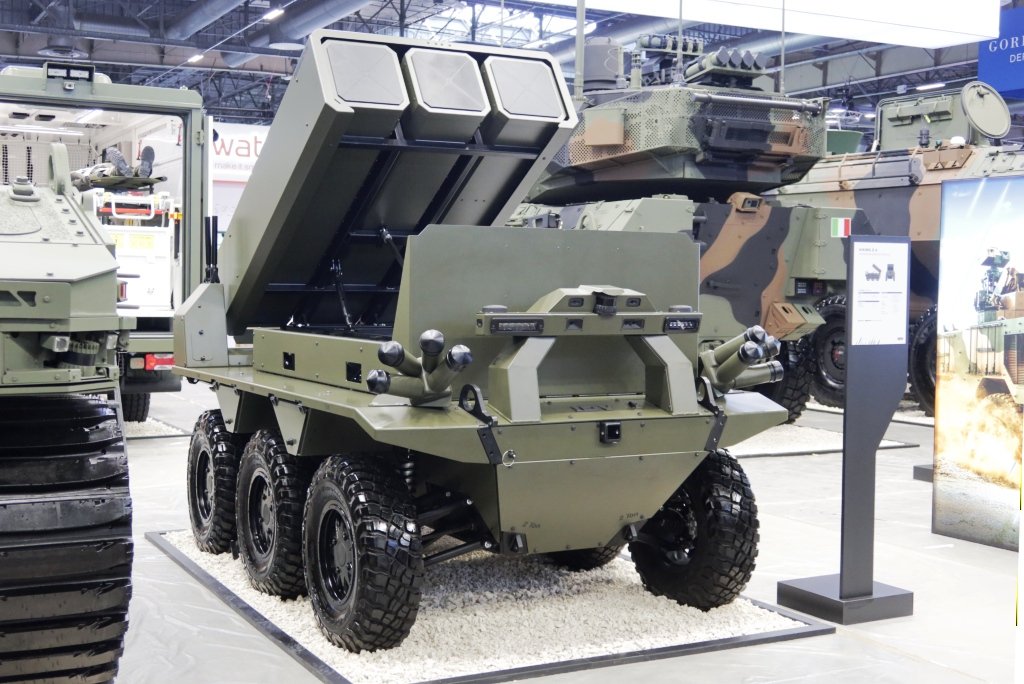
Borne as a parallel hybrid 6×6 unmanned ground vehicle (UGV), IDV Viking in its 2.4 iteration is going serial hybrid, beside receiving also a series of improvements that make it a more flexible and performing platform
The Viking 2.4 presented by IDV, a Leonardo company, at Eurosatory 2026, is the fifth iteration of the 6×6 UGV originally developed by Horiba Mira, that company becoming part of IDV in 2023. The first ones were all powered by a parallel hybrid powerpack; the first Viking that featured a serial hybrid power system was the Viking 2.3, which however was a technology demonstrator and never became a product, the first actual product being the Viking 2.4.
The Viking platform has continuously evolved based on the lessons learned provided by customers, the shift to serial parallel being a quantum jump; now the electric motor is the one controlling the movement, which allows driving at very low speed when needed, for example in CBRN reconnaissance missions. According to IDV the Viking 2.4, which has a gross vehicle masse of 2 tonnes, has a power-to-mass ratio of 50kW/t, which means the electric motor power is 100 kW. No indication was provided about the output of the very compact diesel generator used to reload the battery pack, which energy storage capacity was increased by 50% compared to the earlier models, which increases the range from 20 to 30 km in electric mode, to satisfy a requirement expressed by customers. In this mode the Viking becomes very difficult to detect by thermal sensors, typically installed on attack drones. The fuel tank for the generator allows for 10 recharges of the battery pack, which means a range of 300 km in hybrid mode.
The vehicle architecture sees the battery pack at the front, the electric motor in the middle, and the diesel generator at the rear, in order to obtain the best mass distribution. The electric motor is linked to the axles by three differentials, and is equipped with differential locks. The cooling system has also been modified and it now uses water glycol, a standard product common to most vehicles, rather than the special transformer oil used in previous iterations, which helps maintenance in the field.
Another major improvement is the electronics architecture, which allows easier upgrades, the computer power currently available being five times more powerful than the previous one. When more powerful CPUs will be available, it will be easy to swap from the old to the new one. The increased computing power allows using higher definition cameras, the new ones have four times the definition of older ones. IDV is aiming at a latency under 100 ms, compatible with teleoperation up to the maximum speed of 45 km/h.
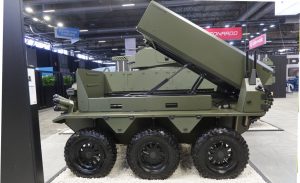
Two Viking 2.4 are exhibited at Eurosatory, one equipped with a Leonardo Hitrole C-UAS RCWS, which includes at the back a mast-mounted Janus-D gimballed optronic sensor. The video feed provided by this sensor will be integrated with those of the platform, which will happen after the show. The second Viking was fitted with a concept missile launcher. This new modular payload is being developed in cooperation with MBDA; the one seen at Eurosatory carried three canisters, however it is also available with five or six canisters. It can host different types of MBDA missiles, such as Spear, Akeron and Brimstone. The system is currently in the concept phase. Coupling such a long-range firepower capacity with a stealth platform like the Viking 2.4 would allow to distribute these systems on the battlefield ready to operate; when a target is detected and identified by the higher echelon, data are transmitted to the selected effector that launches the missile and immediately moves to another position in stealth mode.
The UGV remains communications agnostic, usually comms being government furnished systems, including SATCOM, and tactical radio networks. The system can also be controlled by fibre optic, a backup system for heavily jammed areas.
The Viking 2.4 maintains the size of the former versions, and is 3,000 mm long, 1,800mm wide, 900 mm high to the load bed, payload space being 2,200×1,800 mm. Kerb mass is 1,300 kg while payload is 750 kg.
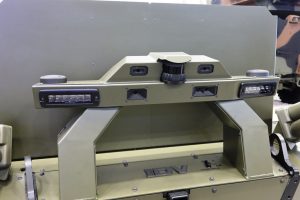
IDV is continuously developing the autonomy capacity, these modules being common to all IDV UGVs. The company is also working on reducing maintenance life cycle.
The Viking 2.4 is a readily available product, the company being currently in the industrialisation phase. The Viking in its previous iterations is currently in service with several countries. IDV has ongoing development programmes in Sweden and Norway. In late May the Italian Army signed a contract for a first batch of eight Viking 2.4 platforms. “This is a very important step for two reasons, the first is that the Italian Army will use them to develop a doctrine around this new uncrewed platform, the second is that signing within the end of May deadline the Viking 2.4 became part of the SAFE catalogue, and now any country in Europe can buy it through the safe mechanism,” Nazario Bianchini, IDV head of sales said. EDR On-Line understood that the first eight Italian Vikings will not be fitted with the Hitrole C-UAS RCWS, and will be used initially mostly for demonstrating their effectiveness in first line logistic roles. However IDV looks forward providing a weaponised Viking in a further step.
Photos by P. Valpolini
