

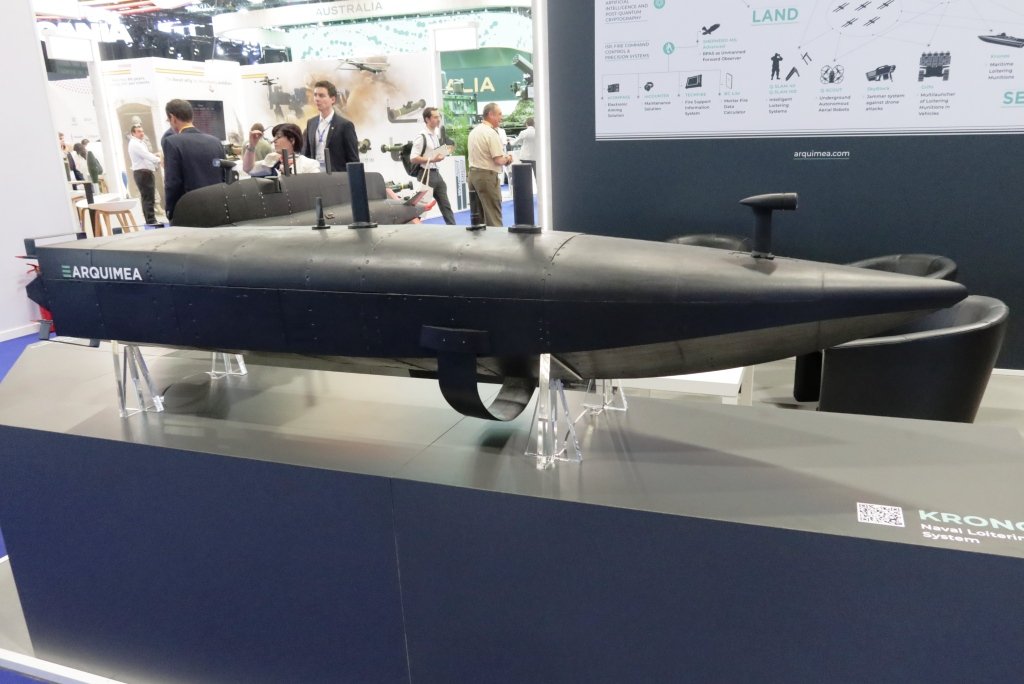
The land equipment benchmark exhibition, Eurosatory is further widening its scope as many defence manufacturers showcased naval uncrewed systems at the Paris event. One of them was Arquimea of Spain, which unveiled the Kronos Mini naval loitering munition, which joins the S-Wise UUV unveiled at DSEI 2025
The S-Wise is mostly a UUV, which can also sail on the surface, while the Kronos Mini is the opposite, a USV capable to sail underwater for limited periods. A single planning hull produced using additive manufacturing and acoustic transparent plastics, it is 2,043 mm long, has a 450 mm beam and a moulded depth of 444 mm. Nominal mass is 50 kg, while payload is in excess of 30 kg, and payload volume is over 30 litres.
The Kronos Mini is powered by three motors on one shaft, maximum continuous rating power being 3 kW, with a 6 kW over boost power. When sailing on the surface maximum speed is over 20 knots, while endurance is 65 NM at 4 knots speed, which means it can navigate for over 24 hours. Submerged, the Kronos Mini can reach a maximum speed of 6 knots for the final navigation to the target. Power is provided by a 1.62 kWh Li-Ion battery pack through a battery management system.
It can operate up to Sea State 4-5, while launch and recovery operations can be performed up to Sea State 3-4. The boat has no rudder, the water jet being deflected by control flaps installed on the bow; the upper two are horizontal while the lower two are inclined according to the V-shape of the hull, each one controlled by an actuator. By moving these surfaces, the boat can be controlled on the three axes.
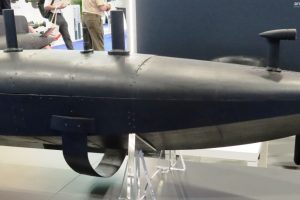
At around one third of the hull from the bow the Kronos Mini features a semicircular, which makes it a half-foiling boat when sailing at speed on the surface, also defined as a ducted lifting body. Not only, when it is time to submerge the wing attitude changes generating the force needed to bring the boat under the sea surface.
The typical mission profile sees the Kronos Mini loitering in the target area waiting for an enemy surface vessel to approach. The boat is fitted with an electro-optic sensor and sonar, used for target tracking, obstacle avoidance and follow me functions. It is fitted with a state-of-the-art onboard computer with edge computing capabilities and a graphic processing unit optimised for convolutional neural networks specifically designed for loitering operations. The Kronos Mini has a high degree of autonomy, as it is capable to recognise, classify, and count objects and map them dynamically. At this point it can share identified targets with other units using similar advanced systems, as well as share areas of interest for better coordination, which allows it to operate in swarms. That said, the final decision for the attack always comes from a human being, a control station allowing keeping the man-on-the-loop. The Kronos Mini has been developed according to STANAG 4817, which establishes a common framework for the multi-domain command-and-control of unmanned systems. It exploits many subsystems used on the S-Wise; EDR On-Line understood that several subsystems, electric motors, antennas, communication equipment, are the same.
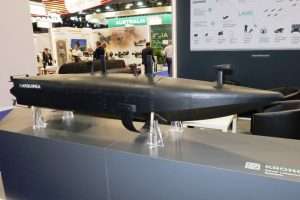
Once the target has been identified and the operator cleared the Kronos Mini for the kill mission, the boat approaches the target and then goes underwater; this is not only due to make it stealthier, but it is also linked to the destructive effect of the warhead, which is much more effective underwater as a higher percent of energy is transferred to the target. The warhead suite is the same used on the S-Wise and is made of two 1.2 kg each shaped charges in tandem configuration capable to penetrate over 250 mm of RHA located at the front, with secondary 5-15 kg each HE charges on the sides of the vehicle, the battery pack adding some more energy, for a total of 120-270 MJ.
When submerged the Kronos Mini navigates using the inertial platform and pressure sensor, optionally also a Doppler Velocity Log, while on surface it exploits GPS signals. It can be deployed from the shore, from surface vessels as well as from submarines, from 533 mm torpedo tubes; fitted with a plastic sabot, the Kronos Mini swims out when the boat sails at low speed.
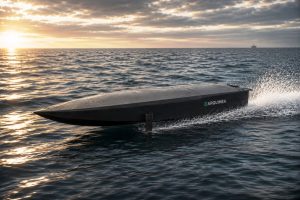
The method of construction, additive manufacturing, and the material employed, plastic, makes the Kronos Mini easy to produce, which fits today requirement of mass and distributed production, typical of what is being done in Ukraine with UAVs. The boat is delivered in a 2,500 x 500 x 900 mm container.
The Kronos Mini is already conducting trials at sea; Arquimea will deploy its S-Wise in the REPMUS (Robotic Experimentation and Prototyping with Maritime Unmanned Systems) exercise that will run in September 2026 in Portugal, while in 2027 it will be the turn of the Kronos Mini to participate in the NATO experimentation exercise.
The two existing uncrewed naval systems will soon be joined by more members of the two families, EDR On-Line understanding these will be bigger systems. The Wise family will see the S-Wise, S for small, flanked by the M-Wise, M for medium, the Kronos Mini to be joined by the Kronos Light, both electric powered but with greater dimensions and higher performances, no more details being unveiled.
Graphic courtesy Arquimea, photos by P. Valpolini
