

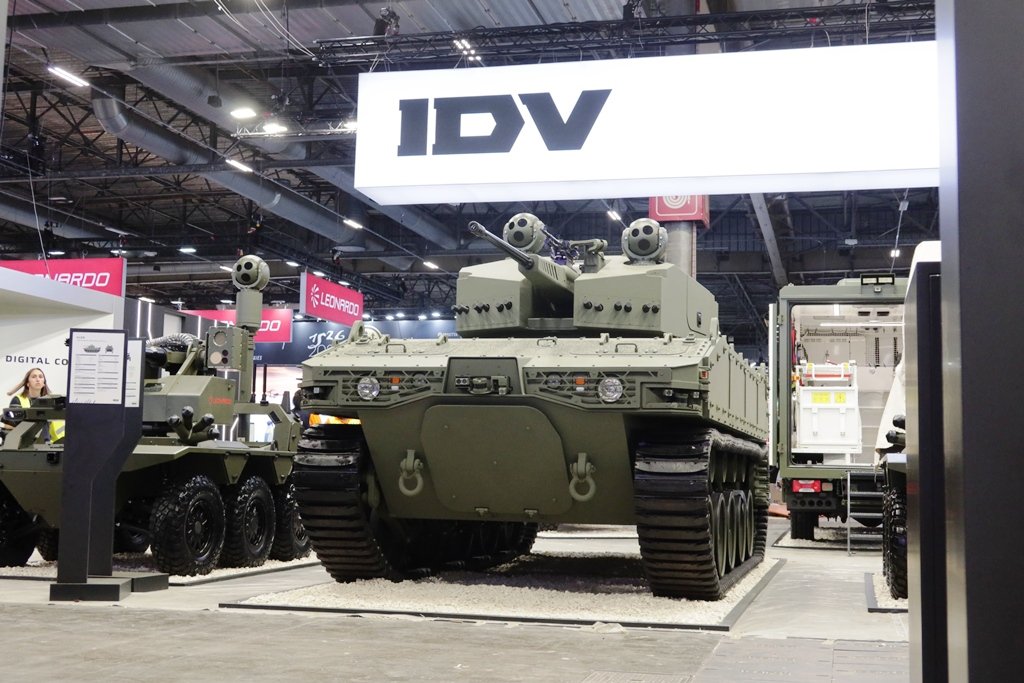
Ground robotics is picking up pace, the Ukrainian front being the first real test bed for uncrewed ground vehicles (UGVs). IDV, which was recently acquired by Leonardo but maintains its name and autonomy, unveils at the Paris exhibition a new tracked robotic platform, the CL2X, a “tank wingman” fitted with an IFV-type turret, the Hitfist 30 UL from Leonardo
CL2X stands for “Carro Leggero 2 X”, for Light Tank 2 x, which shows well what in the intentions of IDV will be the mission for this the 16 tonnes gross vehicle mass uncrewed tracked platform. Work started in 2021, and the “2” shows that there was probably a “1” that never saw the light, remaining on the R&D computer screens. Since inception the choice for propulsion went for a series-hybrid powerpack installed at the rear, which includes two electric motors each providing a 250-kW peak power, with a 2,500 Nm torque, driving the sprockets, which activate tracks, steel and rubber tracks being available. The drivetrain features five roadwheels fitted with hydropneumatic suspensions and an idler at the front. Looking at reliability, IDV used proven components, one example being the final drive, which is that of the old faithful M113, the challenge being integrating all those elements.
The motors are powered by a 130-kWh energy storage system, a range extender ensuring battery reloading, which gives the vehicle a 500 km range on road, maximum speed being 70 km/h. To distribute mass, the two 600 V Lithium-Ion batteries providing 600 V current to the motors are located at the front, on the sides, and ensure a 30 km range in all-electric silent mode; room is available for two additional batteries. Sufficient space is maintained to allow a smaller UGV to be hosted in the forward section of the CL2X, which would act as mother vehicle, a small ramp allowing the UGV to leave the bigger vehicle and to re-embark at the end of its mission. Behind the space reserved for the small UGV we find the fuel tank for the range extender, no details being provided on the latter.
Although a tracked vehicle will never be totally silent, rubber tracks would help reducing noise signature when the CL2X travels on battery only, considerably reducing also thermal signature, the two combined increasing survivability; the prototype seen at the Paris event was equipped with Soucy Defense composite rubber tracks. IDV underlined the importance of controlling cooling when going silent, managing cooling needs being key to avoid noise spikes. Signature is not only acoustic; having the same architecture of an MBT, the CL2X has a reduced front thermal signature, as all “hot” parts, such as powerpack, exhaust, sprockets, are located at the rear. RF signature is another issue; limiting the use of LIDARs when in contact with the enemy is one thing, high voltage
The front and rear geometry allow a 45° approach and departure angle, the UGV being able to overcome a 60% gradient, a 30% side slope, a 0.7 metres vertical obstacle, a 2 metres trench, and can overcome a water obstacle 1.5 metres deep. The CL2X platform is 5.6 metres long, 6 metres with barrel, 2.5 metres wide and 1.8 metres high.
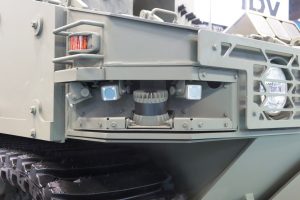
Autonomy is provided by modules that are being used across all IDV uncrewed systems. The first one is the MACE (Modular Autonomy Controlled Equipment), which is the brain of the CL2X, together with the ATLAS, a software allowing geolocalisation even when active sensors are not used for stealthness. While these modules are common to all IDV UGVs, it is clear that software must be adapted to the platform; the CL2X is definitely the bigger platform, vibrations are higher compared to a wheeled vehicle, steering is based on differential speed between the two tracks, hence, traction control is different. On-board cameras see the terrain and decide the course of action, the processor generating orders to the powertrain. The sensors detect the behavior of the tracks—if they’re slipping if the vehicle is turning left or right—and correct the action. A machine learning algorithm hasn’t yet been implemented. Three are the models to be studied, vertical dynamics, powertrain dynamics, and the latter for driving sensors. These are also used on modelling simulators, latency being one of the issues currently under scrutiny.
Its 5 tonnes payload allows to accept the Leonardo Hitfist 30 UL (Uncrewed Light) uncrewed medium-calibre turret, which has a combat mass under 1,500 kg, the turret being detailed in another article.
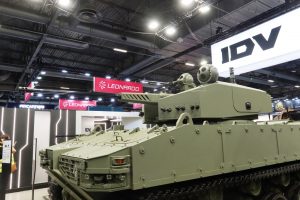
Given the current state of technology, and in accordance with safety measures in the development process, three operators are required to control a CL2X: one operator for the vehicle, one for mission systems, and one as safety supervisor. The aim is however to develop autonomy systems allowing a single command and control vehicle to coordinate multiple UGVs, fully exploiting the Manned-Unmanned Teaming (MUM-T) concept.
In the configuration exhibited in Paris the CL2X can operate as a land-based loyal wingman, integrating manned MBT formations, increasing formation situational awareness while reducing risks for crewed platforms. “Thanks to its stealth capacity, it can also be used for missions in which not being detected is the real challenge,” Luca Perazzo underlined, such as forward reconnaissance, acting as the advanced eyes of the formation. The new IDV UGV can obviously be fitted with other payloads, its’ carrying capacity giving it inherent flexibility.
IDV uncrewed systems are being developed in a quite distributed structure; the MIRA Technology Park facility in Nuneaton, Warwickshire, in the UK, is the one focused on UGVs only, however activities are ongoing in Bolzano, the company HQ, in Piacenza, where military trucks are being produced, as autonomy find applications also in the logistic field, and in Modena. The latter is a centre primarily dedicated to software development for off-road autonomous driving systems; its expertise covers: control software, perception, autonomy, human-machine control interfaces, and communication systems integration.
Photos by P. Valpolini
