

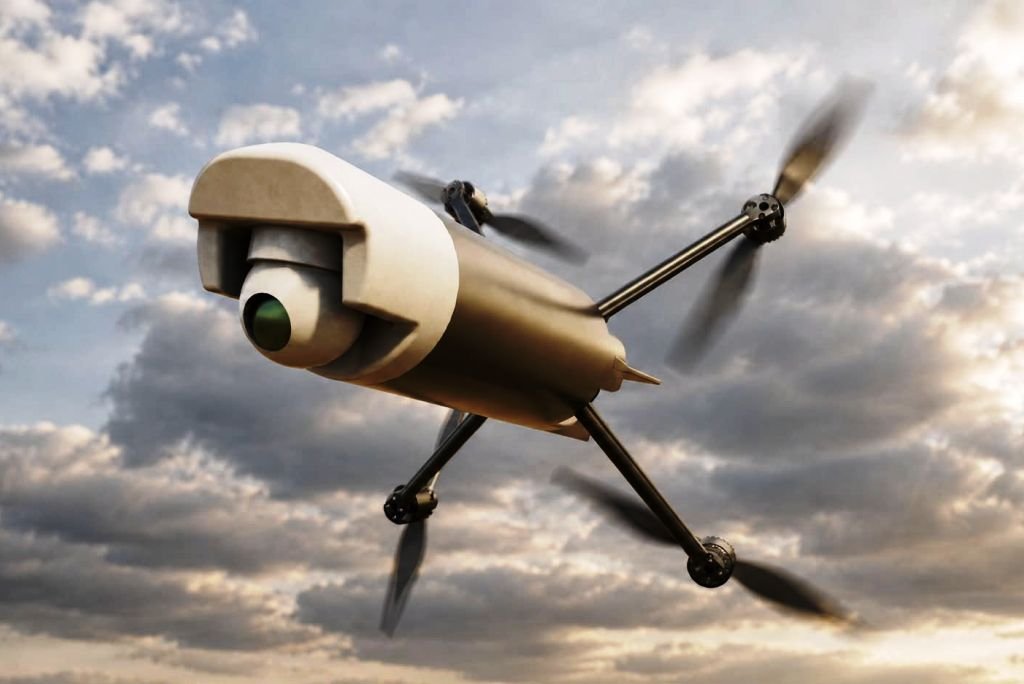
Probably the first nation to develop UAVs over 50 years ago, Israel is at the forefront also of C-UAS solutions, one more being added by Rafael at Eurosatory, despite the limitations imposed by France on the presence of Israeli stands. Although not present in mock-up form, Israel unveiled the Iron Wasp, an interceptor drone developed in cooperation with SpearUAV, now part of Uvision, the system being integrated on a vehicle together with several other Rafael solutions to give birth to the Force Protector, a mobile C-UAS layered defence system
Putting together the know-how of two Israeli companies, Rafael and SpearUAV, led to the development of an interceptor drone, the Iron Wasp, designed to be integrated on vehicles. A modular system, the effector is tube-launched using pneumatic impulse, it comes in the form of a canister that can be attached on an armoured vehicle in a similar way of smoke grenade launchers, which makes it a very flexible solution.
The Iron Wasp configuration reminds that of SpearUAV Viper-I, the interceptor element of the Viper family of loitering munitions, the company being a specialist in encapsulated drone solutions. The Viper-I features a cylindrical fuselage and is launched from a tube, four spars each carrying at their extremities an electric motor activating a two-blade propeller opening after launch, providing the needed thrust. With a mass at launch of 4.5 kg, it carries a 1.3 kg payload and has a range of around 2 km. At the front an optronic seeker is visible, no details being provided. The Viper-I was developed to provide infantrymen a last-ditch defensive solution against incoming threats from the sky.

The fact that SpearUAV was cooperating with a major OEM was no secret; at the International Armoured Vehicles conference in January 2026 EDR On-Line was told that OEM was providing the sensor suite and the warhead, which might be the case of the Iron Wasp. Compared to the original Viper-I, the solution launched at Eurosatory by Rafael brings the encapsulated interceptor at a different level; the Haifa-based company made it clear that its solution aims at defending a whole formation, not the single vehicle. Without the limitations imposed by the man portable issue, the system could grow in mass and dimensions, although no detailed data were provided. EDR On-Line understood that the warhead should be around 2 kg, nearly twice that of the Viper-I, while range should be short of 10 km. As in the case of the Viper-I no information on speed were given, apart that it reaches “a very high speed”, a key feature considering the aim of the system, protecting a formation, and the very limited reaction time available to do so.
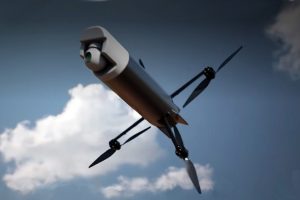
The Iron Wasp maintains the Viper-I architecture, however the front section is completely different, as it hosts a gimballed optronic sensor suite; no details were provided on sensors, but the guess is that it hosts a day/night suite to give the interceptor a 24 hours capability. The sensors have a wide field of view that allows detecting the incoming target and directing the Iron Wasp against it. The system maintains the man-on-the-loop, AI-based algorithms doing most of the job, the human being supervising the operation, being capable to eventually abort it, as reaction times are too short to allow a man-in-the-loop solution.
The front section containing sensors and electronics is followed by the warhead; this was defined to EDR On-Line as a “very unique solution” which was designed and produced in-house by Rafael, no more information being provided. What is clear is that the Iron Wasp does not rely on kinetic energy for neutralising the threat; considering that Rafael developed the Trophy, the experience acquired with that system might have been put to fruition in the development of the new warhead, with further improvements considering the yearly investment, around 10% of incomes, that the company puts in research and development.
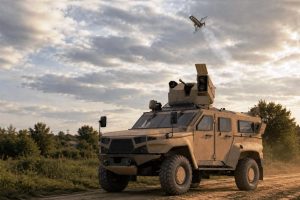
The Multi Canister Launch system adopted allows to easily integrate the Iron Wasp on armoured vehicles, generating a distributed C-UAS capability in a formation, providing some form of medium range sensor suite gives the platforms indication on incoming threats. The Iron Wasp is platform and sensor agnostic, and can be integrated on some categories of assets, such as artillery self-propelled howitzers, which seldom enjoy a protective umbrella.
Rafael is proposing a C-UAS suite installed on a 4×4 light armoured vehicle, which includes a radar, a remote weapon station armed with a ma chine gun and fitted with an optronic package, a command and control system, the whole package being known as Force Protector.
The Iron Wasp is available now, and in September Rafael is planning a live demonstration for international customers.
Images courtesy Rafael
