

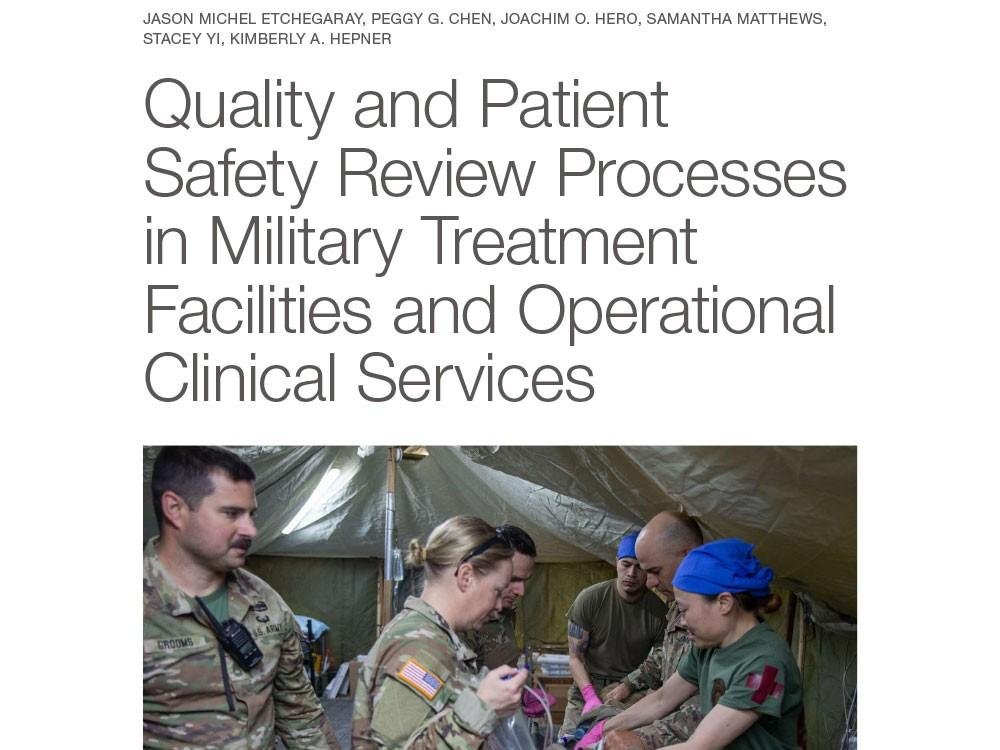
RAND researchers assessed the quality and patient safety review processes for care delivered in military treatment facilities (MTFs) and via operational clinical services (OCSs). MTFs are fixed or permanent medical facilities. OCSs are often provided in austere or operational environments that can be temporary, mobile, or permanent. OCS settings vary widely in their infrastructure and capabilities depending on the operational needs, resources, and location.
The authors conducted an assessment of seven quality and patient safety review processes: credentialing and privileging; quality assurance (QA), standard of care (SOC), and incident review; health care provider accountability; clinical quality metrics transparency; eliminating variation in clinical quality metrics; applying clinical quality management (CQM) to operational settings; and CQM organizational roles and responsibilities. They developed and deployed an internal assessment in which representatives from five U.S Department of Defense (DoD) organizations (the Assistant Secretary of Defense for Health Affairs; the Director of the Defense Health Agency [DHA]; and the Surgeons General of the Army, Navy, and Air Force) reported the ways in which they ensure that service members receive high-quality, safe care. The authors also conducted qualitative interviews with 216 personnel across 19 MTFs and OCS settings who had a role in either overseeing CQM processes or providing care.
Findings were used to identify potential opportunities for improvement. Recommendations included updating lists of active OCS settings, clarifying quality and patient safety requirements, and addressing institutional knowledge loss.
This publication is part of the RAND research report series. Research reports present research findings and objective analysis that address the challenges facing the public and private sectors. All RAND research reports undergo rigorous peer review to ensure high standards for research quality and objectivity.
This document and trademark(s) contained herein are protected by law. This representation of RAND intellectual property is provided for noncommercial use only. Unauthorized posting of this publication online is prohibited; linking directly to this product page is encouraged. Permission is required from RAND to reproduce, or reuse in another form, any of its research documents for commercial purposes. For information on reprint and reuse permissions, please visit www.rand.org/pubs/permissions.
RAND is a nonprofit institution that helps improve policy and decisionmaking through research and analysis. RAND’s publications do not necessarily reflect the opinions of its research clients and sponsors.
