

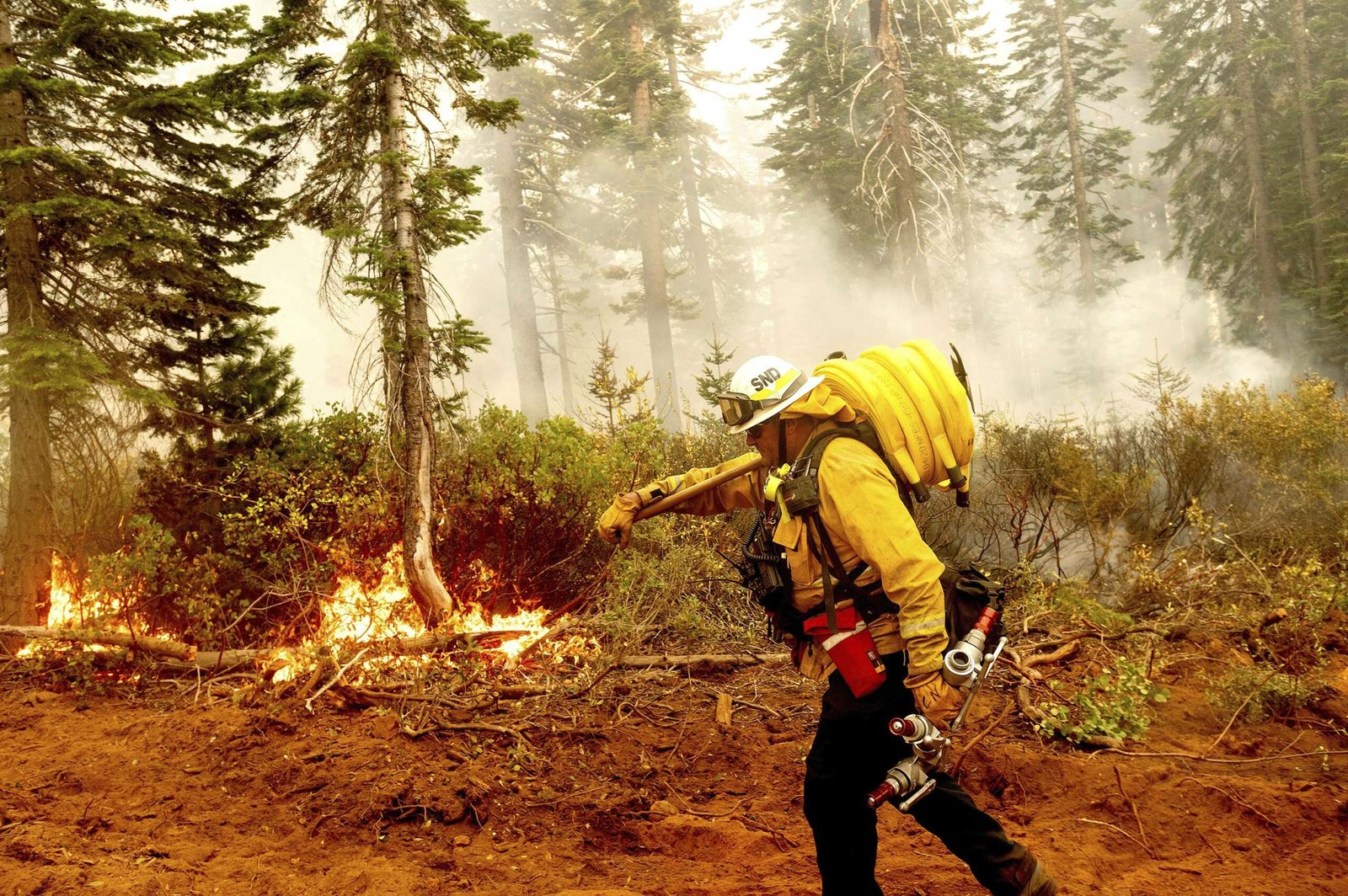
As the summer wildfire season gets underway, federal wildland firefighters are facing an increasingly difficult situation on the job.
About three out of four respondents to a recent survey of federal wildland firefighters said they have considered quitting within the past 12 months. Work-life balance was the most common reason respondents cited for considering quitting. Burnout and low pay were other frequently listed concerns.
Grassroots Wildland Firefighters conducted the employee survey in March 2026 in partnership with National Federation of Federal Employees, a union representing federal wildland firefighters. The survey received 825 responses from wildland firefighters across the Forest Service and the Interior Department.
“We were really surprised at how many people responded to the survey. I think that tells you they want their voices to be heard. They want to talk about the issues they’re facing. That’s indicative of a workforce that is struggling,” Riva Duncan, president of GWF and a retired firefighter, said in an interview with Federal News Network.
For years, federal wildland firefighters have faced excessive overtime, understaffing and inadequate pay and benefits, leading to frequent stress, burnout and low morale. A 2022 Government Accountability Office report found consistent recruitment and retention barriers including low pay, poor work-life balance, mental health challenges and limited career advancement opportunities.
But uncertainty from recent federal workforce reductions and agency reorganization efforts are intensifying long-time workforce challenges for wildland firefighters, Grassroots Wildland Firefighters said. Although the 2025 staffing reductions did not directly impact federal wildland firefighters, Duncan pointed out that separations across support roles, such as logistics and finance, still affected the frontline workforce.
“There is a massive machine working behind the scenes that a lot of the public doesn’t see,” Duncan said. “A lot of those folks who left supported the firefighters in behind-the-scenes positions that are essential to help firefighters do their jobs. That indirectly impacts everybody.”
The new survey results come just ahead of the 2026 summer wildfire season, which is expected to intensify in the coming months.
“What the data makes clear is that the current trajectory — declining unit preparedness, expanding overtime dependency, deteriorating morale and accelerating attrition — is not sustainable heading into the fire year that is already shaping up to be severe,” GWF wrote in a memo summarizing the survey results.
A spokesperson for the Interior Department’s Wildland Fire Service said the agency does not comment on external surveys, but added that the agency is committed to supporting its workforce.
“We are engaging with employees at all levels as we continue the phased implementation of the U.S. Wildland Fire Service,” the spokesperson said in an email to Federal News Network. “We welcome feedback from employees through established channels and value input that helps strengthen the organization and better support our workforce.”
An Agriculture Department spokesperson also said the agency does not comment on external surveys, “particularly when they address matters outside the scope of Forest Service operations.”
“What matters is whether firefighters have the resources, leadership and support they need heading into fire season — and they do,” the spokesperson told Federal News Network. “Rather than focusing on survey headlines, USDA is focused on results. We are ensuring firefighters are trained, equipped and positioned to respond to wildfires, protect communities and safeguard America’s forests. That is the standard by which this administration should be judged.”
As wildfire season approaches, wildland firefighter staffing levels are exceeding agency goals, the USDA spokesperson continued. More than 11,550 seasonal staff members have been hired for the 2026 fire year, hitting the agency’s staffing target earlier than any year since 2022.
“USDA has also implemented permanent firefighter pay reforms, strengthened career advancement opportunities and prioritized operational readiness across the agency,” the spokesperson said.
But many survey respondents still reported workforce shortages in their units. Close to two-thirds, about 62%, said their units are operating below “full strength” staffing levels. More than half said they had “inadequate staffing” during certain fire activities like extended attacks and mitigation actions. Close to 58% said they have seen their unit cancel or postpone a prescribed burn due to staffing issues.
“Uncertainty, very thin, everyone is doing so many jobs. We are spread very thin across a [large geographic area],” wrote one survey respondent, who has been working as a wildland firefighter for over 20 years. “We cannot honor commitments we made to our own people or to our partners.”
Federal wildland firefighters received a permanent pay raise in March 2025, solidifying a temporary boost from the 2021 infrastructure law. Many advocates have said the pay raise was critical to recruitment and retention of wildland firefighters. But some have said that lasting workforce improvements will require reforms beyond a pay increase.
For instance, many federal wildland firefighters are dealing with excessive overtime work, a longstanding challenge for the frontline workforce. Grassroots Wildland Firefighters said the overtime issues appear to have worsened more recently. About 82% of survey respondents said they worked more than 500 overtime hours in the past year. And about 24% said they worked over 1,000 overtime hours in a year, equating to an additional 25 full work weeks on top of their regular schedule.
The workforce challenges are affecting employee morale. About 11% of survey respondents said they would recommend a career as a wildland firefighter “without reservation,” while about 22% said they would not recommend the job at all.
“We don’t have as many experienced, qualified individuals as we used to because staying in fire doesn’t make sense anymore,” one survey respondent from the Forest Service wrote. “If you value time with your family, you have to leave.”
The Wildland Fire Service spokesperson the agency currently supports firefighters through various pay and benefits reforms, including through launching a wildland fire therapy initiative last year, as well as maintaining staffing levels that allow for granting requested time off.
“The health and safety of our wildland fire workforce is a top priority for U.S. Wildland Fire Service, and we will continue to strengthen and expand available resources,” the spokesperson said.
The survey results, however, also showed declining trust in agency leadership. Close to half of respondents, 47.8%, said they are dissatisfied with their agency, while 19.7% said they are satisfied. Analysis from the survey organizers noted that respondents from the Forest Service were “dramatically more dissatisfied,” showing lower trust in leadership than their counterparts at the Interior Department.
“Distrust is at an all-time high, leading everyone to an every-person-for-themselves mentality,” wrote one survey respondent, a firefighter at the Forest Service with more than 20 years of experience.
Some parts of the Forest Service are currently undergoing employee relocations, as part of USDA’s broader reorganization goals. About 500 Forest Service employees will be required to relocate, mostly moving out of the Washington, D.C., office, according to the agency.
The Forest Service has said moving its headquarters and creating a “state-based model” will bring senior leadership and other staffing closer to the geographical regions they serve.
“We support our employees, especially those who may be asked to move, and will help them make the best decisions for themselves and their families,” the Forest Service said on its website.
The relocations, however, will likely cause an exodus of at least some agency staff, leading to further challenges for federal wildland firefighters, Duncan warned.
“They’ve said they’re not going to get rid of positions, but a lot of those people aren’t going to be able to relocate. There are a lot of people who aren’t going to move,” Duncan said. “I think we’re going to see a further reduction in the support folks on the ground.”
The Interior Department is also embarking on a consolidation effort of its wildland firefighting programs. The consolidation will streamline and enhance response to wildfires, an agency spokesperson said, adding that the department’s current staffing of about 5,700 wildland fire personnel is comparable to previous years.
“Our firefighting capabilities remain fully in place, with no gap in response capacity,” the Wildland Fire Service spokesperson said.
Updated Monday evening with comments from the U.S. Wildland Fire Service, and updated Tuesday morning with comments from USDA.
If you would like to contact this reporter about recent changes in the federal government, please email drew.friedman@federalnewsnetwork.com or reach out on Signal at drewfriedman.11
Copyright
© 2026 Federal News Network. All rights reserved. This website is not intended for users located within the European Economic Area.
