

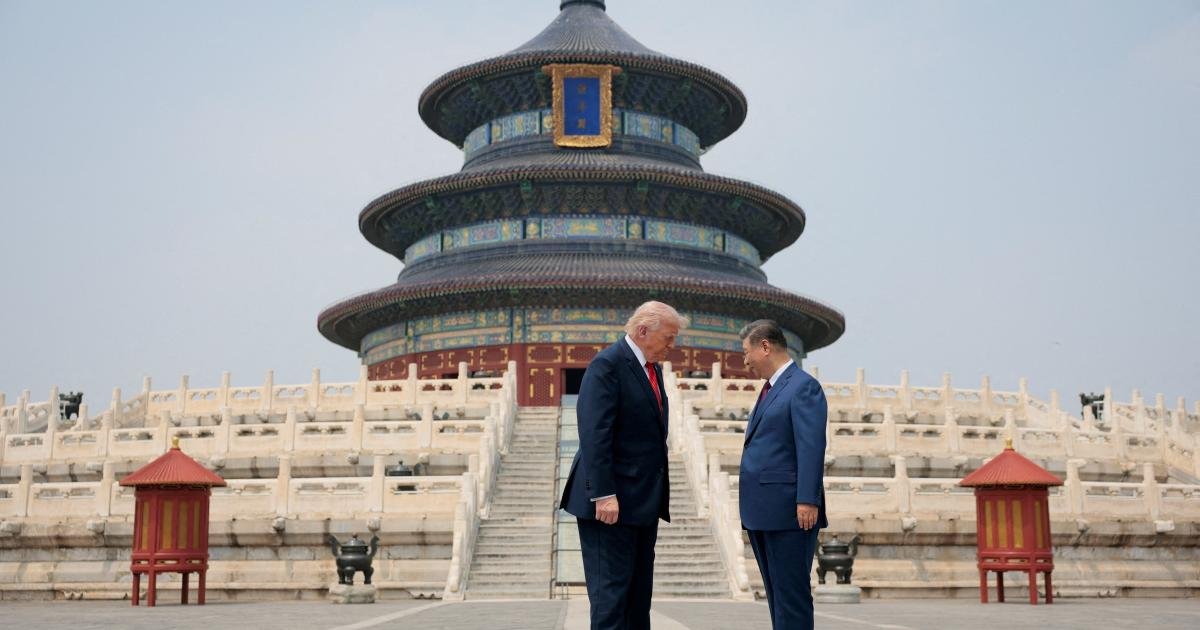
The governments of the United States and China both assert that theirs is the most important bilateral relationship in the world. They also agree that the likeliest trigger for an armed conflict between them is Taiwan. In theory, then, it should come as a relief that U.S. President Donald Trump and Chinese leader Xi Jinping discussed Taiwan at length in Beijing last month and that the leaders emerged with a better understanding of each other’s positions.
Yet the U.S.-Chinese summit was anything but reassuring. Rather, it represented Xi’s opening move in what will be a sustained effort to get the Trump administration to distance itself from Taiwan. Trump’s visit had barely begun when China released a statement that shared a warning Xi had imparted to Trump: if Taiwan “is handled properly, the bilateral relationship will enjoy overall stability,” but if it is not, “the two countries will have clashes and even conflicts, putting the entire relationship in great jeopardy.”
Xi intends to change what it means for Taiwan to be “handled properly” by the United States. Like his predecessors, Xi believes preventing Taiwan’s permanent separation is a core national interest and views its continued autonomy as evidence that China’s civil war remains unfinished. Unlike his predecessors, however, Xi appears to consider it essential to his legacy that he make tangible progress toward bringing Taiwan under China’s authority. At the beginning of his tenure, in 2013, Xi noted that the Taiwan question cannot continue to be passed on from generation to generation. He has since asserted that gaining control of Taiwan is central to China’s rejuvenation, a task that must be fulfilled by 2049, a century after the founding of the People’s Republic of China.
Although Xi has instructed his military to be ready to take Taiwan by 2027, his preference is to gain control of the island without firing a shot. Going to war, even against a weaker foe, is always hazardous, as Russia’s invasion of Ukraine and the United States’ military campaign against Iran make clear. If Xi invaded Taiwan and ended up in a protracted conflict, he would risk his power and legitimacy. And Xi knows that using force against Taiwan would come at the expense of economic development because the United States and its allies would, at the very minimum, respond by cutting China off from advanced technology and imposing crippling economic and financial sanctions.
Xi seems to have concluded that the surest path to securing control of Taiwan without a war runs through Trump, who has frequently criticized Taiwan and questioned the wisdom of defending the island. Xi’s influence was apparent in the days after the May summit, as Trump borrowed rhetoric from Beijing in statements about Taiwanese domestic politics and paused a pending arms sale to Taipei. Trump then repeated his claim that Taiwan stole the U.S. chip industry and said he did not want the United States to fight a war over Taiwan 9,500 miles away. His administration got the message. Secretary of Defense Pete Hegseth subsequently failed to mention Taiwan in his speech at the Shangri-La Dialogue in Singapore, the first time a U.S. defense secretary omitted Taiwan from such a speech in a decade.
What is motivating Trump’s comments and his dismissal of decades of U.S. policy on arms sales to Taiwan is unclear. It might be a belief that this is the best path to de-escalating tensions in the Taiwan Strait and avoiding an armed conflict. It could also reflect a conclusion that reducing support for Taiwan is a price worth paying for improved commercial access to China or a broader détente with Beijing.
The objective of China’s leader is far clearer. Xi is seeking to redefine what is considered normal in the United States’ approach to Taiwan. If China can bring about changes in U.S. policy that strengthen doubts regarding Washington’s reliability, doubts that have already gained ground because of the Trump administration’s general skepticism toward allies, many in Taiwan may conclude that they have no choice but to seek an accommodation on Beijing’s terms. Such a development would raise alarm throughout the region. U.S. allies would come to question the wisdom of putting their security in Washington’s hands, leading to a decisive shift in the balance of power in Beijing’s favor. American policymakers should recognize China’s strategy for what it is and stop giving ground on U.S. commitments to Taiwan—because for now, Xi is moving closer to the success he wants.
A NEW NORMAL
At the May summit in Beijing, Xi appeared to put two steps of his plan in motion. The first was to convince Trump that Taiwan is pursuing formal independence and that unless Washington reins in Taipei, such a move risks triggering a cycle of escalation that could lead to a U.S.-Chinese war. Xi’s words had the desired effect. In an interview with Fox News after the summit, Trump said that Taiwan has “somebody there now that wants to go independent” and that Taiwan’s leaders “want to get into a war and they figure they have the United States behind them.” Such statements are at odds with reality: Taiwan’s ruling Democratic Progressive Party is not pursuing independence and has responded with restraint to Chinese military provocations.
The next step, and a matter of more immediate concern, was to ensure that Trump did not approve a pending $14 billion arms package to Taiwan. Here, too, Xi made headway. Trump commented in the same interview that he was holding the arms package “in abeyance” and that he considered it a “very good negotiating chip.” Trump told reporters during the flight home from Beijing that he and Xi discussed arms sales “in great detail”—in contravention of a long-standing U.S. policy not to consult China on arms sales to Taiwan. The first Trump administration had reaffirmed that commitment, but now the president dismissed it when asked about it on the plane.
Even if the arms package moves forward in the end, the delay will have paid dividends for Beijing. China is less concerned about the delivery of specific weapons to Taiwan, especially given that the arms under review would not arrive on the island until years after the sale was approved. Rather, the intent behind getting Trump to withhold approval was to set a precedent that Washington would consult with Beijing on future arms sales and to sow doubts about the United States’ reliability, thereby undermining Taiwan’s resolve to defend itself and encouraging pro-Chinese politics on the island.
The U.S.-Chinese summit was anything but reassuring.
And now that Xi sees that Trump is willing to renegotiate decades-old elements of U.S. policy toward Taiwan, he will continue to press for concessions. He might, for instance, urge Trump to explicitly endorse Beijing’s view that Taiwan is a part of China, which would represent a fundamental shift in U.S. policy and undercut Taiwan’s international standing. Xi could press Washington to downgrade its security cooperation with Taiwan and even with Australia and the Philippines, which would further undermine deterrence. He could coax Trump to tell Japanese Prime Minister Sanae Takaichi to refrain from playing a role in cross-strait matters.
China is attempting to set new norms around how the United States handles Taiwan. By drawing Trump into making statements and taking actions that his predecessors have not, Xi is establishing a new baseline to which he will hold Trump and his successors if they want to have productive relations with Beijing in other areas. China could demand that future U.S. presidents issue similar warnings to Taiwanese leaders about independence and consult Beijing on arms sales as a cost of doing business. If future administrations decline to do so, China could use their refusal as a pretext for increasing its coercion of Taiwan and taking punitive actions against the United States. Call it linkage, Chinese-style.
In the meantime, Beijing is increasing its pressure on Taiwan. A few weeks after Xi’s summit with Trump, China launched what it called a “special maritime law enforcement operation” off Taiwan’s east coast in which its coast guard interfered with commercial shipping. The Chinese coast guard also entered prohibited waters near an island Taiwan controls in the South China Sea. With these two unprecedented actions, Beijing is aiming to assert its jurisdiction over Taiwan’s waters and set the foundation for a future quarantine of the island.
THINGS FALL APART
The concessions Xi is pushing Trump to make are designed to raise doubts about U.S. commitments to Taiwan, which in turn serves China’s goals of drawing Taiwan further into its orbit and weakening the United States’ regional alliance network. Most immediately, the damage to U.S. credibility threatens to undo important progress Taiwan has made in boosting its defenses. Taiwan’s defense budget has doubled in nominal terms over the last decade, now standing at 3.3 percent of GDP, and Taiwan is aiming for five percent of GDP by the end of the decade—the level of spending the Trump administration has demanded that NATO allies reach by 2035. In May, Taiwan’s legislature approved a $25 billion special defense budget to procure critical capabilities from the United States, such as air defense interceptors, surface-to-air missiles, and antitank and antiarmor missiles.
But if Taiwan can no longer trust that the United States will help it bolster its defenses through arms sales and potentially intervene on its behalf, Taiwanese politicians will have a harder time making the case that further spending will do much to help Taiwan deter or fight off a Chinese attack. According to a 2026 survey conducted in Taiwan, only 34 percent of respondents agreed that the United States “is a credible country.” This number had already declined by more than ten percentage points in the last five years, and Trump’s comments and vacillation on the arms sale could make it dip further. As confidence in Washington’s protection erodes, skeptical politicians will grow even more reluctant to fund defense budgets they consider ineffective. The argument for more accommodation of China will in turn gain traction. Beijing hopes to exploit this opening to push the opposition Kuomintang in a more overtly pro-Chinese direction and return a refashioned KMT to power in 2028.
Xi’s preference is to gain control of Taiwan without firing a shot.
The consequences of a reduction in U.S. support for Taiwan will not stop there. U.S. policy toward Taiwan is seen throughout the Indo-Pacific as a critical indicator of the strength of U.S. commitments. If Washington is willing to negotiate away its support for Taipei, other countries in the region will conclude that they can no longer count on the United States to ensure their security. Countries such as Japan and South Korea might embark on larger military buildups, contemplate acquiring nuclear weapons, and pursue a more autonomous foreign policy that does not necessarily align with U.S. interests. Most countries, however, would conclude that they had little choice but to accommodate Beijing’s preferences.
Either way, the alliance network that anchors the U.S. position in Asia and that remains Washington’s central advantage over Beijing would be severely damaged. Chinese influence would increase, potentially enabling Beijing to constrict U.S. trade and investment relationships in the region. The United States, facing a bolder China and without strong alliances to support it, would have to spend even more on defense to ensure its security.
Crucially, a perceived decline in U.S. support for Taiwan would make it harder for other countries to take steps to strengthen deterrence, further destabilizing the Taiwan Strait. In recent years, the United States has made significant progress in making Taiwan’s fate a matter of international concern. Bilateral statements with Australia, Japan, the Philippines, South Korea, the United Kingdom, and the European Union, as well as multilateral statements from the G-7, have highlighted the importance of preserving peace and stability in the Taiwan Strait. Washington has encouraged its allies and partners to deepen their cooperation with Taiwan and consider how they would contribute in the event of a conflict. These countries’ willingness to risk Beijing’s wrath depends on the assurance of Washington’s backing. If the United States downgrades its own commitments to Taiwan, they will reassess theirs, too.
REGAINING BALANCE
The United States has good reasons not to let China drive a wedge between Washington and Taipei. From a military perspective, Taiwan occupies a critical position along the first island chain, which stretches from Japan through Taiwan and the Philippines. If China were to gain control of Taiwan, it would have a much easier time projecting power in the Pacific Ocean and threatening U.S. territory, and the United States would struggle to defend its treaty allies, above all Japan and the Philippines, from Chinese aggression. China would be able to control the sea-lanes that Japan relies on for energy and food, giving Beijing inordinate leverage over Tokyo. And after Russia’s invasion and attempted conquest of Ukraine, a Chinese attack that resulted in the annexation of Taiwan would further weaken the global norm against changing the status quo by force. More countries would be emboldened to pursue revanchist claims, resulting in a world of even greater chaos.
Allowing Taiwan to fall under Chinese control would also be a devastating blow for liberal democracy. The Taiwanese people have built one of Asia’s strongest democracies despite facing an existential threat from a far more powerful authoritarian neighbor and operating largely in isolation from other countries. Taiwan stands as an example to China’s citizens that a majority ethnic Chinese society can thrive as a democracy. Extinguishing it would have a chilling effect on democratic aspirations not just in the region but around the world.
A conflict over Taiwan would be economically devastating, too. According to Bloomberg, such a war would shave $10 trillion off global output, a shock greater than the COVID-19 pandemic. This is largely because Taiwan produces the vast majority of the world’s most advanced semiconductors, which are needed for everything from smartphones to computers, weapons, and artificial intelligence servers. But chip production is not all that makes Taiwan central to the global economy. The entire AI supply chain runs through Taiwan and is supported by an ecosystem of hundreds of Taiwanese companies. Because of this, Taiwan is now the United States’ fourth-largest trading partner; the United States imports more from Taiwan than it does from China. Although Washington is seeking to reshore semiconductor production, Taiwan will be a crucial economic partner for the foreseeable future. The most advanced chips produced in the United States today still need to be shipped to Taiwan for post-processing. Even if reshoring is wildly successful, the bulk of the world’s most advanced chips will be produced in Taiwan for many years to come.
A worst-case scenario becomes more likely if China succeeds in its attempts to establish new norms for how the United States approaches Taiwan. But Washington can still disrupt Beijing’s strategy and undo the damage from Trump’s comments on Taiwan and his decision to pause arms sales. The first task is to approve the arms package. Xi may respond by canceling his September visit to Washington, but that would be a price well worth paying if he comes away understanding that Taiwan is not his for the taking.
For now, Xi is moving closer to the success he wants.
To ease the doubts about the U.S. commitment to Taiwan that Trump has sown will require more than new arms sales, however. The Trump administration needs to take further action to deter Chinese aggression, such as by helping Taiwan develop its domestic defense industry through joint ventures and technology transfers. Taiwan needs to invest now to ensure that it can quickly scale up production during a crisis, when resupplying the island will be enormously difficult. It needs U.S. help to do so.
Just as important, Washington should send a strong signal that it is committed to Taiwan’s protection and expects its partners to contribute to a U.S.-led defense. President Joe Biden made such a public commitment on four separate occasions, endorsing what we termed “strategic clarity” in Foreign Affairs in 2020. Although senior officials unfortunately walked back the president’s comments, what is notable is that Biden’s statements did not spark a crisis in U.S. relations with China. On the contrary, they might well have discouraged Beijing from testing U.S. will.
Making such a commitment credible today requires that the United States maintain sufficient military power in the region and that its forces are positioned to respond in a Taiwan contingency. It also requires that Washington push back against China’s attempts to assert its jurisdiction over Taiwan, such as by pursuing greater cooperation with Taiwan’s coast guard.
At the same time, the United States should make clear to China that it is not looking for a confrontation. It should reassure Beijing that Washington does not support Taiwan’s independence, that it continues to adhere to its “one China” policy, and that it would support any resolution of cross-strait differences that enjoys the consent of the Taiwanese people.
The United States has deterred Chinese aggression against Taiwan for decades and can continue to do so. The difficulty China’s military faces in launching an amphibious invasion, Taiwan’s defensive advantages, the United States’ upper hand in undersea warfare, and the combined power of allied forces all work in Washington’s favor—as long as the United States is seen as trustworthy by its partners, especially Taiwan and Japan.
But now, Washington must also hold off another line of attack from Beijing. An increasingly powerful, confident, and assertive China is attempting to squeeze Taiwan by persuading Washington to back away from Taipei one step at a time, beginning with delaying or canceling proposed arms sales. It is up to the Trump administration to stop playing into Xi’s hands—and to recognize that the surest way to prevent a conflict in the Taiwan Strait or a costly Chinese takeover of the island is to leave Beijing in no doubt about the United States’ commitment to Taiwan.
Loading…
