

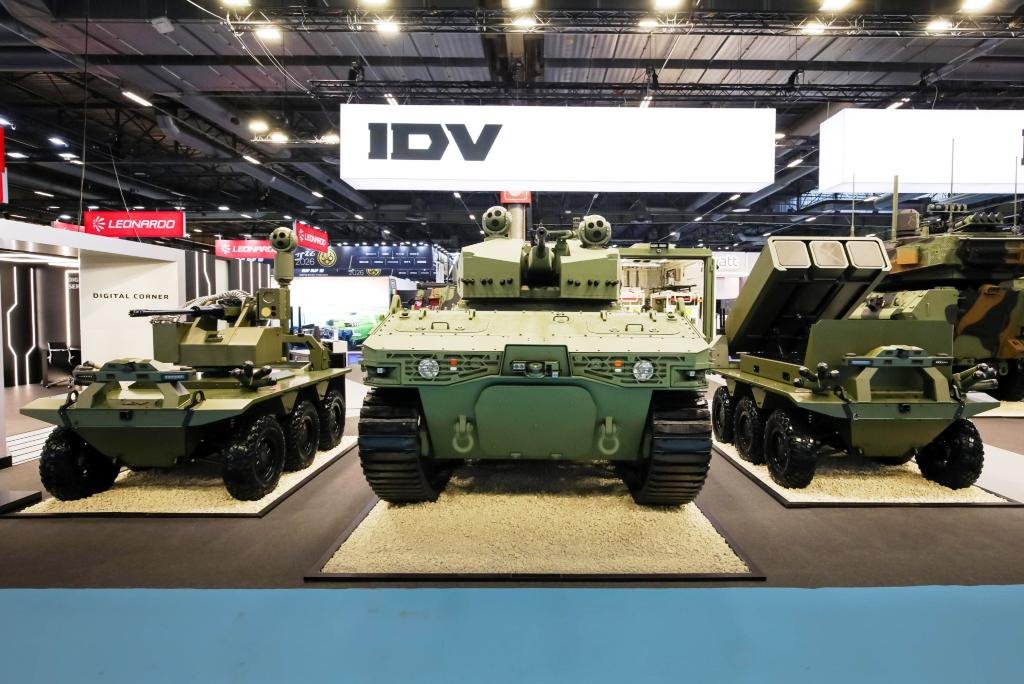
IDV, which was recently acquired by Leonardo, unveiled a tracked uncrewed ground vehicle (UGV) and showcased a deeply modified wheeled one at Eurosatory 2026. After acquiring the UGV division of Horiba Mira, in early 2023, the Italian company has invested in robotics, its CEO detailing the company approach to the UGV issue at the Paris exhibition
“This presentation marks a new chapter of the life of IDV as a Leonardo company. We started our technology roadmap on UGVs some years ago,” Claudio Catalano, the IDV CEO stated at the press conference. Originally a tactical vehicle manufacturer, IDV decided to enter the UGV field for three main reasons. “First of all, life protection, second, because we think it’s a force multiplier, and third, we deeply think that uncrewed technologies will change the operational conduct in the next years,” Catalano underlined.
In these few years IDV understood that the platform is not the focus of the UGV business, the focus is the mission, and this led to the development of some technology bricks capable to evolve with time to exploit technological advancements. “The first of those technology pillar is what we call MACE, for Modular Autonomy Controlled Equipment. It is the hardware that we developed internally, which is providing edge computing that allows to control the vehicle. Microprocessors are continually evolving, so we need to have this component as a make component, not as a buy component, because if we want to remain always in the leading edge of technology, we have to control the computing capabilities. The second is artificial intelligence algorithms. Military UGVs work in an unstructured environment. We don’t have traffic lights and lanes, we have forests, snow covered fields,” Catalano said. By deviating a river the enemy can completely change the situation, compared to the one existing when planning the mission, the CEO underlined, adding that technologies allowing to rapidly detect the environment and re-plan the mission must be rapidly developed. Edge computing is also needed to add modularity, allowing to expand sensing adding more and higher resolution cameras, LIDARs, and other sensors, leading to the need to perform sensor fusion.
“Another pillar technological pillar for us is what we call ATLAS. This software allows post-processing images of cameras to detect the surrounding environments and geolocalize the vehicles when we are in GNSS-denied navigation or when we have to be really stealth, which means that, for example, a LIDAR can be detected,” Catalano explained.
Understanding mobility challenges is key to control the vehicle, the platform dynamics depending on its architecture, tracked, wheeled, number of axles; the computer needs to recognise the vehicle as well as formable terrain physics, as this can be impacted by weather conditions, all this making the development of UGVs for defence applications really challenging.
Last but not least come drive-by-wire systems. Designing them for native uncrewed platforms is relatively straightforward, “However we must be able to develop them also to be implemented on existing platforms, which are fully analogue and were designed to be driven by a soldier,” the IDV CEO said, adding that “Without this whole set of technologies, we cannot develop an uncrewed vehicle.”
The deep involvement of IDV in the uncrewed vehicles business was highlighted by the presence on the Bolzano company booth of three UGVs; two were Viking 2.4, the latest iteration of the 6×6 wheeled UGV, fitted respectively with a Leonardo Hitrole C-UAS remotely controlled weapon station, and with a triple-canister surface launched Brimstone, and the new CL2X, the 16 tonnes tracked platform fitted with a Leonardo Hitfist 30 UL turret, those systems being detailed in separate articles.
Photos courtesy IDV and P. Valpolini
