

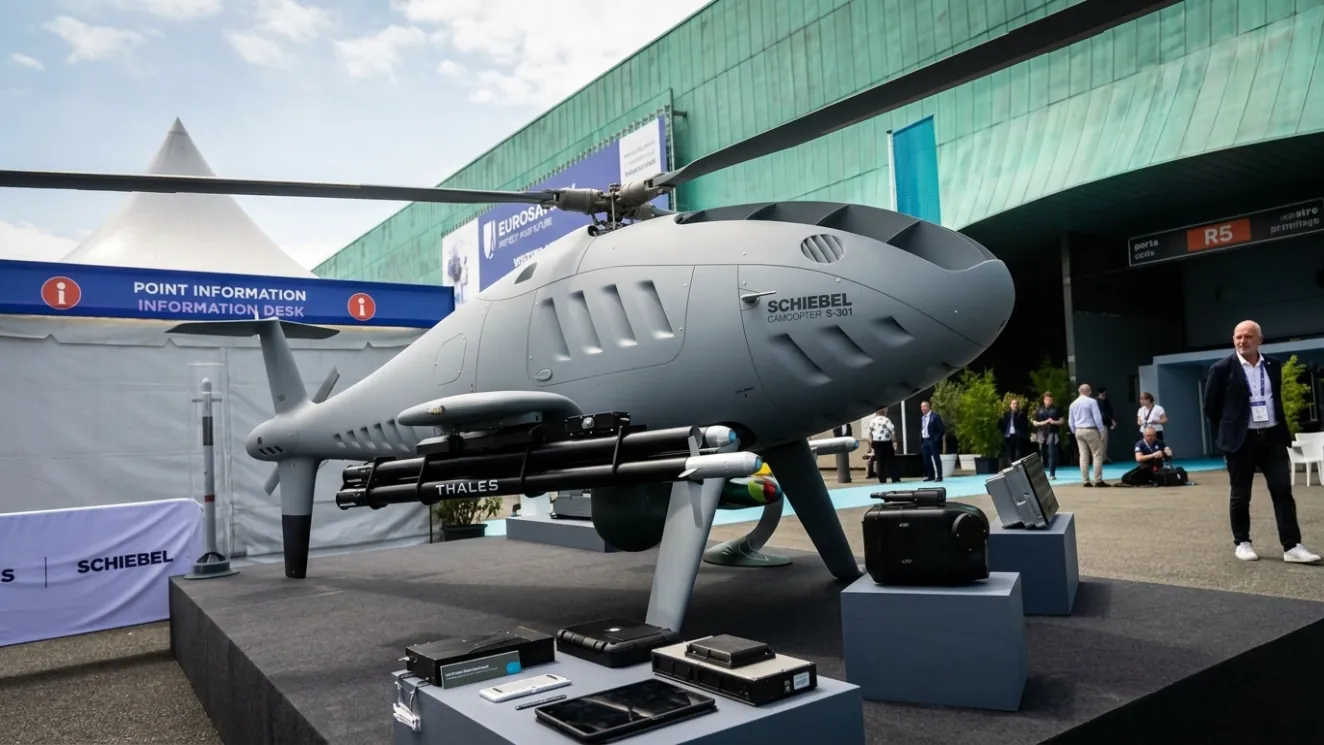
Defense Feeds, Paris. The Camcopter S-301 armed VTOL drone was unveiled at Eurosatory 2026 with a significantly expanded mission profile, demonstrating how unmanned aerial systems are evolving beyond surveillance roles into multi-mission strike platforms.
Developed by Austrian company Schiebel, the latest configuration integrates Toutatis loitering munitions and guided rocket systems, allowing the aircraft to conduct reconnaissance, target acquisition and precision engagement missions from a single platform.
The development reflects broader changes across the defense sector as militaries seek unmanned systems capable of delivering both intelligence and combat effects without exposing manned aircraft to risk.
Schiebel Expands the Camcopter Into a Multi-Role Combat Platform
For years, the Camcopter family has been recognized primarily for intelligence, surveillance and reconnaissance missions. The aircraft has been deployed by military and maritime operators worldwide due to its vertical takeoff and landing capability, compact footprint and ability to operate without conventional runways.
The latest evolution takes the platform a step further by adding offensive capabilities. The integration of loitering munitions and guided rockets enables operators to identify, track and engage targets using a single unmanned system, reducing the need to coordinate separate reconnaissance and strike assets.
This approach mirrors lessons emerging from recent conflicts, where armed drones have proven highly effective in locating targets and rapidly delivering precision effects. Modern military forces increasingly value platforms capable of shortening the sensor-to-shooter cycle and responding quickly to battlefield developments.
By combining reconnaissance and strike functions, the new configuration offers commanders greater flexibility while reducing operational complexity.
Loitering Munitions and Guided Rockets Enhance Battlefield Reach
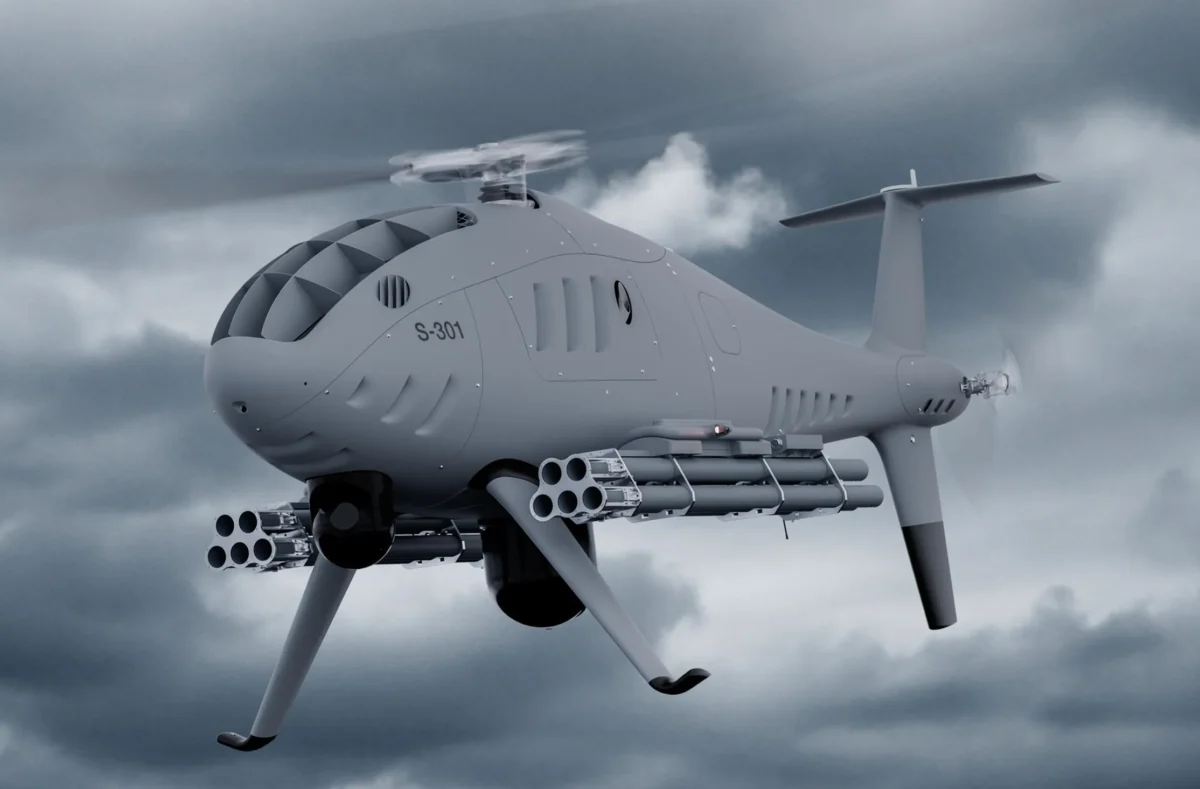
A key feature of the Camcopter S-301 armed VTOL drone is its ability to deploy the Toutatis loitering munition. Loitering munitions have become a major focus of military procurement programs because they combine surveillance and precision strike capabilities within a single weapon system.
Once launched, these weapons can remain airborne while searching for targets before conducting precision attacks when opportunities emerge. This capability provides operators with increased flexibility against time-sensitive targets.
The addition of guided rockets further broadens the drone’s operational utility. Guided munitions allow operators to engage targets with greater precision while minimizing collateral damage. Combined with onboard sensors and targeting systems, the aircraft can support a wide range of missions including battlefield reconnaissance, force protection and precision engagement operations.
Another advantage of the VTOL design is operational flexibility. Unlike many fixed-wing drones, the Camcopter can launch and recover from confined locations, including naval vessels, forward operating bases and austere environments. This feature expands deployment options and supports expeditionary operations where infrastructure may be limited.
The combination of endurance, mobility and strike capability positions the platform as a versatile solution for military forces seeking adaptable unmanned systems.
Strategic Implications for Future Drone Warfare
The Camcopter S-301 armed VTOL drone reflects a broader transformation in how militaries view unmanned aircraft. Rather than operating solely as intelligence-gathering assets, drones are increasingly expected to deliver direct battlefield effects while maintaining persistent surveillance coverage.
The growing popularity of loitering munitions has accelerated this trend. Armed forces are seeking systems capable of conducting reconnaissance, identifying targets and engaging threats without requiring additional strike platforms. This integrated approach improves responsiveness and increases operational efficiency.
For naval and expeditionary forces, VTOL drones offer particular advantages because they can operate from ships and remote locations without dedicated runways. As military operations become increasingly distributed, these capabilities are expected to play a larger role in future force structures.
The system’s debut at Eurosatory also highlights rising demand for modular unmanned platforms that can adapt to different mission requirements. Flexibility is becoming a critical factor as defense planners seek solutions capable of addressing diverse operational scenarios.
By integrating loitering munitions and guided rockets into an established VTOL platform, Schiebel has positioned the Camcopter S-301 to compete in one of the fastest-growing segments of the defense market.
The result is a platform that combines persistent surveillance, rapid response and precision strike capability, illustrating how the boundaries between reconnaissance drones and combat systems continue to blur on the modern battlefield.
