

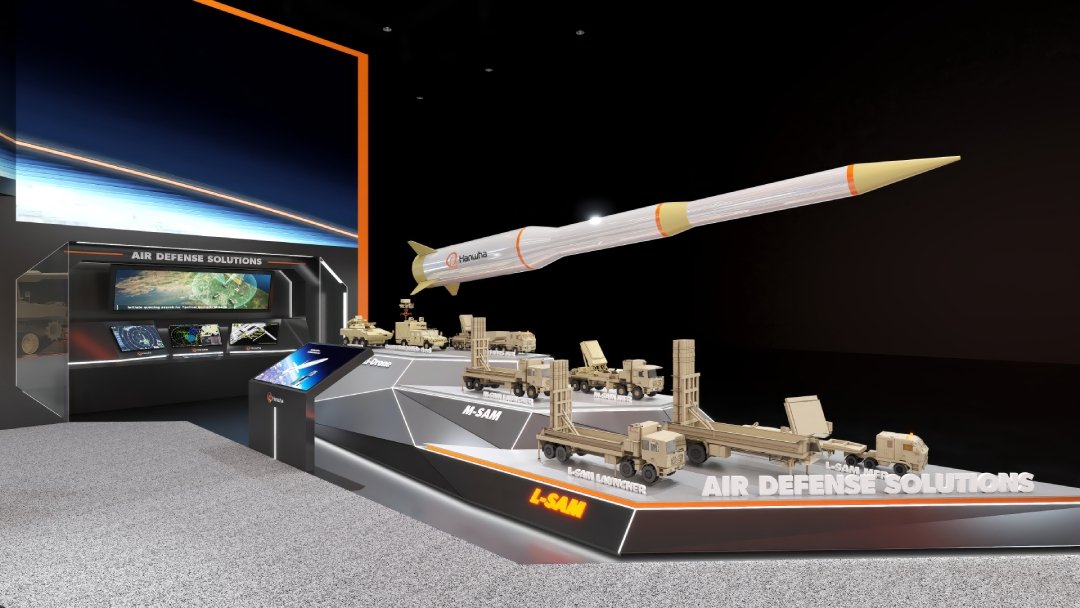

How Hanwha’s L-SAM could become a viable complement within Europe’s evolving layered defence network.
The global demand for advanced air defence systems is increasing at an unprecedented pace due to the overwhelming threat posed by predominantly UAS and ballistic missiles as major deep-strike attack assets. In light of the current security environment in Ukraine and the Middle East, multi-layered and highly reliable air defence systems are increasingly becoming a strategic requirement across Europe and NATO. The overall aerial threat environment has evolved far beyond conventional fixed- and rotary-wing aircraft, creating an increasingly complex and layered battlespace.
However, although various air defence systems are already in service among European nations, the available quantity remains far too limited to defend critical infrastructure, military key terrain and — as seen in Ukraine — civilian living areas. In addition, a huge quantity of Western air defence capabilities has already been donated to Ukraine in order to strengthen its air defence power.
As also seen in other military domains such as ammunition and indirect fires capabilities, the high level of demand for air defence systems and effectors cannot currently be satisfied in terms of both lead time and production quantity. Delivery times for additional batteries of already in-service air defence systems often require five to seven years. This is far too long to fulfil the strategy of achieving “Kriegstüchtigkeit” (war readiness) against a potential Russian attack on NATO soil by 2029.
This growing capability gap is increasingly forcing European nations to consider additional international partners and new approaches to air and missile defence procurement. These discussions are becoming particularly relevant within the framework of the European Sky Shield Initiative (ESSI), led by Germany and aimed at strengthening Europe’s layered air and missile defence architecture.
Even though ESSI was launched in 2022 and several air defence layers have already been identified, not every interception layer is fully covered. A critical gap still remains in the interception layer at altitudes between approximately 40–100 km.
This altitude band represents one of the most challenging engagement zones for ballistic missile defence and remains insufficiently covered by currently available European solutions.
The current reliance on systems such as Patriot (PAC-3) and THAAD presents structural challenges, including supply bottlenecks driven by high global demand and dependence on a limited number of external suppliers.

Filling a Critical Gap in Europe’s Layered Defence Network
In this context, South Korea’s emerging air defence capabilities — and particularly Hanwha’s L-SAM — are increasingly attracting attention as a potential complementary solution.
Hanwha is recognized as a global champion within the air defence domain. For decades, the company has offered V-SHORAD cannon-based solutions, C-UAS high-energy laser-based systems, as well as missile-based air defence systems. Hanwha’s major expertise and recognition come from its in-house missile and radar technologies.
L-SAM is a long-range surface-to-air and missile defence system designed to strengthen the upper layer of a multi-layered air and missile defence architecture. Within the European context, L-SAM is positioned to address a capability gap between Patriot PAC-3 and Arrow 3.
While Patriot provides proven lower-tier ballistic missile defence and Arrow 3 is focused on exo-atmospheric interception, L-SAM is positioned to cover the intermediate high-altitude interception layer, particularly against ballistic missile threats.
The system has completed its development in the Republic of Korea and is expected to enter service with the Korean Armed Forces. This provides an important reference point for European customers: L-SAM is not a conceptual future programme, but a mature Korean air and missile defence capability moving towards operational deployment.
At fire-unit level, L-SAM is designed to provide autonomous engagement capability while remaining interoperable with higher-level air defence and command-and-control networks. Its system architecture includes a multifunction radar, engagement control element, launchers, interceptors, communication equipment, and associated support assets.
For Europe, L-SAM should be understood as a complementary capability rather than a replacement for existing systems. It can strengthen the European Sky Shield Initiative by adding an additional interception layer between currently available solutions, thereby improving resilience against increasingly complex aerial and ballistic missile threats.
Hanwha’s long-term approach is to pursue the Europeanization of L-SAM through cooperation with European partners. This may include integration with European command-and-control systems, industrial participation, local assembly, sustainment, and the possible incorporation of European subsystems where appropriate. In this context, L-SAM represents not only an additional air defence system, but also a strategic option to close a defined capability gap within Europe’s future layered air and missile defence architecture.

Deliverability, Affordability and Industrial Cooperation
L-SAM offers a credible and complementary solution. The system’s capability profile is designed to provide high-altitude interception capability against advanced aerial threats and ballistic missiles within a layered defence architecture.
Hanwha believes that L-SAM can offer cost advantages of more than 20% compared with comparable systems, while maintaining a competitive balance of capability, affordability and availability. This combination of performance, availability and industrial flexibility is increasingly relevant for European nations seeking to accelerate the strengthening of their air and missile defence capabilities.
Further, L-SAM and its predecessor M-SAM (medium-range) are recognized as proven and deliverable systems. Korea has demonstrated rapid and reliable delivery of advanced systems under real demand conditions.
In addition, Hanwha’s L-SAM air defence system can be localized in Europe, while European subsystems can also be integrated. Ongoing discussions with European partners regarding integration into command and control systems are already taking place. Hanwha’s long-term objective is the full Europeanization of L-SAM, including local industrial participation. In this context, L-SAM is not merely an option — it is a strategic solution to a clearly identified gap within ESSI.
