

China is suffering from enormous waste. For decades, government officials have built grand, showy projects that prioritize size and appearance over practicality, cost-effectiveness, and sustainability. Projects such as sprawling but underused airports, oversized but empty exhibition centers, and futuristic technology zones disconnected from industrial needs have proliferated in virtually every sector in which the state has tried to encourage development. Officials have pursued these highly visible projects to impress their superiors and showcase their achievements, but in doing so they often take away resources from less glamorous but more effective development initiatives, ultimately holding back China’s growth.
Chinese leader Xi Jinping is aware of the severity of this problem and has ramped up efforts to stop it. Since 2025, Xi has repeatedly warned local officials not to waste resources on such visibility projects. In a major speech in February 2026, for example, Xi stressed the importance of properly assessing officials’ performance and called out politicians who pursued visibility projects as examples of people holding an “incorrect view of political achievements.” He has also pushed for training sessions that teach party cadres to focus on genuine sources of development and declared that serious misallocations of resources for visibility projects could result in warnings or even expulsion from the party.
These efforts are well founded. But they are also futile. The Chinese Communist Party has long been aware of this type of waste and even launched an explicit campaign against it as far back as 2014, when Beijing announced that it had halted more than 600 visibility projects and punished more than 400 officials for their involvement. Xi cannot stop visibility projects from recurring because they are a feature of China’s political system, not a bug. The country’s top-down system of control encourages local governments to direct resources away from the invisible but important foundations of sustainable development to projects that are designed to show off for higher-ups in the CCP. China’s political system is stuck in a visibility trap that makes the country’s development look far more spectacular than it really is.
Despite the widespread belief that Beijing’s authoritarian political control allows it to avoid short-term thinking, the unstoppable expansion of visibility projects shows that this is not always the case. Whenever Beijing pursues a goal, such as its current aim of becoming a global leader in science and technology, it creates new areas in which wasteful projects proliferate. As China’s economy slows and local government budgets shrink, the strain of visibility projects is growing more severe. China has little money left to waste—but its political system continues to push officials to spend in all the wrong places.
HASTE AND WASTE
Unlike standard development projects, which seek long-term economic and social benefits, visibility projects are designed primarily to increase the political profile of the official who pushes for them. Their target audience is higher-ups in China’s massive party-state bureaucracy rather than the public or investors. Because resources are limited, officials often pursue visibility projects at the expense of less visible projects that could be more sustainable or efficient.
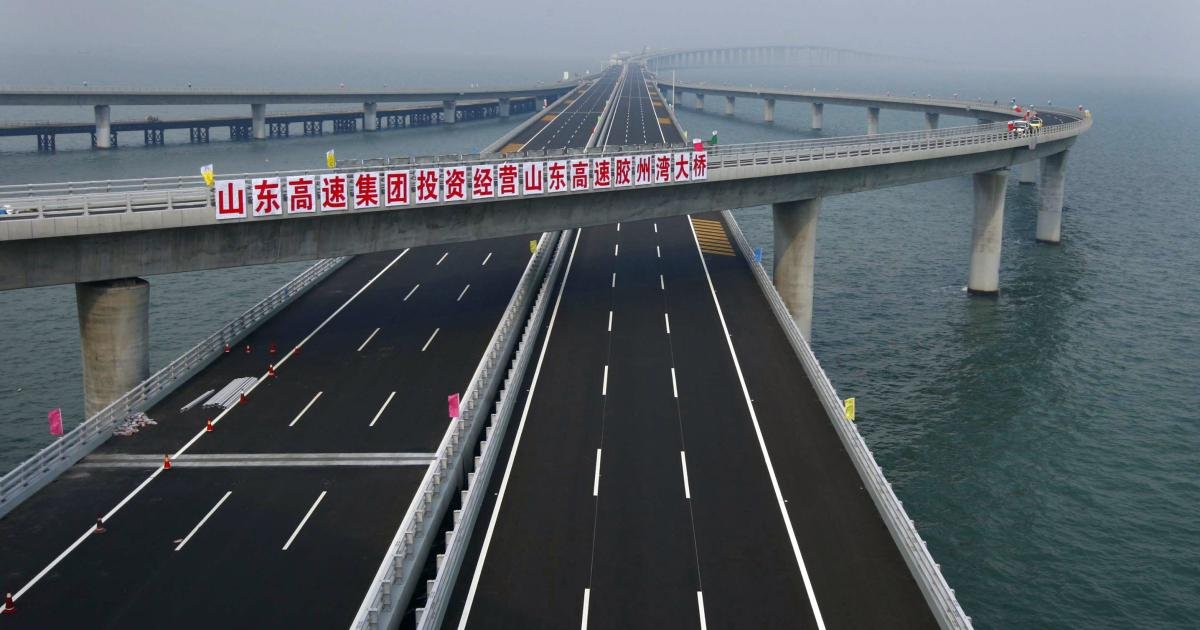
One of the most memorable examples of visibility projects involved urban planning. The city of Qingdao, which is home to China’s third-largest port, needed a way to connect two urban districts on either side of the inlet to the bay on which it sits. In 2000, Qingdao’s mayor, Du Shicheng, faced a choice between building a bridge over the bay or a tunnel underneath it. Urban planners favored a tunnel: a bridge that would not interfere with cargo ships going to and from the port would have to be built across the center of the bay, not at its mouth, and would therefore have to be long, costly to build, and exposed to harsh wind, snow, and ice that would limit its use during winter. A bridge would also be significantly more expensive to maintain than a tunnel.
But a bridge would be highly visible, reshape the city’s skyline, and offer a more powerful signal to higher-ups that Du had left a major mark on the city. Ultimately, Qingdao built both—the tunnel cost about $470 million, and the bridge about $1.6 billion. Today, the city is adding a second tunnel because of heavy traffic, while the bridge operates at a loss because of insufficient use.
Visibility projects are a feature of China’s political system, not a bug.
Qingdao was fortunate: despite Du’s insistence on building a bridge, the city still got the tunnel that it needed. In many other cases, however, visibility projects displace essential development projects. In 15 cities across China that I traveled to for research from 2015 to 2019, city governments prioritized highly visible wastewater treatment plants over the underground pipe systems that make them work. Cities need sewage pipes to collect wastewater to send to treatment plants, and they need underground drainage systems to prevent flooding during heavy rains. Without these, the expensive treatment facilities that the cities had built to showcase their water management efforts were operating below capacity, while pollution was flowing into rivers and lakes, and cities remained vulnerable to devastating floods. Similarly, when Beijing emphasized the importance of modernizing solid waste treatment in the first decade of the 2000s, local officials focused on building state-of-the-art incineration plants while neglecting recycling, which is an invisible prerequisite that makes modern incineration more sanitary.
Even the tech sector suffers from the visibility trap. Chinese leaders have made it a national priority to reduce dependence on foreign technology and promote domestic innovation. Local officials, including those in jurisdictions unprepared for high-tech manufacturing, have seized on the opportunity. In multiple inland localities that lack an educated workforce, efficient logistics, or the supporting infrastructure needed for artificial intelligence or robotics manufacturing, local governments have launched gimmicky “AI tourism towns,” where robots dance and chat with tourists, or they have built theme parks decorated with robot statues. Such investments do little to promote the industry. Instead, they siphon resources away from the slow, invisible work essential to real innovation: research, manufacturing capacity, and education.
THE VISIBILITY TRAP
Local officials pursue visibility projects despite their obvious drawbacks because China’s political system incentivizes both competence and loyalty. The CCP relies on annual quantitative evaluations to assess the performance of its cadres, which is part of what determines whether they will be promoted, demoted, or receive a bonus. At the beginning of each year, higher-level authorities assign lower-level officials a long list of measurable targets such as GDP growth, the unemployment rate, environmental pollution levels, or a maximum number of protests. At the end of the year, higher-level officials evaluate their subordinates according to whether they have met these targets.
Similar to other systems that tie quantitative indicators to individual outcomes, China’s quantitative evaluation metrics encourage manipulation. Officials try to game the results, selectively implement policies, and even alter data to make themselves look more successful and to either garner rewards or avoid punishment. This system generates anxiety among officials who are competing to produce the best possible numbers. When many officials can present excellent scorecards because of their ability to work the system to their advantage, those who want to stand out among their peers are driven to find additional ways—such as visibility projects—to signal their competence.
Visibility projects in China tend to be bigger, more widely occurring, and more likely to be abandoned.
The CCP’s paramount demand of loyalty also encourages waste. Local officials cannot launch projects that fall outside the party’s priorities even if such projects are technically sound or would generate significant development. But pursuing visibility projects that reflect the party’s current agenda signals both competence and loyalty. As a result, visibility projects are especially likely to emerge when Beijing announces new policy directives. Responding to these directives with new big-ticket projects is politically safe for officials because it demonstrates that they want to promote the party’s priorities, and they have room for creativity and flexibility because Beijing has often not yet developed clear measures of success or standards for implementation.
But the need to show loyalty funnels competition between officials into narrow policy areas that can easily become overly crowded and unprofitable, and the ambiguity that new policies produce about what constitutes success encourages officials to stand out by trying to build bigger, faster, and more visibly than their peers. Beijing struggles to stop visibility projects in new policy areas because it takes time to learn which projects are useful, which are wasteful, and which indicators can measure real progress. By the time Chinese leaders understand the policy terrain enough to regulate it, local officials have already moved on to the next policy frontier and have started a new round of wasteful projects with which they can leave their mark.
This cat-and-mouse dynamic is a recurring feature of China’s development in the modern era. In the 1990s and the first decade of the twenty-first century, many visibility projects took the form of large construction efforts: towering government buildings, expansive bridges, massive airports, and sprawling development zones. Many were underused, demolished soon after construction, or never used to capacity. When Beijing began to recognize this waste and restrict these developments, in 2014, officials had already moved on to new ways to signal success. Beijing wanted renewable energy; officials built many wind and solar facilities, but they often could not be connected to the electric grid. Beijing wanted food security; officials forcibly uprooted farmers’ cash crops to plant rice and wheat, destroying livelihoods without meaningfully increasing grain production. More recently, with China’s leaders promoting high-tech sectors, local officials have shifted their focus to electric vehicles, robotics, artificial intelligence, and smart factories. In these sectors, waste appears not only as unused physical infrastructure but also as overcapacity, failed firms, and stranded assets.
WASTE WITH CHINESE CHARACTERISTICS
Visibility projects are not unique to China. Politicians in democracies frequently pursue pork barrel projects to show their constituents that they are delivering benefits or so-called white elephants that look showy but rarely pay for themselves. But visibility projects in China’s top-down system tend to be bigger, more widely occurring, and more likely to be abandoned, leaving behind even greater amounts of waste.
In democracies, visibility projects are usually designed to win votes, reward constituencies, or build legislative coalitions. Politicians may support an inefficient factory to preserve local jobs, a so-called bridge to nowhere that serves a town of only a handful of people, or a hospital without sufficient supplies to keep it running. But there are often limits. Projects that have little public benefit frequently backfire when voters think their elected officials are wasting taxpayer money. After politicians in Alaska tried to earmark federal funds to build a bridge to an island of 50 people, for example, it met such fierce criticism in the press and national resistance that the earmarks were removed and the project was eventually canceled. But in China, such projects can and do flourish because what matters is whether a higher-level leader likes them, not whether citizens benefit. And even when Chinese citizens push back, they have fewer institutional channels through which they can punish wasteful officials than voters in democracies do.
Democratic visibility projects are also smaller in scale: they only need to be visible enough to signal responsiveness to local voters. A standard bridge, hospital, or road may be sufficient. Visibility projects in China, by contrast, tend to be more costly because officials are competing against their peers in other jurisdictions to stand out in the eyes of the same set of political elites. They have strong incentives to make projects visually spectacular, even when the additional scale adds little practical value. It has to be a bridge with record-breaking span, a state-of-the-art hospital, or an eight-lane highway, regardless of whether local conditions make such projects worthwhile.
Chinese visibility projects also tend to be more short-lived than comparable projects in democracies. This is primarily because China’s personnel system gives officials weak incentives to maintain projects launched by their predecessors. The party tends to reassign local leaders to a new location every three to four years, on average, to prevent them from building their own power base in any one jurisdiction. But new officials cannot claim credit for inherited projects. Officials who know they will be transferred to a new location in just a few years want to launch projects quickly and claim visible credit within their short tenure, often without much thought to how to maintain a project after they leave or whether it will be viable in the long term. Democracies do not eliminate these incentives. But electoral competition, party accountability, media scrutiny, and civil society oversight can raise the political cost of abandoning public investments.
Many national projects in China have faltered because of this mismatch between the incentives to launch projects and those needed to sustain them. In northern China, for example, the government has been carrying out a decades-long program to plant trees to control the expansion of the Gobi Desert. Ambitious local officials planted monocultures of fast-growing poplar trees rather than slower-growing native shrubs. Once politicians took credit for the new and impressive forests they had created and moved on to different locales, however, their successors put little effort into managing the poplar trees, which require more maintenance than native vegetation. Eventually, these poorly conceived forests fell victim to pests and disease, resulting in the premature death of thousands of acres of trees.
THE SHORT GAME
Outside observers tend to assume that China is good at long-term planning because of its authoritarian political system. Beijing sets ambitious long-term goals, regularly issues five-year plans, and mobilizes resources to meet these goals on a scale few governments can match. But having a long-term vision is not the same as having institutions capable of carrying it out. In practice, China’s political system distorts long-term national priorities in favor of short-term victories. Visibility projects show that authoritarianism does not eliminate short-term political incentives; in fact, it can make their consequences more severe and harder to correct.
Visibility projects reflect an uncomfortable reality for Chinese leaders: the Chinese state appears more capable than it actually is. Xi can warn officials against visibility projects, but the projects will simply shift from one sector to another as state priorities change. The political incentives built into China’s political system still encourage officials to favor the visible over the vital. To truly rein in visibility projects, Beijing would need stronger sources of bottom-up accountability. It would need to empower citizens, media outlets, courts, and civil society groups to expose waste, challenge official claims, and push back on officials who launch projects that are likely to fail. But those mechanisms would also weaken the party’s monopoly over personnel evaluations, information flows, and political authority. The tools that would make the state more capable of self-correcting would challenge the party’s fundamental demand for authoritarian control.
Because Chinese leaders will not allow such bottom-up accountability, they are always a few steps behind the next boondoggle. China’s overbuilt real estate sector, mounting local government debt, underused transportation infrastructure, and industrial overcapacity all reflect this challenge. It is more difficult and costly to correct course in China than in many other countries because problems tend to reach Beijing’s attention only after the damage has already become severe. Chinese leaders can issue warnings, tighten rules, and punish the most egregious cases, but any effort to eliminate visibility projects will be ineffective as long as accountability remains top-down and individual officials’ careers depend on their superiors rather than the public.
China’s landscape is filled with massive bridges, oversized stadiums, gleaming industrial parks, and futuristic technology zones. Many of these projects serve real purposes. But many are built because they can be seen, measured, and displayed. Pursuing visibility projects often means neglecting investments in the aspects of development that China urgently needs, including human capital, public service provision, and ecological sustainability. The China model may look glamorous from the outside, but without institutional reforms, it will continue to generate projects that showcase ambition while undermining the country’s long-term development.
Loading…
