

Introduction
I have spent most of my childhood playing all sorts of World War 2 videogames. Those were all the rage back then, in the late 90s and early 2000s. A huge portion of World War 2 veterans were still alive and were now grandparents in their late 60s and 70s. Stories were being passed down, new blockbuster movies were being made, with Saving Private Ryan kickstarting a gold rush that saw countless others trying to capitalize on its success.
This wasn’t limited only to movies and books, and the rising media of videogames was coming into its own too, and titles like Medal of Honor, Commandos, Panzer Generals, Close Combat, and Call of Duty were taking the war from being a passive experience to an interactive one. All of these combinations created a perfect storm that led to a constant stream of new media. As with all things, some would succeed and live on to become household names, while others would not, and a special few would capture lightning in a bottle, only to fade into obscurity later on. It’s these games I want to have a look at, revisit some personal memories, and maybe even shine some light on a couple of new games you might not have even known existed to begin with.
12 -War Leaders: Clash of Nations
Developer: Enigma Software Productions | Release Year: 2008 | Genre: Grand Strategy / Real-Time Strategy
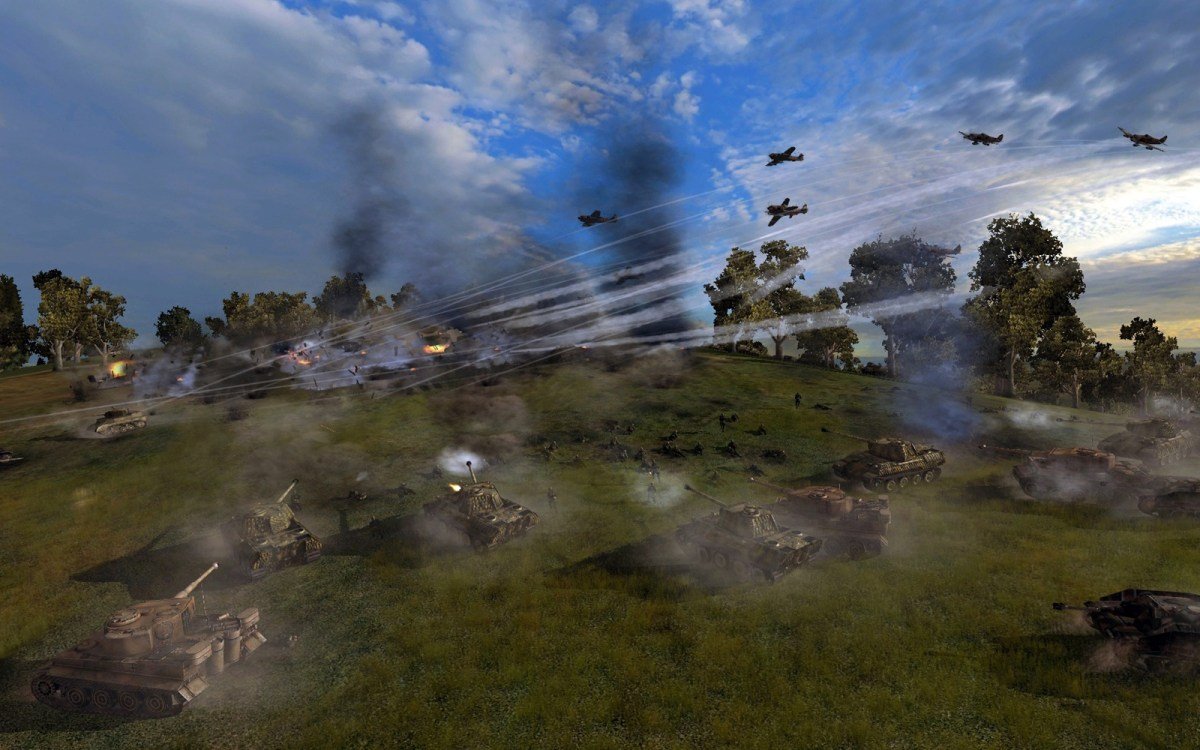
The late 2000s were a weird time. The internet was becoming widespread, and gaming media was mostly composed of enthusiastic website writers and some early YouTube creators, so picking a game was mostly done either by sketchy consultation of this medium or by trusting the box art. Well, War Leaders: Clash of Nations sold me with the latter, being perhaps one of the most ambitious historical wargames ever developed, even if its grand reach occasionally exceeded its technical grasp at launch. The game attempts to fuse the overarching geopolitical management of a grand strategy title like Civilization or Hearts of Iron with the boots-on-the-ground tactical battles of a real-time strategy game, functioning effectively as Total War set during the Second World War. Battles were not as big as they might sound, having just a couple of hundred units per map, but back then, it was impressive! Currently, the game is catalogued as abandonware, and finding it in the wild is quite rare, but if you do, pick it up!
12 – Codename Panzers: Phase 1

Developer: Stormregion | Release Year: 2004 | Genre: Real-Time Tactics
You know you were there to watch these games evolve in real-time when you were surprised by the fact that Codename Panzers: Phase 1 had different sound effects for different weapons. Yup, that’s my core memory from this title. But don’t let that cheeky commentary take away any of the credit from what was, essentially, the best real-time strategy World War 2 prior to Company of Heroes. Stormregion delivered a masterclass in tactical warfare, forcing players to deal with dwindling resources like fuel and ammo, something no other RTS did at the time. Codename Panzers: Phase 1 shifts the focus entirely away from resource gathering, forcing players to rely strictly on the combat groups allocated at the start of each operation, so preserving gall available forces was imperative to deal with any unforeseen consequences. This game alone turned me into an artillery expert, as prior to any assault taking place, I would use it to pound the enemy’s positions to bits. The game also did a great job “modelling” tank armor by giving the armored behemoths of WW2 4 different values for each of their sides, and not just bigger or smaller health bars. I played Codename Panzers: Phase 1, first mission, not too long ago, maybe a couple of months, and it holds up remarkably well.
10 – Silent Storm

Developer: Nival Interactive | Release Year: 2003 | Genre: Turn-Based Tactics
Nival Interactive’s Silent Storm remains an absolute high-water mark for turn-based tactical combat, and was very well received when it came out, and even spawned a beloved sequel called Silent Storm 2. The definitive feature of Silent Storm is its completely destructible, physics-driven 3D environment. If a German is pinned down on the second floor of a French farmhouse, you do not need a clear line of sight; you can simply use a machine gun to chew through the floorboards beneath his feet or level the entire corner of the building with high explosives. Maybe above all of that, what makes Silent Storm so special is the fact that it’s set in an alternative version of the conflict, a topic that stirred plenty of interest in the early 2000s, with several documentary series coming about, unveiling the scary and supernatural secret weapons of Nazi Germany.
6 – Theatre of War

Developer: 1C Company | Release Year: 2007 | Genre: Real-Time Tactical Simulation
Were it not for the recently announced Theatre of War Rearmed, I didn’t even remember that this series existed, and I still have the physical disks lying around somewhere, stored away. I just found out that there’s quite a passionate community for it, so if you’re the kind of wargamer who finds mainstream strategy games far too arcade-oriented, Theatre of War offers a brutal, uncompromised tactical simulation that’s surprisingly deep, and worth experiencing if you can stomach its ridiculously low frame rate. Every single soldier and vehicle is tracked with immense detail. Bullets and shells have actual physical trajectories, armor penetration calculations account for striking angles and steel thickness, and individual crew members can be incapacitated inside a vehicle, leaving the survivors to scramble or abandon the tank. But just between you and me, if I were you, I would wait for Rearmed to come out, because having played its playtest, I came out of it very much impressed with this labor of love from a single developer, and better yet, the game runs at high frame rates now.
8 – R.U.S.E.
Developer: Eugen Systems | Release Year: 2010 | Genre: Real-Time Strategy
The year 2026 has been one of the kindest for strategy and wargamers, with some of the best titles of the last couple of years coming out, some promising ones being announced, and classics like R.U.S.E. returning to digital storefronts. Let’s just ignore for a moment the clown show that is the game asking for 30 bucks for a title that’s 20 years old, and not that impressive in this day and age, but admittedly, it stands out due to being the only game built around the concept of military deception and intelligence warfare. Played on a massive virtual war table that smoothly zooms out to display standard military map markers (a feature that would become a hallmark for Eugen), the game hinges on the use of “ruses”, a kind of special ability that allows you to deceive your opponent. You can hide your true army composition, construct fake wooden decoy bases, trick enemies into believing a massive column of heavy armor is advancing down a flank, or intercept enemy operational radio traffic. It’s a fun gimmicky, and it’s worth playing for the campaign, but the game doesn’t have a lot of staying power after that.
