

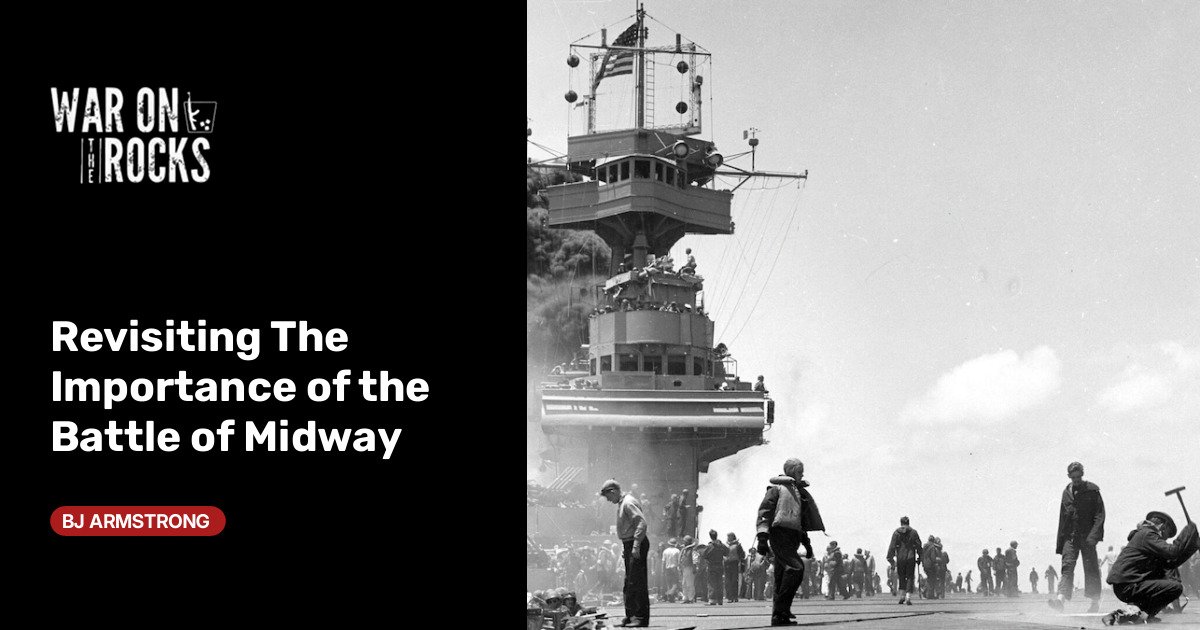
The Battle of Midway has assumed a place in American naval lore that has put it on par with other great battles in world naval history. What Salamis was for the Greeks, Trafalgar for the British Royal Navy, and Tsushima for the Japanese, the clash northwest of Midway Island on June 4, 1942, represents for the U.S. Navy. It was a moment of heroism, professional skill, and victory, which came to define how the Navy viewed itself for the rest of the 20th century and beyond.
Unlike those other great battles, however, Midway was a decidedly modern naval operation. It involved forces fighting beyond visual range and synchronized joint operations undersea, on the surface, and in the air. It also was an early instance of successful cyber integration into an operational plan and demonstrated American prowess in logistics and industrial capacity.
The lopsided victory at Midway was the springboard that launched the U.S. Navy to victory in the Pacific theater of World War II. The battle laid the foundation of modern multidomain naval thinking which set the force on a course to become the global naval hegemon. More than 80 years later, Midway continues to provide insights and reminders about naval power today and into the future.
Losing Battles and the War
Following the attack on Pearl Harbor, the Japanese Imperial Navy swept across the Pacific as the most powerful Navy in the world. The destruction or damage of eight battleships on Dec. 7, 1941 left the U.S. Navy without a significant force to strike back. The Japanese also sank the battleship HMS Prince of Wales and the battlecruiser HMS Repulse in the South China Sea on Dec. 10, knocking back British power in the Pacific. These preemptive attacks preceded the Japanese campaign to seize the Philippines, sending Gen. Douglas MacArthur and American forces scrambling to defend allied Australia.
Japanese forces advanced through Southeast Asia, occupying Thailand, Burma, and Malaya by the end of 1941. They seized Singapore from the British in February 1942. Two weeks later, a combined Allied fleet of American, British, Dutch, and Australian warships were routed in the Battle of the Java Sea. Japanese forces then landed in the Dutch East Indies, modern day Indonesia, seizing precious oil and resources needed to fuel the war effort.
The Americans struck back as best they could. In March 1942, in a daring mission from the rolling deck of the USS Hornet, Lt. Col. Jimmy Doolittle launched a force of B-25 light bombers toward the Japanese home islands. Doolittle and his raiders rained bombs down on Japanese cities, surprising military leaders who believed the home islands were beyond the reach of an Allied attack. While the Doolittle raid was militarily ineffective, it helped boost American morale.
In April, Japanese forces began advancing south toward Australia, and the U.S. Navy responded. Chief of Naval Operations Adm. Earnest King directed Adm. Chester Nimitz to send all three of his aircraft carriers southwest from Hawaii. In the Battle of the Coral Sea in early May, the Americans fought the Japanese to a tactical draw: The Americans lost more ships, but the Japanese lost more aircraft and pilots. Coral Sea was the first military battle between aircraft carriers, in which the opposing fleets never saw one another and aircraft did most of the fighting. Despite having more losses, the Americans won a strategic victory by halting the Japanese advance.
To reclaim the initiative, and push the Americans further from their growing empire, the Imperial Japanese Navy set its sights on the tiny atoll of Midway in the middle of the Pacific Ocean. Roughly halfway between Hawaii and Japan, the island would become the first defensive outpost for the Japanese as they prepared for a possible American counterattack. Adm. Isoroku Yamamoto, the Japanese naval commander who led the team that planned the Pearl Harbor attack, set to work planning an invasion.
While the Japanese assembled their plan, U.S. Navy cryptologic units were hard at work. By early May, the code-breaking unit in the basement of Nimitz’s headquarters was regularly reading bits of the Japanese naval code. Led by Cmdr. Joe Rochefort, Station HYPO identified a Japanese operation in the works which they believed pinpointed Midway. Analysts back in Washington disagreed, believing that the target was the West Coast or Alaska. Rochefort suggested that Nimitz instruct the garrison commander at Midway to radio in the clear that the island’s water system was failing. The Americans waited and listened. In coded Japanese message traffic, the code name that had been used in the messages about the strike was used to report that Midway was running out of water. The Japanese target was Midway.
With their cryptological and intelligence success, Nimitz and the American planners dispatched the only carriers left to Midway. USS Enterprise and Hornet sailed on May 28 as Task Force 16, under Rear Adm. Raymond Spruance. The day before, USS Yorktown had limped back to Pearl Harbor trailing a 10-mile-long oil slick, in desperate need of repair from damage at Coral Sea. The ship was immediately moved into drydock. As Spruance and his Task Force set to sea, shipyard workers scrambled around the clock to return Yorktown to a combat ready condition. Nimitz put Rear Adm. Frank Jack Fletcher, who had brought the ship from the Coral Sea, in command of the forces headed to Midway. On May 29, after only two days in drydock, Yorktown was refloated. The next day, Nimitz came aboard to wish Fletcher and his crew “good luck and good hunting.” After a frantic three days, in a marvel of American industrial capacity, Yorktown was ready for supplies and armament and set sail later that day with the escort ships of Task Force 17.
The Battle
The Japanese began their assault on June 3 by attacking the Aleutian Islands. Nimitz and his commanders knew from the cryptanalysts that this was a diversion. Task Forces 16 and 17 rendezvoused northwest of Midway at “Point Luck” — a pre-arranged meeting point — to wait for the enemy’s arrival. American long-range reconnaissance flights launched from Midway airfield, while the submarine USS Nautilus patrolled west of the island. The search for the Japanese fleet had begun.
At 0534 hours on June 4, scouting aircraft spotted the Japanese carriers. As Spruance’s carriers turned into the wind and began launching their airwings, the initial Japanese strike on Midway was already underway. An hour earlier, the 1st Air Fleet, also known as the Kidō Butai (“mobile force”), comprising four Japanese aircraft carriers under the command of Vice Adm. Chūichi Nagumo, had launched over 100 aircraft against Midway. The U.S. Navy task forces left behind the island’s garrison to defend itself with its Army and Marine Corps aircraft and anti-aircraft guns and focused instead on hunting the Japanese carriers.
As Japanese aircraft arrived over Midway, the American aircraft launched at about 0800 hours and began closing in on the Kidō Butai from the northeast. Around that same time, one of Nagumo’s reconnaissance aircraft radioed in a surprising spot report of American warships north of the island, leaving the Japanese commander with a dilemma. He did not know the American carriers had already launched a strike. He could either launch a second wave of attacks on Midway in preparation for the amphibious assault that came next or he could strike at the American ships. Nagumo chose the latter. Realizing that only three American carriers were left anywhere in the Pacific, he had the chance to destroy all of them. It was too good an opportunity to pass up.
As the Japanese worked their deck cycle to rearm and prepare to launch an attack on the Americans at Point Luck, the airwings launched by Spruance and Fletcher began to arrive. Three torpedo squadrons were the first to spot the Japanese. Flying older, slower U.S. Douglas TBD-1 Devastator torpedo bombers, the squadrons made low approaches to hurl their torpedoes into the sea. Japanese Mitsubishi A6M Zero fighters in the air to protect their ships pounced. Flying through a hail of anti-aircraft fire and fighter attacks, the American bombers were decimated. All 15 bombers of Torpedo Squadron 8 (VT-8) were shot down and only Ensign George Gay survived. While the squadron’s sacrifice was almost total, it would not be in vain.
Japanese Zeroes dove down from their overwatch positions to join the fight at sea level, leaving the sky above wide open. It was then, at 1020 hours, that U.S. Douglas SBD Dauntless dive bombers arrived above the Japanese carriers and began their onslaught. In a matter of minutes, the Kaga, Akagi, and Soryu were all in flames. American bombs penetrated their decks and triggered secondary explosions from the fueled and armed Japanese planes. Explosions buffeted through the ships and they began to sink.
Afterwards, the remaining Japanese carrier Hiryu launched aircraft in search of the American carriers. Just after noon, they appeared above Yorktown and the American fighters attempted to repel the attack. But three bombs and two torpedoes found their target. The damage was too much for the ship to endure, and crew began abandoning ship. The carrier, which American shipyard workers had returned to action in just three days, was lost. A few hours later, aircraft from Enterprise found Hiryu. Four 1,000-pound bombs found the ship’s deck, setting it ablaze.
At the end of the day, the Japanese force was devastated. Four aircraft carriers, nearly 250 aircraft, and three thousand sailors were lost. The Kidō Butai was gone. In the aftermath, the Americans also sank the cruiser Mikuma and severely damaged Mogami. A Japanese submarine found Yorktown, listing dangerously after its crew had escaped, and put a torpedo into it, sinking the carrier as well as the destroyer USS Hammann.
Japanese Apogee
Historians have often called Midway the high-water mark of the Japanese offensive in the Pacific. The lopsided victory raised the American spirit, which had been crushed under the continuous Japanese onslaught of Pearl Harbor, Singapore, the loss of the Philippines, the Battle of the Java Sea, and the inconclusive losses at Coral Sea. As Tom Hone pointed out in these pages, Midway represented a tidal shift for the Americans. The battle preceded a hard-fought victory at Guadalcanal, which froze the Japanese advance and permitted the Allies to start their own offensive. Nimitz’s Central Pacific island-hopping campaign followed and sailed all the way to the shores of the Japanese home islands.
Midway was a turning point more than operationally. It also represented the clear advantage that American intelligence and cryptographic analysis created. Breaking the Japanese naval code gave the Americans a leg up for the remainder of the war.
The battle also represents a pivotal moment for American defense industrial capacity. Repairing Yorktown in just three days’ time was a sign of things to come. A month after the battle, the USS Essex was launched at Newport News Shipbuilding — the first of 24 fast fleet carriers launched over the next 3 years as American shipyards operated at an astonishing capacity and built a fleet that would overwhelm Japanese defenses.
As the American fleet rapidly grew, the Imperial Japanese Navy shrunk. The loss of four aircraft carriers at Midway was catastrophic. While Japanese industry could produce some of the most advanced ships and weapons in the world, it had limited capacity. The Japanese also lost hundreds of aircraft. Crucially, among the 3,000 sailors lost at Midway, several hundred were pilots. These were aviators with significant combat experience, including some of the best leaders and instructors in the military. The Japanese training pipeline was not built to replace pilots as quickly as the American system. The lack of talented aviators continued to hamstring Japanese operations for the rest of the war.
Midway Miracle or Shattered Sword?
The early history of Midway was dominated by the firsthand account of Capt. Mitso Fuchida, a Japanese pilot who led the first wave of the Pearl Harbor attack and had been aboard Akagi during the battle. Published in 1953 and translated to English in 1955, Midway: The Battle that Doomed Japan, presented a high-intensity narrative based on Fuchida’s memory, highlighting the sacrifice of the torpedo squadrons and their tactical impact on the battle. From his perspective, unsurprisingly, the American success was a lucky break.
Samuel Eliot Morison, a Harvard professor and historian, had been commissioned in the Naval Reserve to sail with the Pacific fleet and document the war. He offered a chronological operational narrative that necessarily left out the role of intelligence and cryptanalysis, as it remained classified. Morison’s account highlighted Nimitz’s intuition to defend and reinforced the perception that luck was on the side of the Americans.
However, memoirs are often incomplete and memories are sometimes faulty. While many American and western officers and historians embraced Fuchida’s narrative, others began to question the lack of supporting source material. When the history of the cryptological work was declassified, historians began to see the battle in a new light. In 2005, Jonathan Parshall and Anthony Tully published Shattered Sword: The Untold Story of the Battle of Midway, a radical departure from earlier understanding of the battle. Based on archival research in Japanese military archives and primary sources from American records, the authors began exposing inaccuracies in Fuchida’s account. Much of the Japanese airwing had been below decks in the hangar for refueling and rearmament, rather than on deck as Fuchida claimed. This resulted in causing secondary explosions inside the ships, inflicting far more damage and explaining why the carriers sank so quickly. Additionally, the Zeroes had not been ordered to attack the American torpedo squadrons, which would have been a failure in fighter control. Instead, the aggressiveness of the Japanese pilots caused them to abandon their overwatch positions. It also became evident that the claim by the submarine Nautilus of having sunk Kaga was inaccurate — the dive bombers deserved the credit.
More recent historians of the battle have included luminaries like Craig Symonds and John Keegan, who have integrated the “shattered sword” findings with deep takes of the leaders on both sides. Finally, contemporary analysis continues to identify Midway as a watershed event, while offering insights for naval affairs in the 21st century.
Insights and Reminders from 1942
Three key elements of the U.S. victory remain relevant to today’s strategists and naval professionals. The first is the successful integration of intelligence and cryptologic functions into a broader operational plan, demonstrating an early example of the importance of cyber. Midway showed that these kinds of operations are not a silver bullet or magical weapon, but instead contribute to an overall battle or campaign, synchronized with operational planning and strategy. The integration of cyber with intelligence functions — both feeding operational decision-making and being a part of the planning function — was critical at Midway and has only become more important today.
Second, the success was built on key naval infrastructure and industrial capacity. The stunning work at Pearl Harbor to bring Yorktown back to the fight was only possible because of a well-resourced drydock and shipyard and skilled and experienced workers. Midway was also strategically significant because it bought American shipyards time to finish building the Two Ocean Navy that would flow west on the offensive. Today, as the world’s navies contemplate the return of great-power operations to the vastness of the Pacific these insights remain key. The ability to maintain, repair, and build ships is vital in an ocean-spanning conflict.
Finally, the battle demonstrates the leadership challenges of managing risk and accepting the contingency of war. Nimitz put all his cards on the table at Midway, sending his last three capital ships — aircraft carriers — and thus risking the ability to defend Hawaii if the Japanese decided to attack again. He told his commanders to be governed by the principle of calculated risk: If they believed the risk was worth it, he inherently trusted them to take it. In actuality, the Americans were lucky. When then-Lt. Cmdr. Wade McClusky and his airwing approached the limit of their fuel in search of the Japanese carriers, and if he had turned south instead of turning north, they may have missed the enemy entirely. The entire battle may have turned out differently. Even though modern warfare is more networked and automated than ever before, contingency and the fog of war can still slip wild cards into the deck. Today’s leaders should understand calculated risk and delegate decisions to trusted subordinates to seize operational opportunities when they arise.
The tide of World War II in the Pacific theater turned in mid-1942 as American naval forces rose to the occasion. In the months and years following Midway, many new ships sailed west and joined Nimitz’s forces on the offensive.
America’s industrial capacity combined with good intelligence work and planning enabled U.S. naval leaders to accept risk and lead their sailors and marines to the Japanese home islands. The Battle of Midway was the decisive battle of the war in the Pacific not because the fighting ended the next day, but because the Imperial Japanese Navy never recovered from their terrible losses, which set the stage for American success. In the 21st century, the battle offers key insights for how navies and nations should think about war in the Pacific.
Benjamin “BJ” Armstrong is a U.S. Navy officer and an associate professor of war studies and naval history at the U.S. Naval Academy. He is the author or editor of seven books including Naval Presence and the Interwar U.S. Navy and Marine Corps: Forward Deployment, Crisis Response, and the Tyranny of History.
The opinions expressed here are in his personal and academic capacity and do not reflect the policies or position of any U.S. government entity.
Image: National Museum of the U.S. Navy via Wikimedia Commons
