

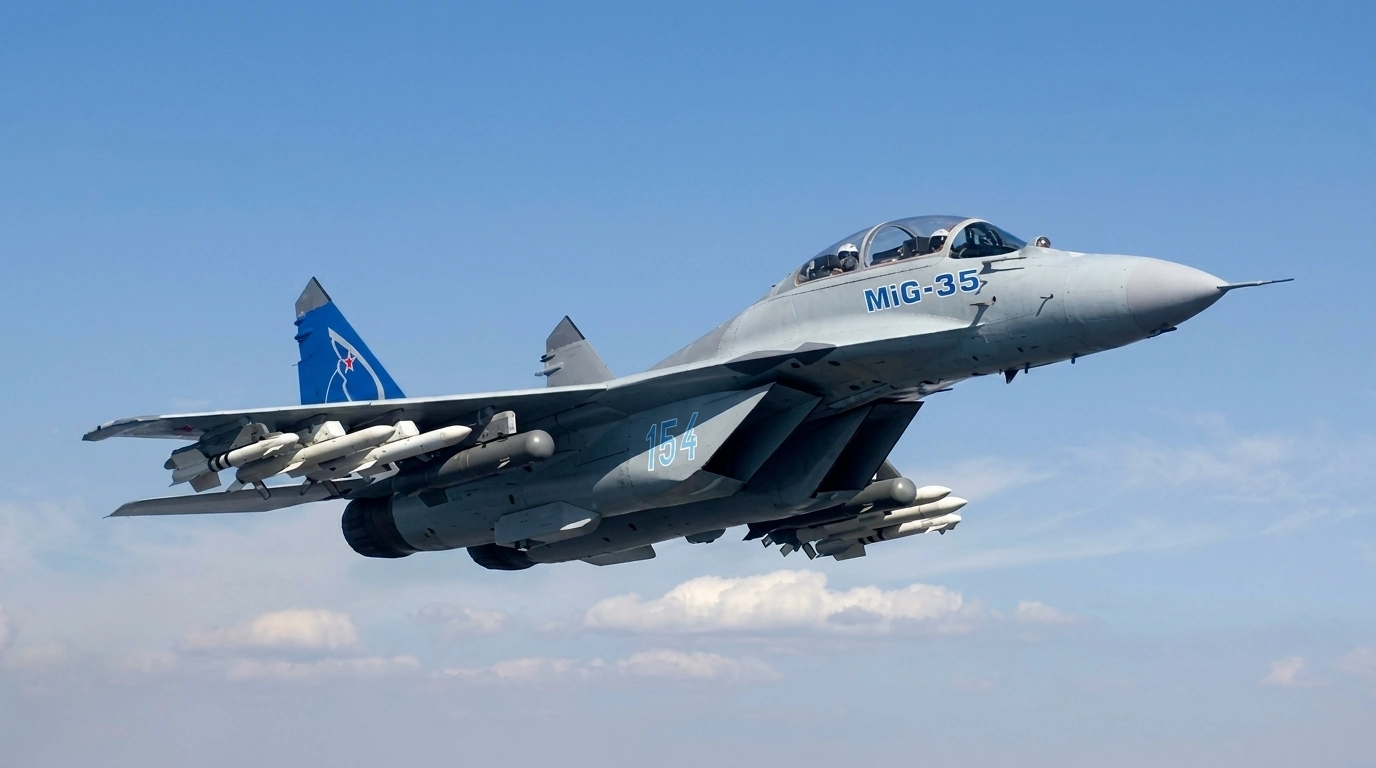
Imagine standing beside a runway as two fighter jets thunder overhead. One is a cutting-edge stealth aircraft that dominates headlines. The other is less famous, less talked about, yet quietly represents one of the most ambitious attempts to reinvent a Cold War legend. That aircraft is the Mikoyan MiG-35.
At first glance, the MiG-35 looks like another member of the long-running Fulcrum family. Look a little closer, though, and a different story emerges. Beneath its familiar silhouette lies a fighter designed to bridge two eras: the rugged practicality of Soviet aviation and the sensor-heavy battlefield of the 21st century.
The Mikoyan MiG-35 Super Fulcrum is often described as the ultimate evolution of the MiG-29, a jet that earned a reputation for agility and raw performance during the final decades of the Cold War.
But the MiG-35 isn’t merely an upgraded MiG-29 with fresh paint and modern electronics. It’s a comprehensive redesign aimed at delivering enhanced range, advanced radar technology, precision-strike capability, and significantly improved pilot awareness.
What makes the aircraft especially interesting is its position in today’s fighter market. While attention often gravitates toward stealth platforms such as the F-35 or Su-57, the MiG-35 follows a different philosophy.
Instead of relying primarily on low observability, it focuses on maneuverability, multirole flexibility, and cost-effective operation, qualities that still matter in many air forces around the world.
What Is the Mikoyan MiG-35 Super Fulcrum?
The Mikoyan MiG-35 occupies an unusual place in modern military aviation. It’s neither a brand-new fifth-generation fighter nor a simple modernization of an aging aircraft. Instead, think of it as the final, most refined chapter in a story that began when the original MiG-29 first took to the skies in the late 1970s.
To understand the MiG-35, it helps to picture the MiG-29 as a classic sports car. The original design had tremendous speed, impressive agility, and a reputation for thrilling performance, but it also had limitations in range, maintenance efficiency, and onboard electronics.
Over the decades, Russian engineers kept improving the platform. The result was the MiG-35, a fighter that retains the DNA of its predecessor while incorporating technologies that would have seemed futuristic when the Fulcrum first entered service.

Development of the MiG-35 accelerated during the early 2000s as Russia sought a more affordable multirole fighter capable of competing on the international market.
The aircraft drew heavily from lessons learned through the MiG-29M and carrier-based MiG-29K programs. Engineers introduced increased internal fuel capacity, improved flight controls, upgraded engines, and an entirely new suite of sensors designed for modern combat environments.
The nickname “Super Fulcrum” reflects this transformation. NATO assigned the original MiG-29 the reporting name “Fulcrum,” and aviation observers often use “Super Fulcrum” to distinguish the MiG-35 from earlier variants.
The label isn’t official Russian terminology, but it captures the aircraft’s purpose rather well: taking the proven strengths of the Fulcrum family and pushing them several steps further.
Unlike many fighters designed primarily for either air superiority or ground attack, the Mikoyan MiG-35 was built as a genuine multirole platform. It can conduct air-to-air combat, precision strike missions, reconnaissance operations, and maritime attack missions, all within a single airframe.
This versatility has become increasingly valuable as air forces seek aircraft capable of performing multiple missions without maintaining large fleets of specialized jets.
In many ways, the MiG-35 represents an effort to answer a difficult question: how do you keep a legendary fighter relevant in an age dominated by advanced sensors, networked warfare, and ever-rising procurement costs? The Super Fulcrum is Russia’s answer.
MiG-35 Technical Specifications
Numbers rarely tell the whole story of a fighter jet, but they do reveal its personality. And the Mikoyan MiG-35 has a personality built around speed, agility, and operational flexibility.
At its core, the MiG-35 remains a twin-engine fighter derived from the MiG-29 lineage.
However, engineers significantly revised the airframe to carry more fuel internally, reducing dependence on external tanks and extending mission endurance. This may sound like a small improvement, yet in combat aviation, extra range often determines whether a mission succeeds or fails.
The aircraft is powered by two Klimov RD-33MK turbofan engines, each producing roughly 19,000 pounds (88 kN) of thrust with afterburners.
Compared with earlier MiG-29 powerplants, these engines offer improved fuel efficiency, greater reliability, and reduced smoke emissions, a surprisingly important upgrade since visible exhaust trails can make aircraft easier to spot.
Key MiG-35 Specifications
| Specification | MiG-35 |
| Length | 17.3 m (56.8 ft) |
| Wingspan | 12.0 m (39.4 ft) |
| Height | 4.7 m (15.4 ft) |
| Maximum Takeoff Weight | Approx. 24,500 kg |
| Engines | 2 × RD-33MK |
| Maximum Speed | Mach 2.25 |
| Service Ceiling | 17,500 m |
| Ferry Range | Up to 3,100 km |
| Combat Radius | Around 1,000 km |
| Weapons Payload | Up to 7,000 kg |
One of the most overlooked aspects of the MiG-35 is its payload capacity. With nine external hardpoints and the ability to carry approximately seven tonnes of weapons, the aircraft can be configured for vastly different missions. On one sortie it might carry long-range air-to-air missiles for interception duties; on another, precision-guided bombs and anti-ship missiles.

The speed figure, around Mach 2.25, grabs attention, but modern air combat is rarely a pure race. What’s arguably more valuable is the aircraft’s combination of acceleration, climb rate, and maneuverability. Pilots need a jet that can rapidly change energy states, reposition during engagements, and react to threats in seconds.
Taken together, the MiG-35’s specifications reveal a fighter designed not merely to fly fast, but to remain adaptable across a wide spectrum of combat scenarios. That’s where its real strength lies.
Advanced Avionics and Sensor Systems
A modern fighter jet is often described as a flying computer with wings. If that’s true, then the Mikoyan MiG-35 represents a dramatic leap forward from the analog-era roots of the original Fulcrum.
In air combat today, seeing the enemy first is frequently more important than turning tighter or flying faster.
The MiG-35 was developed with this reality in mind. Its designers focused heavily on sensors, pilot awareness, and battlefield connectivity, areas where older Soviet fighters often lagged behind their Western counterparts.

At the center of the aircraft’s sensor suite is the Zhuk-A Active Electronically Scanned Array (AESA) radar. Unlike traditional mechanically scanned radars that physically move to search the sky, an AESA radar can steer beams electronically at incredible speed.
The practical benefit? Faster target tracking, greater resistance to jamming, and the ability to monitor multiple threats simultaneously.
For a pilot, this translates into a clearer picture of the battlespace. Instead of chasing individual contacts one at a time, the system can manage numerous targets at once while supporting both air-to-air and air-to-ground operations.
The MiG-35 also incorporates an advanced Infrared Search and Track (IRST) system. This feature deserves more attention than it usually gets.
Unlike radar, which emits signals that can potentially reveal an aircraft’s position, IRST works passively by detecting heat signatures. It’s a bit like spotting a campfire in the dark without using a flashlight. That passive capability can provide a significant tactical advantage during contested engagements.
Major Sensor Systems
| System | Purpose |
| Zhuk-A AESA Radar | Target detection and tracking |
| IRST / OLS System | Passive target acquisition |
| Helmet-Mounted Sight | Rapid weapon cueing |
| Electronic Warfare Suite | Threat detection and countermeasures |
| Data Link Systems | Network-centric operations |
Another important upgrade is the aircraft’s electronic warfare package. Modern battlefields are saturated with radars, missiles, and electronic surveillance systems.
The MiG-35’s defensive suite helps detect threats, deploy countermeasures, and improve survivability when operating in hostile airspace.
Taken together, these systems transform the MiG-35 from a traditional dogfighter into a sensor-driven multirole combat platform. In many respects, the aircraft’s electronics, not its engines, represent the biggest step forward from previous Fulcrum generations.
MiG-35 Weapons and Combat Loadout
A fighter jet is only as effective as the tools it brings into battle, and this is where the Mikoyan MiG-35 aims to prove its versatility. Rather than being optimized for a single mission type, the aircraft was designed to carry a broad mix of weapons, allowing commanders to tailor its loadout to the mission at hand.

Think of the MiG-35 as a military multitool. One day it can serve as an air-superiority fighter hunting enemy aircraft. The next, it can launch precision strikes against ground targets or threaten naval vessels hundreds of kilometers away.
The aircraft features nine external hardpoints and can carry up to 7,000 kilograms (15,400 pounds) of weapons and fuel tanks. That’s a substantial payload for a medium-weight fighter and gives planners considerable flexibility.
Air-to-Air Weapons
For aerial combat, the MiG-35 can carry a variety of missiles:
| Missile | Role |
| R-73 | Short-range dogfight missile |
| R-74M | Advanced infrared-guided missile |
| R-77 | Beyond-visual-range missile |
| R-77-1 | Improved long-range engagement missile |
The R-77 family is particularly important because it gives the MiG-35 the ability to engage targets well before visual contact. Modern air combat increasingly revolves around detecting and attacking threats at long distances, making these weapons essential.
Air-to-Ground Strike Capability
The MiG-35 can also employ:
- KAB-series precision-guided bombs
- Kh-29 tactical missiles
- Kh-38 precision strike missiles
- Unguided rockets and conventional bombs
This allows the aircraft to attack bunkers, infrastructure, armored vehicles, and battlefield targets with varying levels of precision.

Maritime and Specialized Weapons
Against naval threats, the MiG-35 can carry anti-ship missiles such as the Kh-31A and Kh-35. It can also deploy anti-radiation missiles like the Kh-31P, designed to seek out and destroy enemy radar installations.
And then there’s the old-fashioned backup: the internal 30mm GSh-30-1 cannon. While missiles dominate modern aerial warfare, the cannon remains valuable for close-range engagements and ground attack missions.
What makes the MiG-35’s weapons package noteworthy isn’t any single missile or bomb, it’s the sheer variety. Few missions require exactly the same toolkit, and the Super Fulcrum was built to adapt quickly as operational demands change.
MiG-35 vs Other Modern Fighter Jets
Comparing fighter aircraft is a bit like comparing elite athletes from different sports. A sprinter, a marathon runner, and a decathlete may all be world-class, but each excels in different areas. The same principle applies when evaluating the Mikoyan MiG-35 against modern rivals.
The MiG-35 was designed to occupy a middle ground. It offers advanced capabilities without the extreme acquisition and operating costs associated with many fifth-generation fighters.
As a result, its most direct competitors are aircraft such as the F-16V, Rafale, Eurofighter Typhoon, and even Russia’s own Su-35.
Quick Comparison
| Aircraft | Generation | Max Speed | Key Strength |
| MiG-35 | 4++ Generation | Mach 2.25 | Agility and multirole flexibility |
| F-16V | 4.5 Generation | Mach 2.0 | Proven combat record |
| Rafale | 4.5 Generation | Mach 1.8 | Multirole versatility |
| Eurofighter Typhoon | 4.5 Generation | Mach 2.0 | Air-superiority performance |
| Su-35 | 4++ Generation | Mach 2.25 | Long range and heavy payload |
MiG-35 vs F-16V
The F-16V benefits from decades of operational experience and a vast global support network. However, the MiG-35 offers twin-engine redundancy and generally carries a heavier weapons load. For nations prioritizing survivability and payload, that can be attractive.
MiG-35 vs Rafale
The French Rafale has proven itself in combat and enjoys strong export success. Its sensor fusion and operational maturity are often viewed as advantages. The MiG-35 counters with high-speed performance and potentially lower acquisition costs.
MiG-35 vs Eurofighter Typhoon
The Typhoon was originally optimized for air superiority and remains one of the world’s strongest dogfighters. The MiG-35 competes by offering broader affordability and a balance between air-to-air and strike missions.
MiG-35 vs Su-35
This comparison is particularly interesting because both aircraft come from Russia. The Su-35 is larger, carries more fuel, and can transport a heavier weapons load.
The MiG-35, meanwhile, is lighter, potentially cheaper to operate, and better suited to air forces seeking a medium-weight multirole fighter.
The reality? No fighter wins every category.
The MiG-35’s appeal lies in balancing performance, capability, and operational cost rather than dominating a single metric. That’s often overlooked, but for many air forces, it’s exactly the point.
Advantages and Disadvantages of the MiG-35
Every fighter aircraft is a collection of trade-offs. Engineers can maximize speed, range, stealth, payload, or affordability, but rarely all at the same time. The Mikoyan MiG-35 is no exception. Its strengths are genuine, yet so are its limitations.
What makes the MiG-35 interesting is that many of its advantages stem from choices that differ from current industry trends.
While some modern fighters focus heavily on stealth and network-centric warfare, the MiG-35 emphasizes proven aerodynamics, multirole flexibility, and operational practicality.
Major Advantages
| Advantage | Why It Matters |
| Advanced AESA radar | Improved target detection and tracking |
| High maneuverability | Strong close-range combat performance |
| Large weapons payload | Supports diverse mission profiles |
| Twin-engine design | Increased survivability and redundancy |
| Multirole capability | One aircraft, multiple mission types |
| Improved fuel capacity | Better endurance than older MiG variants |
One often-overlooked strength is the aircraft’s evolution from the MiG-29 platform. Decades of operational experience helped engineers identify weaknesses and refine the design.
The result is a fighter that addresses many of the shortcomings associated with earlier Fulcrum models, particularly range and maintenance concerns.
Yet the aircraft faces notable challenges.
Key Limitations
| Limitation | Impact |
| Limited export success | Smaller global support ecosystem |
| Low production numbers | Reduced economies of scale |
| No true stealth design | Greater radar visibility than fifth-generation fighters |
| Limited combat record | Fewer real-world operational data points |
| Strong competition | Faces established rivals worldwide |
Perhaps the biggest obstacle isn’t technical at all.
The MiG-35 entered service during a period when many countries were either purchasing proven Western fighters or investing directly in fifth-generation aircraft. That leaves the Super Fulcrum competing in a narrow middle ground.
There’s also the perception challenge. In defense procurement, perception can be almost as important as performance. Aircraft with extensive combat records often enjoy an advantage over newer designs, regardless of specifications.
Viewed objectively, the MiG-35 is neither a revolutionary game-changer nor an obsolete relic. It’s a highly capable 4++ generation fighter that offers a compelling blend of agility, firepower, and versatility.
Whether those strengths outweigh its limitations depends largely on the needs, and budgets, of the air force considering it.
