

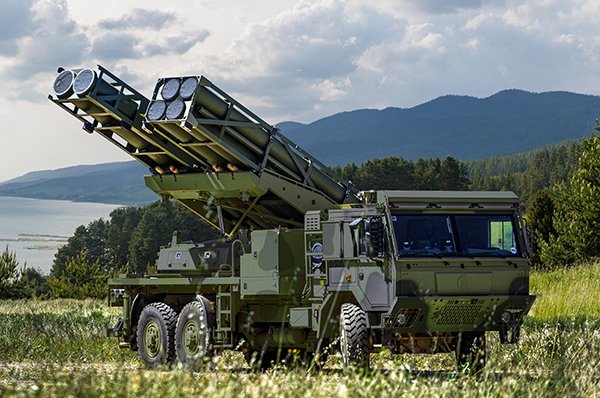
Under license from Elbit Systems, India’s Nibe Group has begun local assembly of the Israeli-developed Precise and Universal Launching System (PULS), which is a multi-barrelled rocket launcher.
This is the first time an Israeli land-based rocket artillery system will be delivered to the Indian Army.
Nibe inaugurated a new defence manufacturing complex at Shirdi in Maharashtra on 23 May, in the presence of Defence Minister Rajnath Singh. The minister flagged off the first two locally assembled launchers, known locally as the Suryastra universal rocket launcher system.
Under the industrial agreement with Elbit Systems, Nibe Group will manufacture the launcher platform in India, while the Israeli firm will focus on system integration, fire control systems and long-range rockets.
Both the 150km-range EXTRA rocket and 300km-range Predator Hawk missile were recently tested at Chandipur Integrated Test Range, achieving a circular error probable of 1.5m and 2m respectively.
This initial delivery forms part of a January 2026 Indian Army contract valued at INR2.93 billion (US$34 million), which covered two launcher systems and associated munitions, spare parts and a comprehensive support package.
The Indian Army publicly displayed the PULS system for the first time at the Republic Day parade in January 2026. Those launchers carried two long-range strike options: the aforementioned EXTRA precision-guided rocket and Predator Hawk missile.
India selected Tatra 6×6 high-mobility vehicles locally assembled by state-owned firm Bharat Earth Movers Limited (BEML) as the platform for the system.
A standard PULS battery configuration comprises two launcher vehicles, one battery command post and two transport-loader vehicles. Each launcher carries two modular pods capable of firing four Predator Hawk missiles, eight EXTRA rockets, or a combination of both. An operating crew of 2-3 persons is required.

The Indian Army operates three types of rocket launcher types: the indigenously developed Pinaka, along with the Russian BM-30 Smerch and legacy BM-21 Grad. The PULS acquisition could supplement or progressively replace portions of the army’s Smerch fleet, which was acquired from Russia in 2005 and 2007.
Unlike Russian systems built around a single munitions family, PULS employs an open-architecture approach capable of integrating multiple munition types and vehicle platforms.
Nibe Group has expanded its involvement in India’s domestic artillery sector, having entered into a licensing agreement in May 2025 with the Defence Research & Development Organisation covering technology transfer for the Pinaka.
The Indian Army plans to field ten Pinaka regiments by the end of this year.
by Atul Chandra
