

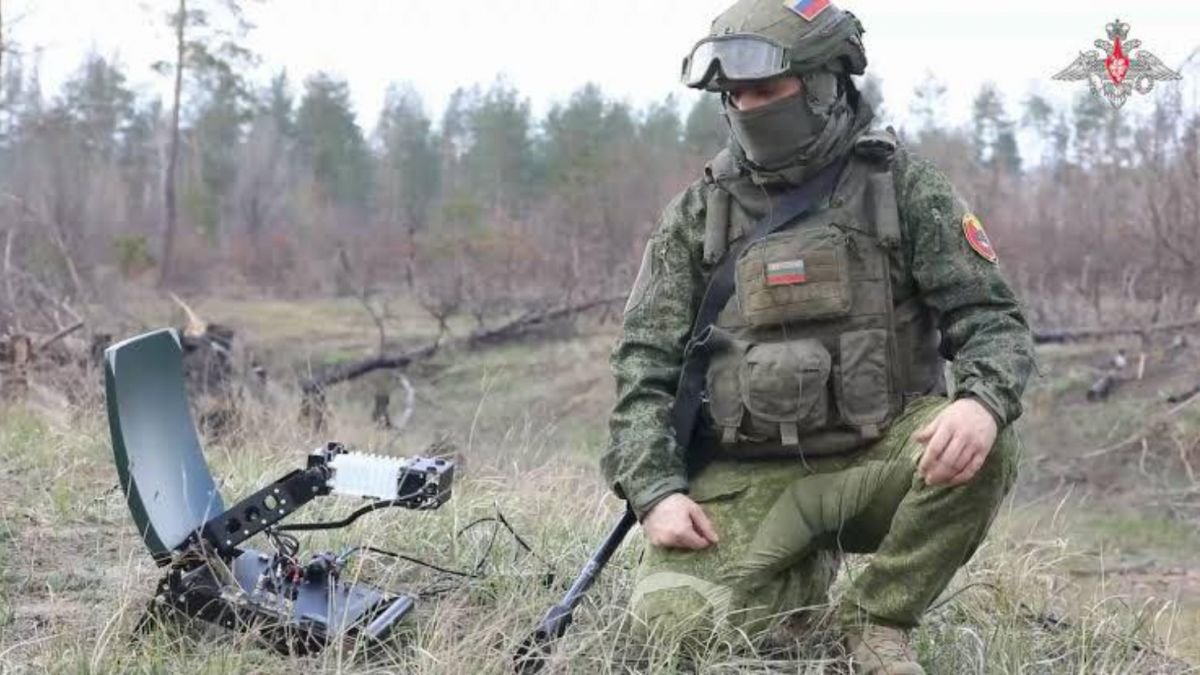

In the wake of losing illicit access to the Starlink satellite communications constellation, the Russian military has been forced to rely on inferior alternatives.
In February SpaceX deactivated Russian access to the company’s Starlink Satellite Communications (SATCOM) constellation in the Ukrainian theatre of operations. Russian forces deployed there had been using the constellation illicitly via terminals purchased on the black market. Starlink terminals, and hence access to the constellation, were made available to Ukraine just days after Russia’s second invasion in February 2022. Since then, the terminals have provided vital tactical and trunk communications for the Ukrainian military, and civilian SATCOM access in parts of the country where conventional telecommunications and internet access have been disrupted or unavailable.
SpaceX does not make Starlink coverage available in Russia as this map illustrates, and the company is prevented from doing so by existing United States government sanctions against Russia. Nonetheless, evidence began to emerge in February 2024 that Russian forces occupying parts of Ukraine were gaining access to the network using illicitly sourced terminals. Notionally, Starlink coverage over Russia was geofenced, i.e. Starlink satellites would not provide uplink and downlink services as they traversed Russian territory. The spacecraft provide a footprint of coverage, like a spotlight beam, on the ground. Footprints covering Ukraine could overlap into Russian-occupied areas, particularly those near the zero line, up to 20 kilometres/km (12.4 miles) into zones held by the Russians. Like the Ukrainian military, Russian forces have used the Starlink network to provide operational and tactical communications. Russian engineers have also employed Starlink terminals to provide beyond line-of-sight links to control Uninhabited Aerial Vehicles (UAVs).
Impact
Starlink deactivation in Russian-held parts of Ukraine has followed two approaches: First, only those terminals registered for use in Ukraine with the country’s government will now work there. Second, terminals operating in Ukraine traveling at speeds exceeding 49 knots (90 kilometres-per-hour) now automatically shut down. This latter step is intended to prevent the terminals providing radio links for UAV control.
The impact of the loss of Starlink communications in Ukraine for Russian forces there has been tangible and immediate. As this analysis makes clear, Russian forces had developed a reliance on the network, the removal of which has caused what appears to be major bottlenecks in Russian tactical and operational communications. This loss has had a corresponding impact on Russian command and control. Starlink depravation may have also yielded tactical benefits for Ukraine by helping to facilitate the latter’s liberation of territory in some areas.
Unsurprisingly, the Russian military is hurriedly working to introduce alternatives to make up for the Starlink shortfall. Reports emerged in early April that Russian forces in Ukraine were using a new SATCOM terminal known as Sprint-030. Armada understands that Sprint-030 terminals access Russia’s Express and Yamal communications satellite constellations. These constellations cover all of Europe and Russia ensuring that connectivity will be provided above Russian-occupied parts of Ukraine.
Primarily, the Sprint-030 terminals move Ku-band traffic across the Express and Yamal constellations on uplink frequencies of 13.75 gigahertz/GHz to 14.5GHz and downlink frequencies of 10.7GHz to 12.75GHz. Official documents seen by Armada state that the Sprint-030 terminals have an uplink speed of ten megabits-per-second/mbps and download data at a speed of one megabit-per-second. The terminals weigh twelve kilograms (26 pounds/lbs).
Starlink terminals also provide Ku-band links although there is a major difference in the reported data rates provided by these systems. For example, Starlink terminals facilitate uplink and downlink speeds of between 3.72mbps and 50.56mbps. The discrepancy in data rates between the Sprint-030 and Starlink terminals will negatively affect the Russian military. Slower data rates influence the quantity and richness of the data that can be sent across SATCOM links. Using Sprint-030 terminals to provide connectivity between UAVs and their pilots will affect the clarity of the video that can be transmitted by the aircraft. Latency is another concern: Starlink data rates provide low latency making them ideal for moving data in near real time; an important consideration when the terminals are used for UAV control and aircraft can be moving at high speeds. Starlink terminals have an added advantage in that some weigh as little as one kilogram (2.2lbs).
While the Sprint-030 terminals have been touted as an alternative to Starlink the capabilities of these systems, and the constellations they use, clearly cannot match the former. To exacerbate matters, there are concerns regarding the reliability of Express and Yamal coverage. In March one of the Express constellation satellites, Express-ATI, suffered a failure affecting television broadcasts for millions of Russians. Russian troops have been complaining about the inferiority of the Yamal constellation compared to Starlink.
The loss of Starlink alone will not cause a Russian military collapse in Ukraine, but it certainly does not aid what is increasingly looking like a desperate situation for Moscow’s forces unlucky enough to be deployed there. Moreover, the introduction of alternatives like Sprint-030 which lack equivalent capabilities to Starlink will do little to help already shattered Russian morale.
by Dr. Thomas Withington
