

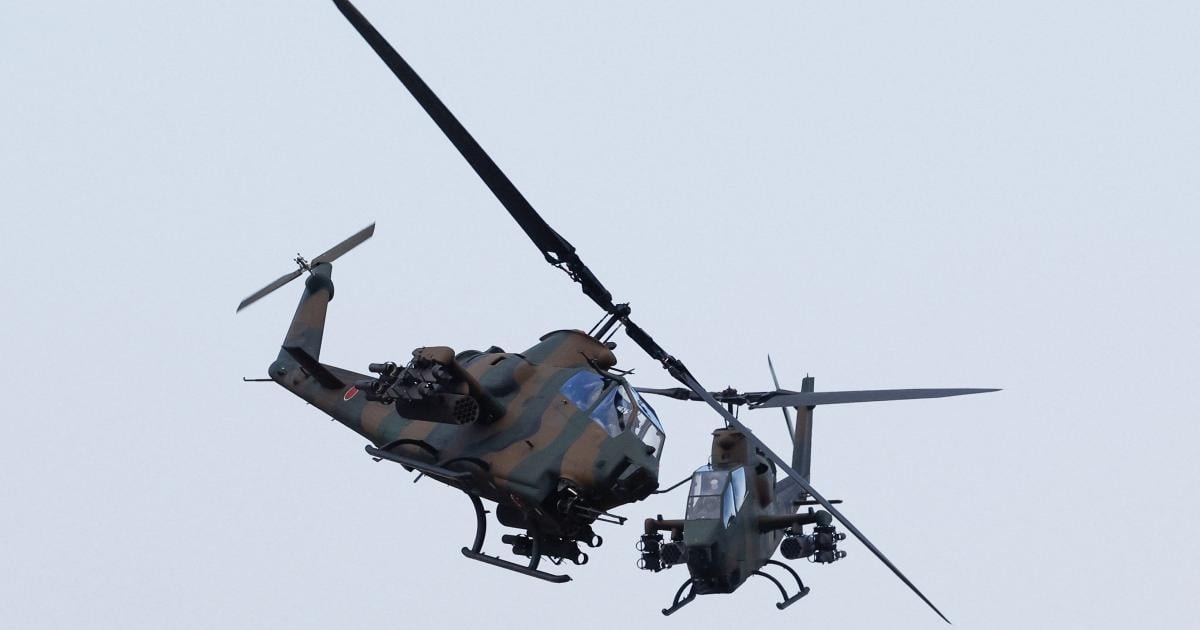
Japan’s long-dormant defense industry is finally waking up. Constrained by a constitution imposed by the Allied military occupation after World War II, Japan has for decades adhered to a pacifist security policy. It technically maintains no military (although its Self-Defense Forces are more formidable than many foreign militaries), and until last month, the government had forbidden the export of lethal weaponry. Cultural attitudes have reinforced Japan’s pacifism: Japanese citizens have historically derided hawkish politicians and defense firms as “merchants of death.”
These constraints on defense production have taken their toll. Japan is almost entirely dependent on the United States as a guarantor of its security and as a provider of military equipment. Japan’s defense industry is sclerotic and uncompetitive, in part, because the cash-strapped Self-Defense Forces had been its only customer. The disintegration of the defense industrial base—and thus Japan’s ability to arm itself in wartime—once seemed irreversible.
Today, that status quo is beginning to erode, and with remarkable speed. Politically and culturally, Japan is realigning around a very different vision of defense, one more in tune with the industrial policies and security challenges of the day. Stigma around defense production has been eclipsed by concern over Chinese aggression and fear that the rules-based order is showing cracks. After decades of association with the country’s past militarism, Japan’s defense industry is experiencing a renaissance. If the country can overcome its lack of capacity, poor cybersecurity, and economic dependence on China, it could redefine its own security and reshape the global market for arms.
TOKYO’S ZEITENWENDE
Successive American ambassadors have pleaded with Japan for years to take its security more seriously. Japan’s approach has finally started to shift, a consequence of Chinese assertiveness, waning confidence in America’s security guarantees, and a fear that what happened to Ukraine could happen to a country in Asia. Chinese aggression now routinely tops Japanese opinion polls of national security concerns, surpassing even North Korean missile threats. In the event of escalation in the Taiwan Strait, U.S. and Japanese defense planners are united in their belief that Japan’s military in its current state would be insufficient to meet the challenge, and that Japan’s missile stockpiles and defense manufacturers could not sustain a prolonged conflict.
Japan is in its fourth year of a five-year graduated commitment to doubling the national defense budget, from roughly $35 billion in 2022 to about $60 billion by 2027. In absolute terms, Japan is now the ninth-biggest military spender in the world. Government contracts are now big enough for defense firms to turn a profit, and more companies are angling for a shot at a lucrative procurement deal.
Japan has already started pursuing ambitious defense projects in recent years. The Ministry of Defense’s Acquisition, Technology and Logistics Agency is jointly developing a sixth-generation stealth fighter with Italy and the United Kingdom. Japan’s defense industry titan, Mitsubishi Heavy Industries, is in the process of building a new hypersonic glide vehicle, effectively the country’s first ballistic missile. The company is also constructing 11 Mogami-class warships ordered last year by Australia in a first-of-its-kind sale for Tokyo.
Japan is now the ninth-biggest military spender in the world.
Longtime Japan observers, accustomed to the glacial pace of the country’s consensus politics, have been stunned by the decisiveness of Tokyo’s bureaucracy in rolling back defense regulatory barriers that have been in place for decades. Former Prime Minister Fumio Kishida first laid the groundwork for policy changes in 2022, but the ongoing revolution in Japan’s defense industrial sector has found its true champion in Sanae Takaichi, the country’s charismatic new leader. Thanks to a resounding victory in snap elections in February, she has the political mandate and staying power to ensure that the Japanese bureaucracy follows through on its policy overhaul. Under her leadership, Japan’s arms industry is now open for global business.
For Japan’s security, this news comes not a moment too soon; the country is hard at work transitioning to a more modern defense concept. Defense planners have learned from the war in Ukraine the dangers of overinvesting in so-called exquisite armaments—large and expensive defense platforms that make for enticing targets in a shooting war. Japan is now spending more on cheaper, mass-producible unmanned platforms, the capacity to keep weapons operational in a prolonged conflict, and weapons systems that can strike adversaries from safe distances. Any conflict in the South China Sea is likely to involve drone swarms, autonomous underwater vehicles, cyber-capabilities, space-enabled imagery and communications technologies, sophisticated jamming tools, and AI to coordinate it all. Japan is also investing in old-school munitions production, having witnessed the speed with which missile stockpiles were depleted throughout the Ukraine conflict and how quickly Gulf Arab countries burned through their interceptors during the war with Iran. With this combination of priorities, Japan hopes to credibly bolster its deterrence on a budget.
But Japan’s defense boom is about more than security. Channeling investment into advanced manufacturing—aerospace, shipbuilding, and software—is a central pillar of Tokyo’s strategy to revive the economy after decades of anemic growth. Japanese defense planners are also hoping that these investments will demonstrate to the Trump administration that Japan is taking on its share of the security burden.
MADE IN JAPAN
Yet the implications of Japan’s new forays into defense extend far beyond its own borders. If Tokyo can seize the opportunity, Japan’s defense revival may one day reshape the global arms industry, one that has long been dominated by a handful of suppliers.
The United States, by far the world’s largest arms exporter, produces high-cost, high-performance platforms, including the F-35 Lightning II stealth fighter and the Terminal High Altitude Air Defense System. For many potential buyers, these systems are both prohibitively expensive and increasingly out of sync with a contemporary defense concept that favors cheaper, disposable options that can be produced en masse. More damaging still, American defense companies can no longer meet sky-high global demand—even customers with the money to pay are now faced with long wait times and blown delivery dates as U.S. companies struggle to secure their supply chains.
Russia and China, two of the United States’ largest competitors, peddle significantly cheaper equipment, but most U.S. partners are unwilling to brave the geopolitical fallout, or the potential security vulnerabilities, associated with buying from adversaries. Additionally, the performance of Russian equipment in Ukraine has led to skepticism regarding its efficacy in modern warfare, and Chinese armaments have garnered a reputation for poor quality and durability.
A Japanese defense renaissance, if successful, represents a wholly new source of arms for middle powers by middle powers. Japan’s customer list is limited to countries with which it has formalized defense transfer ties, ensuring that access to its growing arsenal will be limited to U.S. partners in Europe and Southeast Asia. These countries stand to gain a trusted new defense supplier, additional industrial capacity that could reduce wait times for goods, and an infusion of competition into the marketplace. The Philippines and Indonesia have both expressed interest in buying Japanese defense systems, including a stripped-down version of the Mogami-class frigate. Malaysia and Vietnam are also likely beneficiaries given their existing technology transfer agreements with Japan, shared interest in maritime deterrence, and track record of buying Japan’s nonlethal defense products. Chinese maritime coercion against many Southeast Asian countries has created a ripe regional market for Japanese defense goods; in the long term, Japanese products may make containing Chinese maritime influence cheaper and easier.
For much of Europe, Japan’s defense revolution also cannot come quickly enough. The war in Ukraine has exposed the fragility of European supply chains and the limits of munitions stockpiling. As weapons caches run low after four years of sustained support for Kyiv, Europe is desperate to rearm and wary of relying on the increasingly unreliable United States for supplies. Japan has already begun making inroads into Europe’s defense market, dispatching a delegation to Finland and Sweden in February to deepen its defense technology relationships.
LAND OF THE RISING GUN
Realizing Japan’s defense ambitions will not be easy. After decades of underinvestment, the country lacks engineering talent and industrial capacity, and must retrofit a number of its critical manufacturing facilities. Potential customers will be watching closely to see if Japan can deliver its Mogami-class frigates to Australia on time.
Reliance on China is another complication. Although Japan has made strides to secure its supply chains, it still relies on China for components for its military equipment. Moreover, most Japanese defense contractors are actually divisions within larger industrial or technology conglomerates that derive only a small share of their revenue from defense. Many of their more profitable divisions remain dependent on the Chinese market. So far, Japan’s major defense companies have been willing to make products that China may find threatening, but that calculus may begin to change as Chinese retaliation continues to heat up.
Japanese companies also face a challenge in locking down foreign defense contracts. Japanese firms have traditionally viewed defense production as more of a public service than a viable commercial enterprise. They are not accustomed to lobbying for overseas defense contracts, and the Japanese government is not used to helping them. In contrast, South Korea is known for aggressively marketing goods from its own defense firms and for sending hefty diplomatic delegations to seal deals for domestic suppliers. Navigating the global arms bazaar requires a set of skills that Japan has yet to develop.
Japan’s arms industry is open for global business.
Similarly, Japanese defense firms will need help financing an increase in industrial capacity. Companies are constrained by a frugal Ministry of Finance and a small and cautious domestic venture capital ecosystem. Silicon Valley venture firms may find opportunity in filling the gap, and the United States government itself might do well to fund Japanese efforts directly, given their shared security interests.
The most pressing issue for Japan, however, is the poor state of its cybersecurity. The country’s vulnerabilities have been repeatedly exposed in network intrusions, raising alarm in Washington over the risks of sharing intelligence with its close ally. Fragmented ministerial oversight, restrictive laws, and a thin talent pool have all held back Japan’s cyberdefense. These weaknesses invite adversaries to steal sensitive data, compromising Japan’s military capabilities and its credibility as a defense technology partner. Japan’s ability to fend off Chinese and North Korean cyberattacks and protect its own intellectual property, and that of its partners, will determine whether defense dollars translate into real security.
China has responded to Japan’s buildup with displeasure, sanctioning a number of Japanese companies, tightening critical mineral exports, and discouraging Chinese tourism to Japan. News outlets affiliated with the Chinese state have painted Japan’s decision to export lethal weapons as a return to the country’s World War II militarism. But the rest of the region seems to disagree with Beijing’s interpretation: in April, the Philippines welcomed Japanese combat troops onto its soil for the first time since World War II for joint exercises, and in May, Vietnam rolled out the red carpet for Takaichi to discuss critical mineral supply chains and security in the South China Sea.
Though more Chinese reprisals may follow, Takaichi and her administration show no signs of backing down. Rebuilding Japan’s defense industrial base will take years, assuming it can surmount the many obstacles in its way. Yet the country is demonstrating that it has the political will to rise to the challenge. As the prime minister declared last month while launching a sweeping review of Japan’s national security strategy: “There is not a moment to spare.”
Loading…
