

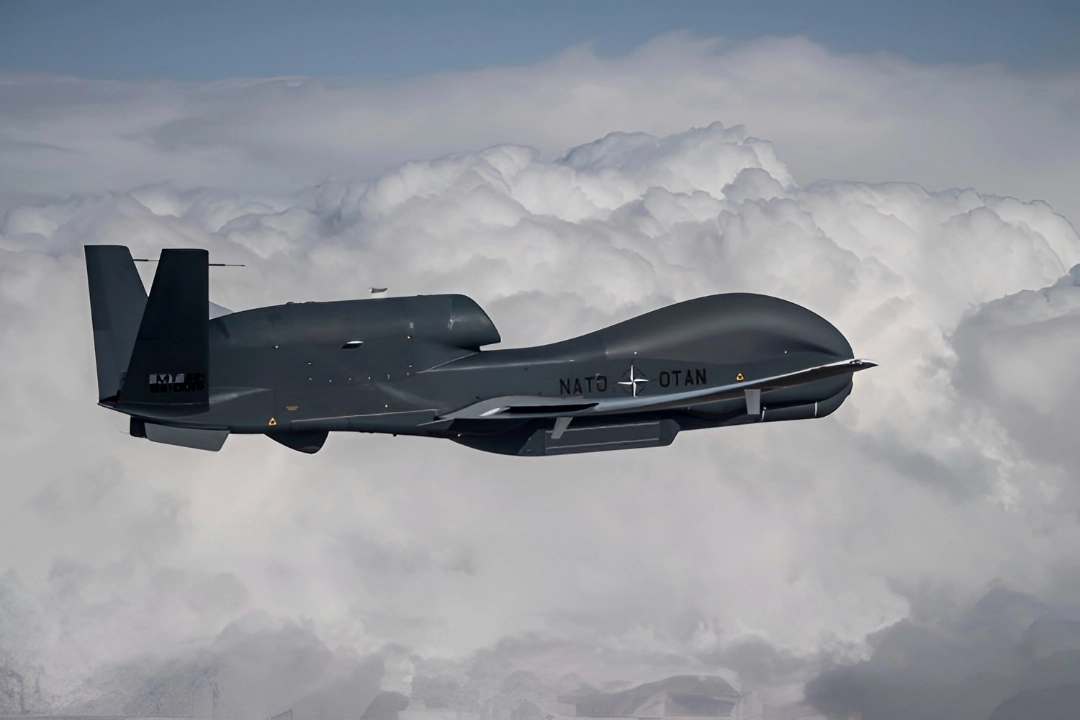
You don’t hear it. You don’t see it. And yet, it might be quietly mapping an entire region from the edge of space.
That’s the strange power of the RQ-4D Phoenix, a drone that doesn’t behave like the ones most people imagine. No buzzing overhead. No cinematic dogfights. Instead, it cruises at altitudes so high that commercial aircraft look like they’re skimming the ground, gathering intelligence with a kind of patient, almost clinical precision.
Here’s the twist: the RQ-4D Phoenix isn’t just another unmanned aircraft. It’s one of NATO’s most ambitious shared defense assets, essentially a flying sensor platform designed to watch, track, and understand what’s happening across vast territories in real time.
Think of it less like a drone and more like an orbiting observatory… just one that happens to fly for over 30 hours straight without landing.
If you’ve ever wondered how modern alliances keep tabs on fast-moving geopolitical situations, without boots on the ground, this is a big part of the answer.
In this post, you’ll get a clear, no-nonsense breakdown of what the RQ-4D Phoenix actually is and why it quietly plays such a critical role in NATO surveillance operations.
We’ll dig into its specs, its missions, and even where it fits in the bigger picture of intelligence gathering today.
Because once you understand what this aircraft can do, it changes how you think about “eyes in the sky.”
What Is the RQ-4D Phoenix?
At first glance, the RQ-4D Phoenix sounds like something out of a sci-fi novel, sleek, distant, a bit mysterious. In reality, it’s very real… and already hard at work above Europe and beyond.

So what exactly is it?
The RQ-4D Phoenix is a high-altitude, long-endurance (HALE) unmanned aerial vehicle, built for one primary job: watching everything without being noticed. It was developed by Northrop Grumman, but here’s where it gets interesting, it doesn’t belong to just one country. Instead, it’s operated by NATO as part of a shared intelligence system known as the Alliance Ground Surveillance (AGS) program.
That alone makes it unusual. Most military drones are owned and controlled by individual nations. The Phoenix, though, is more like a collective asset, multiple countries pooling resources to keep a constant, high-resolution eye on large regions.
Read also: MQ-4C Triton: How the U.S. Navy’s Drone Sees the Entire Ocean
Technically, the RQ-4D is based on the Global Hawk platform, but it’s been tailored for NATO’s specific needs. Think of it as a customized version of an already proven aircraft, upgraded with sensors and systems designed for multinational operations.
And here’s the part people often underestimate: this drone isn’t about striking targets. It doesn’t carry weapons. Instead, it delivers something arguably more valuable, information. It tracks movement, maps terrain, detects changes on the ground, and feeds that data back to analysts in near real time.
In a world where decisions are made in minutes, that kind of visibility isn’t just useful, it’s decisive.
So while it may never make headlines like fighter jets or missiles, the RQ-4D Phoenix plays a quieter, deeper role: helping leaders see the full picture before they act.
Technical Specifications of RQ-4D Phoenix
Let’s get concrete for a moment, because the RQ-4D Phoenix isn’t just conceptually impressive, it’s physically enormous. People imagine drones as small, almost toy-like machines. This one? Not even close.
Picture a wingspan wider than a Boeing 737. Yes, really.
That oversized frame isn’t for show, it’s what allows the aircraft to stay airborne for extreme durations while carrying heavy, power-hungry surveillance systems.
Here’s a clear breakdown of its core specs:
| Specification | RQ-4D Phoenix |
| Type | High-Altitude Long-Endurance (HALE) UAV |
| Wingspan | ~39.9 meters |
| Length | ~14.5 meters |
| Height | ~4.7 meters |
| Max Altitude | ~18,000 meters (60,000 ft) |
| Endurance | 30+ hours |
| Range | ~16,000 km |
| Engine | Rolls-Royce AE 3007 turbofan |
| Cruise Speed | ~570 km/h |
Now, a couple of details that don’t always make it into spec sheets, but matter.
First, that range means the RQ-4D Phoenix can take off from a base in southern Europe and monitor regions thousands of kilometers away without landing. No refueling mid-air. No forward deployment required.
Second, the engine choice, a turbofan rather than a propeller, helps it operate efficiently at high altitude, where thinner air changes everything about flight dynamics.

And then there’s payload capacity. While exact figures are often kept vague, what’s clear is this: the aircraft can carry multiple sensor systems simultaneously, allowing it to collect different types of intelligence in a single pass.
In simple terms? It’s not just flying far and high, it’s doing meaningful work the entire time.
Key Features and Capabilities
The RQ-4D Phoenix isn’t impressive because of one standout trick, it’s the combination of endurance, altitude, and sensor intelligence that makes it quietly formidable. Think of it as a system built for patience. It doesn’t rush. It lingers, observes, and connects dots over time.
High-Altitude, Long-Endurance Performance
Start with the basics: this aircraft lives in the upper reaches of the atmosphere. We’re talking up to ~18,000 meters (around 60,000 feet), well above commercial air traffic. At that height, it can monitor massive areas without needing to reposition constantly.
And it doesn’t tire. A single mission can stretch beyond 30 hours, which means one RQ-4D Phoenix can cover what would otherwise require multiple aircraft rotations. For analysts on the ground, that continuity is gold, no gaps, no blind spots, just a steady stream of data.

Advanced Surveillance Technology
Now, the real magic sits inside.
The Phoenix is equipped with MP-RTIP radar (Multi-Platform Radar Technology Insertion Program), a mouthful, sure, but incredibly powerful. This system allows the drone to perform Synthetic Aperture Radar (SAR) imaging, meaning it can produce detailed ground images regardless of weather or lighting conditions.
Clouds? Nighttime? Dust storms? Doesn’t matter.
It can also track moving objects across wide areas, vehicles, formations, patterns of activity, building a dynamic picture instead of a static snapshot.
All-Weather, Persistent ISR
“Persistent ISR” (Intelligence, Surveillance, Reconnaissance) sounds like jargon, but the idea is simple: stay present long enough to understand what’s changing.
That’s where the RQ-4D Phoenix stands out. It doesn’t just capture moments; it observes behavior over time. And in modern defense, patterns often matter more than isolated events.
Put it all together, and you’ve got something less like a drone… and more like a watchful, high-altitude analyst that never blinks.
Role of RQ-4D Phoenix in NATO Operations
The RQ-4D Phoenix really comes into its own when you look at how it’s used, not just what it is. Because on paper, it’s a high-end surveillance drone. In practice, it’s more like a shared “eye in the sky” for an entire alliance.
Intelligence, Surveillance, and Reconnaissance (ISR)
At the heart of its mission is ISR, Intelligence, Surveillance, and Reconnaissance. But let’s strip the acronym down to something human: it helps decision-makers see clearly before they act.
The Phoenix collects wide-area imagery, tracks movement patterns, and feeds data back in near real time. Analysts can watch how a situation evolves hour by hour, instead of reacting to outdated snapshots. That shift, from reactive to predictive, is where the real value lies.
For example, instead of simply detecting a convoy once, the RQ-4D Phoenix can monitor where it came from, where it’s going, and whether that behavior is routine… or unusual.

Alliance Ground Surveillance (AGS) Program
Here’s where things get uniquely NATO.
The RQ-4D Phoenix is a core asset of the Alliance Ground Surveillance (AGS) program, a multinational effort funded and used by several NATO members. Rather than each country building its own system, they share this one, pooling intelligence, infrastructure, and operational control.
It’s a bit like a joint subscription to a very expensive, very powerful service. Everyone contributes, everyone benefits.
Strategic Importance
And strategically? The impact is subtle but huge.
The Phoenix enhances situational awareness across borders, supports crisis response, and helps coordinate multinational operations without needing a constant physical presence on the ground.
In a way, it reduces uncertainty, and in geopolitics, uncertainty is often the most dangerous variable of all.
Quiet aircraft. Big implications.
Recent Missions and Deployments
If the RQ-4D Phoenix were just a high-tech prototype, it’d be interesting. But it’s not, it’s active, deployed, and increasingly visible in places that matter.
In the past couple of years, one pattern has become clear: NATO isn’t just operating the Phoenix, it’s pushing it closer to strategic frontlines.
Take its deployment to Finland, for instance. That move wasn’t random. With Finland joining NATO and sharing a long border with Russia, positioning the RQ-4D Phoenix there effectively expands the alliance’s surveillance reach into Northern and Eastern Europe. From that vantage point, the drone can monitor vast areas, land, sea, and even Arctic approaches, without ever crossing into contested airspace.

And this isn’t a one-off.
The Phoenix has been used to support:
- Eastern European monitoring missions, especially after heightened regional tensions
- Maritime surveillance, tracking activity across key sea lanes
- Crisis response scenarios, where rapid intelligence is critical
What’s interesting, almost counterintuitive, is how visible these “invisible” missions have become. Flight tracking enthusiasts sometimes spot RQ-4D patterns online, tracing long, looping paths that hint at persistent observation. It’s like watching a satellite… except it’s much closer, and far more flexible.
Another recent development: system upgrades. NATO has been refining the Phoenix’s software and sensor integration, improving how quickly data is processed and shared across member states. That means faster insights, not just better images.
So while the aircraft itself hasn’t changed dramatically in shape or size, its operational role is evolving fast, becoming more integrated, more responsive, and more central to how NATO keeps watch in a shifting security landscape.
RQ-4D Phoenix vs RQ-4 Global Hawk
At some point, the comparison becomes unavoidable. The RQ-4D Phoenix didn’t appear out of thin air, it’s built on the same DNA as the RQ-4 Global Hawk, a well-known U.S. Air Force surveillance drone.
But calling them identical would miss the nuance. It’s more like comparing a standard production model to a custom-built version designed for a very specific client.
Let’s break it down.
| Feature | RQ-4D Phoenix | RQ-4 Global Hawk |
| Operator | NATO (multi-national) | U.S. Air Force |
| Primary Role | Alliance-wide ISR | National ISR missions |
| Sensor Suite | Enhanced for AGS integration | Varies by block/version |
| Data Sharing | Multi-country, real-time distribution | Primarily U.S.-controlled |
| Mission Focus | Broad-area, collaborative surveillance | Strategic & tactical ISR |
The biggest difference isn’t hardware, it’s how the data is used.
With the Global Hawk, intelligence flows through a single nation’s command structure. With the RQ-4D Phoenix, that same kind of data is shared across multiple NATO members, often simultaneously. That requires a different kind of system architecture, more interoperability, more standardization, and, frankly, more political coordination behind the scenes.
There are also subtle differences in sensor configuration. The Phoenix is optimized for wide-area ground surveillance across diverse terrains, aligning with NATO’s need to monitor everything from Eastern European plains to coastal regions.
So yes, they share a common airframe. Same long wings, same high-altitude profile.
But philosophically? They serve different worlds.
One is about national capability.
The other is about collective awareness.
And that distinction changes everything.
Why the RQ-4D Phoenix Matters
It’s easy to get lost in the specs, the altitude, the endurance, the radar jargon. But the real question is simpler, and a bit more human:
Why does the RQ-4D Phoenix actually matter?
Because modern security isn’t just about strength anymore. It’s about awareness.
The Phoenix gives NATO something incredibly valuable: the ability to see patterns before they become problems. Not after a crisis begins, but in that quiet, ambiguous phase where things could still go either way.
Think about it like this. Imagine trying to understand traffic in a city by looking out a single window. You’d see movement, sure, but no context. Now imagine watching the entire city from above for 30 hours straight. Suddenly, patterns emerge. Congestion, anomalies, unusual routes. That’s the difference the RQ-4D Phoenix brings to military intelligence.
It also changes how decisions get made.
Instead of relying on fragmented reports or delayed satellite passes, leaders can access continuous, real-time insight. That shortens reaction times, reduces guesswork, and, perhaps most importantly, helps avoid miscalculations.
There’s also a political dimension. Because the Phoenix is a shared NATO asset, it builds a common understanding among member states. Everyone’s looking at the same data, not competing interpretations. That might sound small, but in multinational operations, it’s huge.
And then there’s deterrence, the quiet kind. When potential adversaries know they’re being observed persistently, it can influence behavior without a single shot fired.
So no, it doesn’t carry weapons.
But in many cases, it doesn’t need to.
Information, used well, can be just as powerful.
