

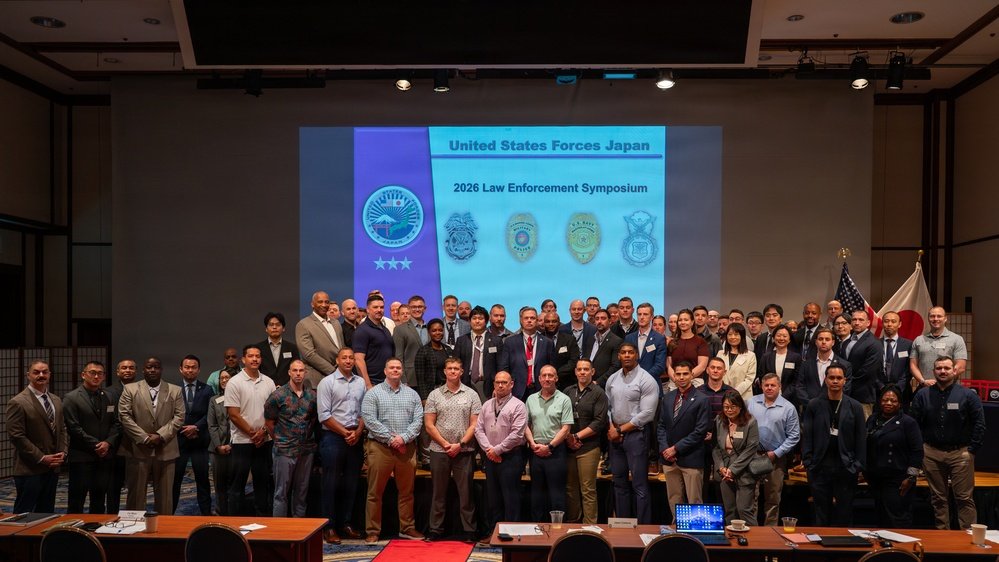
The Protection Directorate, formerly known as the Provost Marshal Office, consists of personnel within USFJ that handle law enforcement, base defense, security operations and force protection. They are responsible for managing security postures, providing crisis response and ensuring that the command and service components have the right capabilities to accomplish their law enforcement objectives.
The symposium focused on plans for USFJ’s command and control upgrade, an initiative to transform and operationalize USFJ while enhancing its ability to respond to evolving security challenges in the Indo-Pacific region.
“The important thing for us related to this event is command relationships,” said Dr. Reginald “Reggie” Seabrook, USFJ Protection deputy director. “As a USFJ community, we have a joint solution for our protection objectives. We don’t have to rely on just an Army way, a Navy way, a Marine way, or an Air Force way.”
Participants included representatives from law enforcement directorates across USFJ’s subordinate components: U.S. Army Japan, Marine Forces Japan, Commander Naval Forces Japan, Fifth Air Force, and U.S. Coast Guard Japan, alongside Japanese agencies such as Japan Customs and Tochigi Prison.
“As we keep building our relationships and improving our communication, the alliance gets stronger,” said U.S. Air Force Senior Master Sgt. Michael Flores, USFJ Protection Directorate non-commissioned officer in charge. “That’s what we need here—to really work as a cohesive, unified team. Not just as Japan and America, but as one.”
The event underscored the critical nature of the U.S.-Japan alliance at the local and civil level, emphasizing the need for continuous cooperation between military installations and host-nation facilities.
“It is important to strengthen the relationship between the U.S. military and Tochigi Prison so that we can take care of any inmates related to the military in the most appropriate way,” said Kyochika Miyoshi, Tochigi Prison warden. “Normally, it can be difficult to connect with foreign government and military organizations. Through this symposium, it has been beneficial to meet, discuss and exchange ideas with these other agencies.”
The symposium aligned units with USFJ priorities, aiming to unify command structures by creating a shared protection ecosystem and ensuring all components are familiar with each other’s capabilities.
By improving communications, solving integration challenges for joint operations and addressing vulnerabilities, the symposium also aimed to refine the efficiency of the Protection Directorate.
“Sometimes, protection can be a thankless job. It’s not important until it is,” said U.S. Marine Corps Brig. Gen. Kelvin Gallman, USFJ deputy commander. “We owe it to our 60,000 plus men, women and their families to protect them. Nobody else is going to do it for us.”
Moving forward with greater integration and open communication, U.S. military law enforcement personnel and USFJ’s Protection Directorate hope to set the conditions to expand operational cooperation and bolster bilateral capabilities with Japan.
