

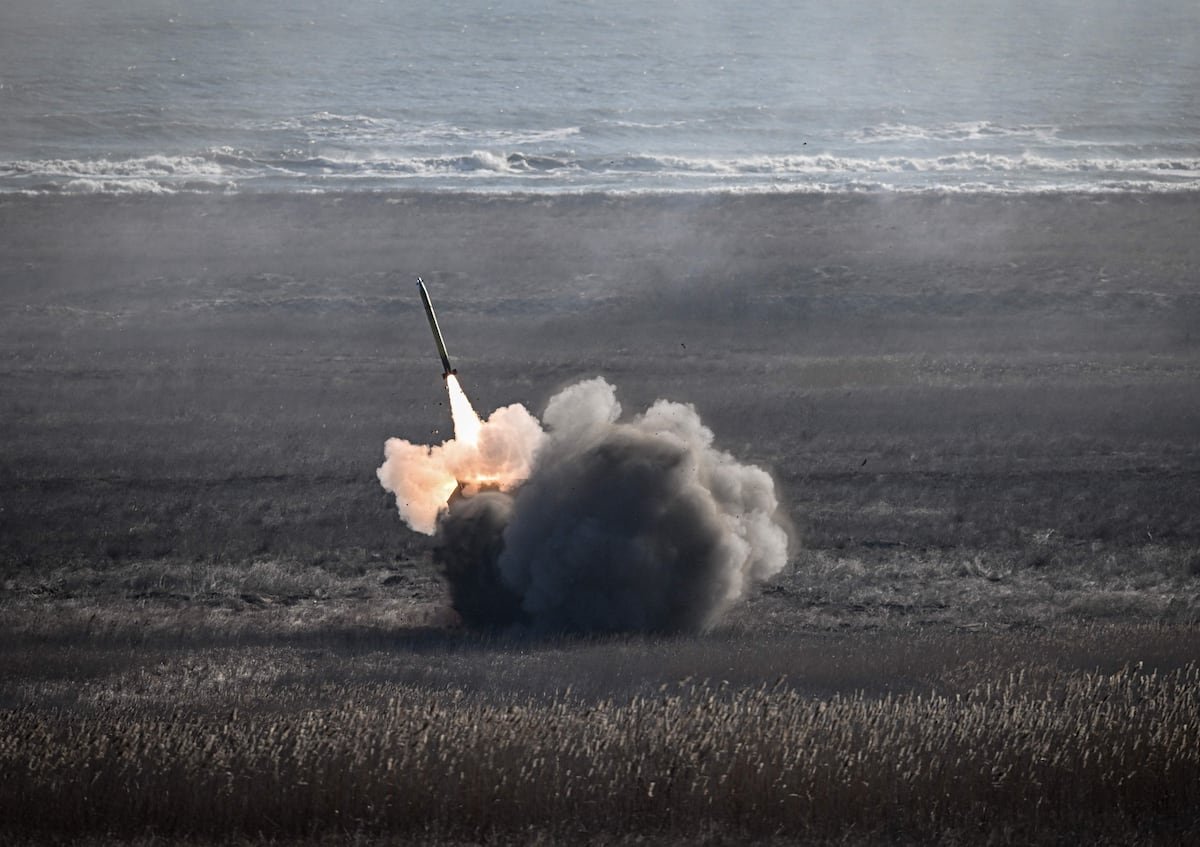
PARIS – French defense firm Safran and missile maker MBDA successfully test-fired their jointly developed rocket-artillery munition this month, and expect to be able to deliver the first multiple-launch rocket systems in 2029 should their offer be picked by the French armed forces.
Safran and MBDA fired the first Thundart munition developed for France’s Long-Range Land Strike program at the Île du Levant test range in the Mediterranean on April 14, the companies said in a statement on Wednesday. The ground-to-ground rocket has a 150 kilometer range, and the companies are considering the development of longer-range munitions.
France aims to replace nine aging Lance-Roquettes Unitaire systems with at least 13 new rocket-artillery systems in 2030, according to an update of its defense budget. In addition to domestic offers from Safran and MBDA as well as Thales with ArianeGroup, the country is evaluating off-the-shelf solutions, according to Armed Forces Minister Catherine Vautrin.
“Lessons learned from recent conflicts with regards to high-intensity combat demonstrate the need for the ability to fire effectively at long range,” Vautrin said in a senate hearing on Tuesday. “The successor to the LRU, this is a priority capability and let’s be clear, one that is indispensable for the Army.”
Safran and MBDA can meet the time table for an operational capability in 2030, the companies said. If asked by France’s Directorate General for Armament, the companies are ready to supply operational systems as early as 2029, Safran told Defense News in response to questions.
Safran and MBDA are considering setting up a joint venture to continue the development of Thundart, including in the area of longer-range rockets. Around 100 employees across both companies have been working on the system, according to the firms.
The companies said Thundart is fully designed and produced in France, and is currently the only sovereign system in Europe that has demonstrated a strike range beyond that of the LRU system now in service with the French Army. The system is not subject to any restrictions regarding the United States International Traffic in Arms Regulations, according to Safran.
“The idea, as far as I’m concerned, is obviously to do everything possible to find a sovereign solution,” Vautrin said in the senate on Tuesday, though she said that sovereign system will be evaluated on effectiveness, price and ability to deliver. The minister said she has asked the DGA to evaluate off-the-shelf solutions to make a “clear comparison” of pros and cons of each option, including Asian systems.
Several European forces have acquired the Chunmoo rocket artillery system produced by South Korea’s Hanwha Aerospace, while other systems in service include the PULS system from Israel’s Elbit Systems and Lockheed Martin’s HIMARS. France has reportedly also been considering India’s Pinaka rocket system.
France aims to buy a total of 26 rocket-artillery systems with 300 munitions by 2035 at the latest, and gradually equip a rocket artillery battalion by 2030, according to Patrick Pailloux, the head of the DGA.
The launcher will be mounted on an eight-wheel truck produced by Scania France, loaded with as many as eight rockets per launcher, according to Safran. The launcher will have “shoot and scoot” capability, being able to quickly fire and then leave its firing position rapidly, Safran said.
The Thundart rocket is powered by propulsion developed by MBDA’s rocket-engine unit Roxel, and is fitted with an adapted version of the AASM guidance kit developed by Safran for glide bombs. The munition has a high supersonic speed with a 100-kilogram payload, and is resistant to electronic warfare, according to the companies.
Safran in March tested a new AASM seeker combining inertial navigation, laser and infra-red guidance, with delivery of the new seeker to start in 2027.
Thundart is easy to scale up for mass production, with both companies are “fully prepared” to ramp up production, according to MBDA and Safran. MBDA has said it plans to increase missile production by 40% in 2026 from a year earlier, while Safran says it increased production of AASM guidance kits fourfold in 2025 compared to 2022.
Rudy Ruitenberg is a Europe correspondent for Defense News. He started his career at Bloomberg News and has experience reporting on technology, commodity markets and politics.
