

Australia plans to invest a record A$425 billion (US$307 billion) over the next decade to modernise its defence force. This comes as the country faces an increasingly turbulent strategic environment, such as rising tensions involving China, alongside continued US pressure to lift defence spending to at least 3.5% of gross domestic product.
This was announced in the release of Australia’s 2026 National Defence Strategy (NDS) and Integrated Investment Program (IIP) on 17 April, outlining a significant increase in defence spending.
It was highlighted that the country will invest an additional A$14 billion over the next four years, and an additional A$53 billion over the decade, pushing defence spending to 3% of GDP by 2033 under NATO measurements.
Speaking at an Australian National Press Club event for the release of the NDS and IIP, Australian Defence Minister Richard Marles said that the additional defence spending will enhance military capabilities, strengthen national resilience and expand the domestic defence industrial base.
Referring to the inaugural NDS unveiled in 2024, he said, “We have been creating an Australian Defence Force (ADF) that is able to operate at greater range, engage in impactful projection: a more amphibious army; more capable northern bases that can project our air force farther; longer-range missiles; a much more capable surface fleet; and the acquisition of long-range, nuclear-powered submarines.”
“As a result of NDS 26 and the updated IIP, investment across all of these capabilities will continue – but we will also go further,” Marles added.
In the following text, Asian Military Review examines the capability updates outlined in the latest NDS and IIP.
Land domain
In the land domain, Australia is seeking an army capable of littoral manoeuvre and that is paired with land-based, long‑range strike capabilities. This will enable localised sea control and deny potential adversaries access to Australia’s maritime approaches.
Representing a major build-up of its littoral capability, the largest since World War Two, the Department of Defence signed two contracts for eight Landing Craft Heavy (LCH) and 18 Landing Craft Medium (LCM) with Austal Defence Australia in recent months. These will be operated by army personnel.
In particular, the LCHs are stated as being capable of transporting a payload of 500 tonnes – which might comprise six M1A2 SEPv3 Abrams main battle tanks or nine AS21 Redback infantry fighting vehicles – up to 4,000nm away.

Having taken delivery of its first High Mobility Artillery Rocket System (HIMARS) in 2025, the army’s long-range fires is being further enhanced with incremental deliveries of Precision Strike Missiles (PrSM).
Under the Guided Weapons and Explosive Ordnance Plan, Australia has signed an agreement with the US for the production, sustainment and follow-on co-development of the PrSM, including the more advanced Increment 2 version.
The army’s future combined-arms operations are also taking shape. This includes the ongoing delivery of 75 M1A2 SEPv3 tanks, 211 Boxer combat reconnaissance vehicles and 30 AS9 Huntsman self-propelled howitzers. The planned delivery of 129 AS21s will further enhance firepower and troop mobility.
HIMARS is also undergoing transformation. Twenty-nine Boeing AH-64E Apache Guardian attack helicopters and 40 Sikorsky UH-60M Black Hawk utility helicopters are being progressively delivered.
The Apaches are replacing Tiger armed reconnaissance helicopters – set for withdrawal by the end of 2026 – while the Black Hawks replace the MRH90 Taipan, which were withdrawn in early 2023 following a fatal crash.
As for air defence, the ongoing introduction of the ground-based National Advanced Surface-to-Air Missile System (NASAMS) is progressing.
In addition, a new medium-range ground-based air defence system is being prioritised for acquisition to counter advanced aircraft and missile threats. The system will form part of the National Integrated Air and Missile Defence System.
It was also indicated that low-altitude air defence systems, in both dismounted and vehicle-mounted configurations, will be acquired to counter uncrewed aerial systems and helicopters.
Air domain
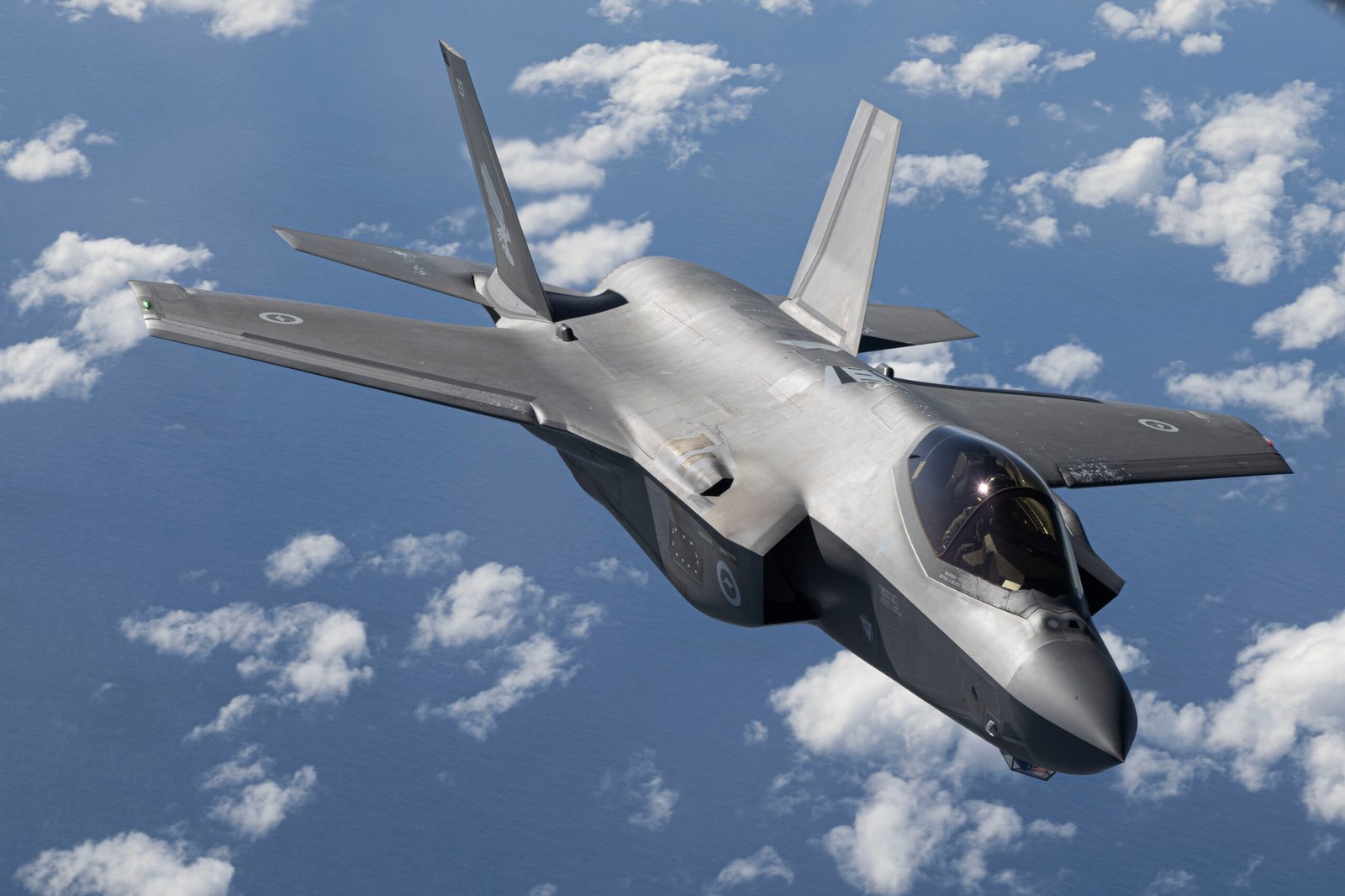
The Royal Australian Air Force (RAAF) is enhancing the strike capabilities of its key platforms through a series of advanced weapons integrations.
These include the Long-Range Anti-Ship Missile (LRASM) across the F-35A, F/A-18F and P-8A fleets to improve long-range maritime strike, and the Advanced Anti-Radiation Guided Missile – Extended Range (AARGM-ER) on the EA-18G and F-35A to target enemy radar systems.
The Joint Air-to-Surface Standoff Missile – Extended Range (JASSM-ER) is also being integrated onto the F/A-18F and F-35A to strengthen land attack capability, alongside the addition of the Joint Strike Missile (JSM) to the F-35A fleet.
In parallel, the F/A-18F will be capable of employing hypersonic air launched weapons in the future. Under the Australian-US Southern Cross Integrated Flight Research Experiment (SCIFiRE) programme, both countries are collaborating on the Hypersonic Attack Cruise Missile and this will be integrated across the Super Hornet fleet.
It was also revealed that the RAAF’s E-7A Wedgetail airborne early warning and control aircraft, which has been incrementally upgraded over its two decades of service, will eventually be replaced by a next-generation platform. While options and timelines remain unconfirmed, Boeing is contracted to sustain and upgrade the current fleet for another decade.
Having entered service just a decade ago, ten C-27J Spartan aircraft will be withdrawn early, with an unidentified fleet of commercial aircraft to replace them for logistics transport across the Pacific. The RAAF has been dissatisfied with the aircraft due to high operating costs and its failure to deliver the intended battlefield airlift capability.
Australia will continue investing in the Boeing MQ-28A Ghost Bat collaborative combat aircraft, which will enhance the lethality and survivability of the crewed fleet through sensing, electronic warfare, strike and missile defence capabilities.
Maritime domain
The Royal Australian Navy (RAN) – which recently marked its 125th anniversary – is being developed into a force with significantly lethal capabilities across the surface, subsurface, air and land domains.
This includes the introduction of conventionally armed, nuclear-powered submarines under the AUKUS trilateral partnership with the US and UK. Under the plan, Australia is expected to acquire three former US Navy Virginia-class submarines, with the potential for up to two additional boats if required, from the early 2030s.
This will be followed in the 2040s by the SSN-AUKUS, based on a next-generation UK design that will integrate technologies from all three nations.

Alongside this, the RAN is developing uncrewed underwater and surface vessels to complement the fleet in roles such as intelligence, surveillance, reconnaissance (ISR), strike and logistics operations. Large optionally crewed surface vessels could also be added in future.
Examples of uncrewed platforms include the Anduril Ghost Shark extra-large uncrewed underwater vehicle, the first of which was recently delivered to the RAN, as well as a fleet of uncrewed surface vehicles such as the Bluebottle and Speartooth.
The surface combatant force is also being upgraded with long-range strike/anti-ship and air defence missiles such as the Tomahawk, Naval Strike Missile and SM-6, enabling engagement of land, maritime and air targets at greater distances.
Undersea warfare capability will be strengthened through six new Hunter-class frigates, while the broader surface fleet will be boosted by eleven Upgraded Mogami-class frigates, with the first three recently signed into contract.
Upgrades to the three Hobart-class destroyers are also on the cards.
Space and cyber domains
Australia will also strengthen its space and cyber capabilities to support ISR and resilient communications.
In space, this includes a multi-orbit satellite communications system, the Australia-UK-US Deep Space Advanced Radar Capability, and investments in geospatial intelligence and space control.
In cyberspace, upgrades to defence networks aim to improve resilience, alongside expanded defensive cyber systems and increased workforce capacity.
by Roy Choo
