

ABSTRACT
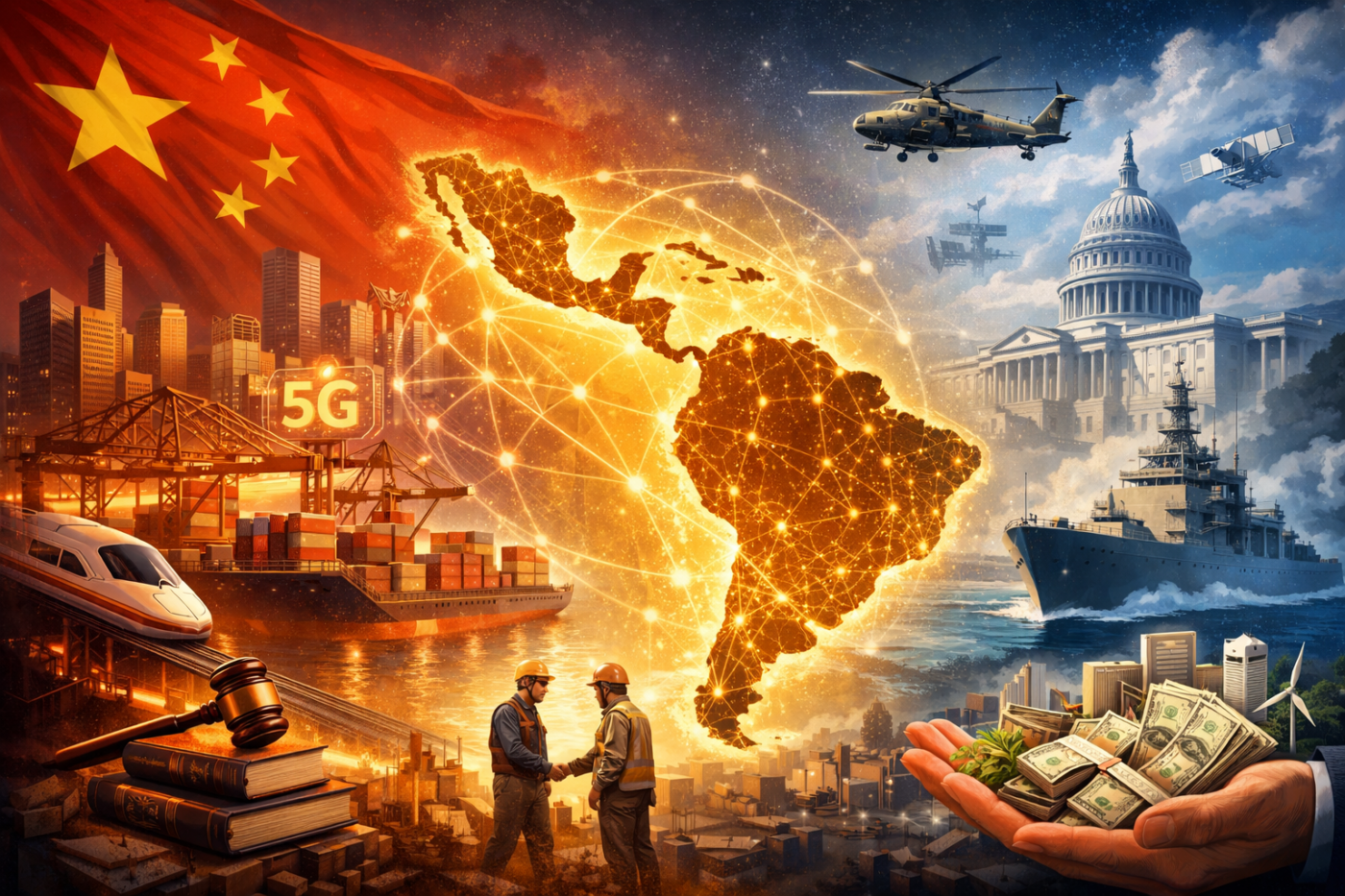
China’s growing role in Latin America is framed as more than routine geopolitical competition, instead resembling a form of “unrestricted warfare” that uses economic, technological, legal, and informational tools to reshape the regional strategic environment below the level of armed conflict. The article argues that while Latin American states retain agency, the United States’ main challenge is to provide credible alternatives to China’s deepening, structurally influential presence.
There has been an increased focus by the United States on the Western Hemisphere in the latest National Security Strategy, but strategic competition in the region did not begin with Washington’s rediscovery of it. The People’s Republic of China (PRC) has increased its influence in Latin America with one analysis by the European Parliament stating that China could overtake the US as the continent’s most important trading partner by 2035. According to the PRC’s 2025 Policy Paper on Latin America and the Caribbean, the areas that the PRC is attempting to integrate itself into Latin America are as diverse as trade, infrastructure, and BeiDou navigation integrations. While some Western commentary might indicate that this is simply a theatre of ‘geopolitical competition’ between the US and China, are we mislabeling these activities as “competition” when they fit more closely within the logic of unrestricted warfare?
Unrestricted warfare is a concept taken from the book of the same name written ostensibly by two Chinese People’s Liberation Army Air Force colonels in 1999. According to an article by Professor Gerschaneck, the colonels wrote about the PRC engaging in asymmetric warfare against the United States by using non-military tools ranging from leveraging international law and economic warfare to cyber operations and terrorism. Unrestricted Warfare (UW) and the tactics it espouses are not official Chinese doctrine, even if elements of the tactics it proposes do appear in official sources. The definition of Unrestricted Warfare (UW) that is used in this piece, namely a whole-of-state approach by the PRC to reshaping the strategic environment in Latin American through asymmetric non-military tools, is contested. A 2016 RAND report argues that “use of measures short of war is neither unrestricted nor warfare”. However, unlike similar terms, such as hybrid warfare or grey-zone competition, UW not only has been used to address Chinese activities, it is also better at addressing the whole-of-state coordinated approach employed by the PRC. While acknowledging this contestation, this phrase can provide a framework to judge China’s strategic below threshold activities in the region – cognisant that China is not formally ‘at war’ with the United States. This is because these activities enable the PRC to shape the strategic environment within which both states would operate doing wartime. More importantly, the strategic logic of UW remains useful because, as per an US Army War College study, “a nation can exercise deterrence by choice—proactively shaping the environment to constrain the adversary to choices that do not threaten”; it also called the current strategic competition between the United States and China in between war and peace, which lends credence to use of UW in this context.
Latin America has traditionally been within the US sphere of influence – a key part of the now 200-year-old Monroe Doctrine. Depending on how – and whether – the US reengages with the region, these countries could pivot towards China, despite their traditional links. The current administration has identified critical minerals as key to national security. Latin America holds significant untapped reserves of these minerals, including 35% of lithium reserves. Brazil has the third largest global reserves (after China and Vietnam) in rare earths, which are crucial for defence technologies, from the F-35 to submarines and munitions. The National Security Strategy acknowledges the need to develop stronger economic relationships in Latin America as well as inform countries in the region about the ‘hidden costs’ of engaging economically with China (implicitly), such as “espionage” and “debt traps”.
The most visible component of China’s presence in Latin America has been its economic footprint. According to the China Daily (a state outlet), China’s trade with Latin American and Caribbean (LAC) countries surpassed $500 billion in 2024 and continues to grow, positioning Beijing as a primary market for raw materials and manufactured goods. In 2024, $8.5 billion or 6% of China’s outward foreign direct investment (OFDI) targeted the wider region. Moreover, Chinese state-owned banks have loaned more than $120 billion to LAC countries since 2005. In China’s policy towards the region, it explicitly mentions no political conditions to development assistance. However, trade and loans have been explicitly identified as components of economic warfare under the doctrine of UW. Loans can “function as a predatory instrument” to indebt developing countries and gain control of their infrastructure. This has been seen in Sri Lanka, where Hambantota port was leased to China as the former couldn’t repay its debts. While a report by BISI argues that the PRC is unlikely to engage in hostile activities using its ports, it acknowledges the wartime advantages that ownership could bring. This course of action could be a potential avenue for future action in Latin America. China is rapidly expanding its stake in critical infrastructure: state-owned COSCO Shipping has a majority stake in Chancay Megaport in Peru, one of 14 ports with majority Chinese ownership across Latin America. PRC has invested in countries’ civilian infrastructure in the past before establishing overseas military bases, prompting concern that this could be replicated in Latin America.While China has not explicitly leveraged ports in Latin America to achieve political ends, it has used infrastructure-related incentives, including stadiums, water treatment plants, and dual-use ports, after countries in Central America exchanged recognition from Taiwan to China.
CSIS reports have warned about the potential ways China could use these ports. There is an inherent dual-use logic in how they are built through Party-State coordination. During wartime, China can make use of dual-use facilities for its own military vessels, using these ports as logistics hubs that might supplement the People’s Liberation Army Navy’s limited basing abroad (as opposed to the basing of the US Navy in the Pacific). During peacetime, such ports can be used for commercial operations alongside intelligence gathering on US and allied navies. The danger of military use is exacerbated by the positioning of most Chinese-owned ports near Sea Lines of Communication (SLOCs) or chokepoints. While Chancay is not a chokepoint, it lies on a key SLOC between Latin America and China and hosts a vast logistics complex; moreover, its ability to accommodate deep-water vessels means it could directly host warships. The PRC has invested in countries’ civilian infrastructure before establishing overseas military bases, prompting concern that this pattern could be replicated in Latin America. Given the proximity of these ports to the continental United States, it would be unlikely for Beijing to overtly do so.
Beyond physical infrastructure and finance, China’s engagement in Latin America increasingly operates through legal frameworks, standards bodies, and multilateral institutions. This legal and institutional dimension is explicitly theorised within the UW framework, alongside official Chinese doctrine, the PLA’s ‘Three Warfares’, which formally incorporates legal warfare (lawfare) as a named strategic instrument alongside public opinion and psychological warfare. By contrast, broader Western concepts such as hybrid warfare and grey-zone ocmpetition, do not incorporate legal and institutional manipulation as a deliberate, codified component. This makes UW a more analytically precise lens for examining China’s behaviour specifically..Beijing has institutionalised its regional diplomacy through the China–CELAC Forum, a platform that promotes cooperation under principles of sovereignty and non-interference outlined in official PRC policy. These norms align with China’s broader diplomatic messaging in the Global South and can shape regional resistance to external security alignment initiatives perceived as infringing on domestic autonomy.
China has also expanded its role in technical standards and digital governance cooperation. The Digital Silk Road framework promotes Chinese telecommunications architecture, smart city platforms, and data governance models abroad. Experts have assessed that adoption of foreign digital standards can create long-term regulatory dependence and reduce states’ – especially developing ones – flexibility in future technology choices. This operates through bundling: telecom networks, cloud infrastructure, and governance frameworks are integrated together, raising switching costs across every layer once adoption begins. Removal becomes politically and technically costly, as domestic regulators, engineers, and firms become reliant on these systems for daily operations. In Latin America, Chinese firms have provided surveillance, data storage, and urban management systems that come bundled with technical protocols tied to the PRC. Chinese actors are now attempting to internationalise its standards beyond these bilateral arrangements.
Trade agreements also embed normative influence. China has concluded free trade agreements with Chile, Peru, and Costa Rica. Standards harmonisation within trade agreements can significantly shape domestic regulatory environments. China’s FTA with ASEAN (Association for South East Asian Nations) includes provisions for cooperation in sectors as diverse as EVs, the digital economy and supply chains.
Chinese state media outlets have signed content-sharing agreements with major Latin American newspapers and broadcasters. They have also cultivated popular bilingual social media influencers and embedded paid propaganda supplements that mimic local reporting. These partnerships typically involve publishing Chinese state-produced content — often without clear disclosure and designed to resemble the outlet’s own journalism — in exchange for financial support. A term that might be used to describe this phenomenon is ‘sharp power’. This has been defined as the “aggressive use of media and institutions to shape public opinion abroad […] used to “pierce, penetrate, or perforate the information and political environments in the targeted countries”. China has been identified as employing sharp power as part of its broader political warfare activities. However, this is part of a broader strategy, not operating on its own. Sharp power should therefore be understood as a subset of the informational element of unrestricted warfare, as it gives the PRC undue influence by shaping local narratives and discouraging critical coverage through financial leverage and opaque media integration.
There has been research linking Chinese state media’s production, even for foreign audiences, with communicating the PRC’s strategic narratives as well as shifting public opinion. A report by Freedom House explicitly states that China’s state media and organs are used to further its goals “expanding Beijing’s global influence, ensuring openness to Chinese investment, and limiting any international speech or actions that are perceived to threaten the CCP’s grip on power.”
According to a Diplomat article discussing the 2025 Chinese Policy Paper, the document outlines a strategic expansion of elite engagement through training programs and exchange visits for Latin American officials, journalists, and scientists hosted by PRC institutions. These initiatives, organised under programs such as the “Global Civilization Initiative” and the “Peace Program”, focus on governance, digital technologies, and security, exposing regional leaders to Chinese administrative, judicial, and technological models like the BeiDou satellite system. China’s elite engagement programs in Latin America resembles sharp power as defined previously. This form of influence, while licit and not overtly coercive, can shift the incentives and worldviews of regional leaders in ways that privilege Beijing’s strategic objectives, thereby meeting criteria for elite capture as a sub-threshold foreign policy tool that reshapes governance preferences rather than engaging in open conflict. Co-optive influence on elites fits within a broader theory of competitive statecraft outside traditional warfare.
Parallel to these state-to-state and institutional exchanges, the Chinese Communist Party’s International Liaison Department (ILD) conducts sustained party-to-party engagement across Latin America, cultivating long-term relationships with both ruling and opposition political elites while promoting CCP governance narratives and ideological frameworks. The scale of these interactions is significant. Between 2002 and 2017, the CCP held nearly 300 meetings with 74 political parties across 26 LAC countries and state media claimed in 2012 that over 90 political parties in over 30 countries were involved in “friendly exchanges” with the CCP. Although often low-visibility and framed as “dialogue” or “experience sharing,” these interactions function as a political influence infrastructure that socializes regional actors into Chinese policy preferences and helps smooth the political terrain for deeper economic, diplomatic, and technological integration with the PRC.
Technology ecosystems further reinforce these networks. Chinese firms such as Huawei have built large portions of regional telecommunications infrastructure, and the U.S. Federal Communications Commission has identified security concerns associated with reliance on these vendors in sensitive networks.While these systems are commercially operated, private firms are also required to store data in China and hand over all data to the Chinese government.
A final consideration in this must be Latin American agency. These states, similar to middle powers around the world, are hedging between the US and China. LAC states seek strategic autonomy, the capacity to cultivate multiple partnerships without surrendering independent foreign policy. This complicates the UW framing: if states are willingly engaging with China to maximise their own interests, Beijing’s activities cannot be characterised as purely coercive. As noted in some commentary, China is offering to fill capabilities that these states lack – and the US hasn’t provided. More cynically, LAC countries are capable of maximising economic advantages, leveraging their natural resources and balancing influence from both great powers. Indeed, Brazil’s hedging strategy explicitly seeks dual, proportional and simultaneous engagement with both superpowers for deterrence and profit, suggesting economic engagement with Beijing does not automatically translate into strategic alignment. Therefore, Latin American agency and overlapping national interests cannot be ignored when engaging with the region.
China’s activity in Latin America is not traditional military confrontation, but it systematically alters the strategic environment in ways consistent with the logic of Unrestricted Warfare across institutions, media and economies. This has been demonstrated across seven interlocking mechanisms: economic and financial tools including trade, loans, and infrastructure investment; dual-use port ownership near critical SLOCs; legal and institutional influence through multilateral forums and trade agreements; digital standards and telecommunications architecture that create structural lock-in; state media partnerships and sharp power that shape elite and public narratives; elite capture through training programs and the Global Civilization Initiative; and sustained party-to-party engagement through the ILD that socialises regional actors into CCP governance preferences. The cumulative effect is a reshaping of the strategic landscape, constraining future choices of states as well as American activities— without open conflict. The central issue, then, is less about halting China’s presence outright and more about whether the United States and its allies can offer credible, transparent, and sovereignty-respecting alternatives. Without such options, Beijing’s influence is likely to expand not through overt force, but through deepening patterns of structural dependence built over nearly two decades of sustained engagement.
