

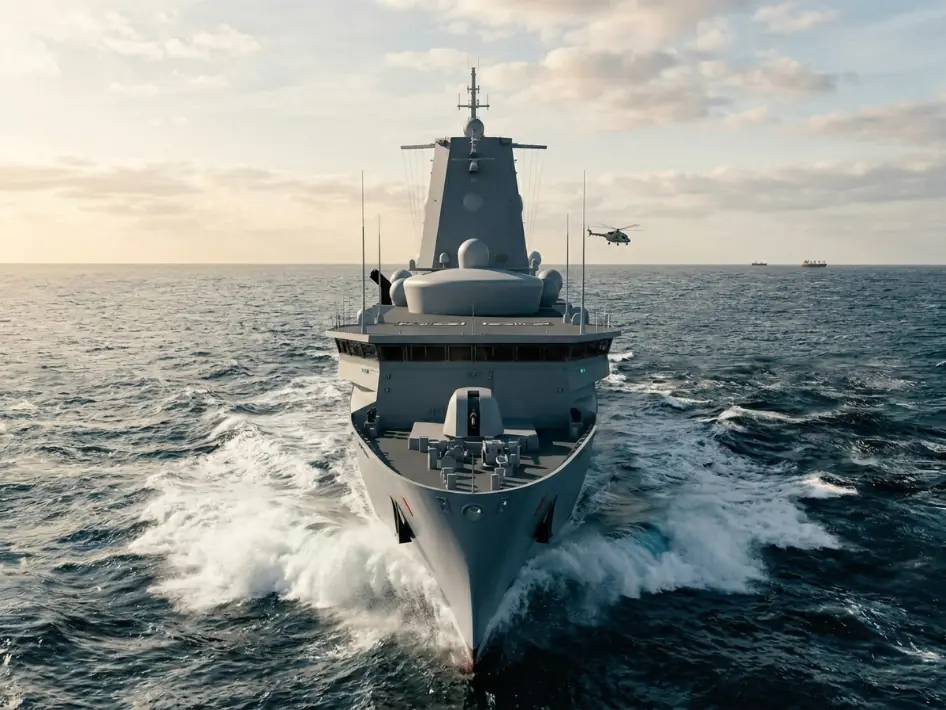
Defense Feeds, Wolgast – Germany has accelerated production of a critical maritime intelligence capability. Rheinmetall Naval Systems moved into early construction of the country’s third Class 424 intelligence vessel, cutting steel at Peene-Werft shipyard on April 16, 2026, ahead of original schedule.
The Germany Class 424 Intelligence Ship Enters Early Production program signals Berlin’s determination to modernize maritime intelligence-surveillance-reconnaissance capabilities with platforms designed for persistent collection, enhanced situational awareness and effective operations in increasingly contested waters.
This strategic acceleration keeps the Bundeswehr on track to field new intelligence platforms that sharpen Germany’s ability to monitor activity in contested naval environments and generate timely intelligence for fleet and joint-force commanders.
The Germany Class 424 intelligence ship represents a generational shift from Cold War-era platforms. These vessels operate as dedicated maritime reconnaissance platforms optimized for signals intelligence, communications intelligence and electronic intelligence operations.
With approximate length of 130 meters and displacement exceeding 4,000 tons, these ships are significantly larger and more capable than legacy OSTE-class vessels they replace. Expanded size enables integration of more powerful sensor arrays, larger mission crews and advanced onboard processing infrastructure for high-volume data exploitation.
Advanced Maritime Intelligence Architecture
The defining feature of the Germany Class 424 intelligence ship design is its role as a sea-based intelligence node within Germany’s broader multi-domain operational framework. Vessels are equipped with state-of-the-art electromagnetic spectrum monitoring systems capable of detecting, intercepting and analyzing radar emissions, communications signals and other electronic signatures across vast maritime regions.
These systems include multi-band antenna suites, direction-finding equipment and secure data links enabling real-time intelligence transmission to joint command structures ashore and within NATO networks.
The ships will conduct persistent surveillance missions in strategically sensitive areas including the Baltic Sea, North Sea and North Atlantic approaches. Their primary role involves monitoring adversary naval movements, tracking electronic emissions from warships and coastal defense systems, and mapping the electromagnetic battlespace.
This capability proves critical for early warning, threat identification and supporting targeting processes for allied forces. Unlike airborne intelligence-surveillance-reconnaissance platforms, these Germany Class 424 intelligence ships offer sustained presence and endurance, allowing continuous intelligence collection over extended periods without reliance on host-nation basing.
The vessels also support cyber-electromagnetic activities conducted by the CIR, reflecting Bundeswehr emphasis on integrating cyber and electronic warfare capabilities into naval operations.
Operating as forward-deployed intelligence platforms, Class 424 ships contribute to both defensive and offensive information operations, including electronic support measures and potentially enabling electronic attack coordination in joint operations. Their role extends beyond passive collection to becoming active participants in shaping the information environment at sea.

Design Features and Survivability
From survivability and design perspective, the Germany Class 424 intelligence ship incorporates reduced-signature features including optimized hull shaping and electromagnetic-emission control measures to limit detectability.
While not frontline combatants, these vessels must operate in proximity to contested zones, requiring enhanced self-protection systems, secure communications and resilience against electronic and cyber threats. Modular internal layout allows future upgrades, ensuring adaptability to emerging technologies including artificial intelligence-assisted signal analysis and next-generation electronic warfare systems.
The replacement of OSTE-class platforms with Class 424 marks critical transformation in Germany’s maritime intelligence posture. Older platforms, commissioned during Cold War, focused primarily on regional surveillance with limited processing capacity.
In contrast, Germany Class 424 intelligence ship is designed for network-centric operations, capable of handling massive data volumes and integrating seamlessly into allied intelligence architectures. This transformation aligns with NATO’s increasing reliance on shared intelligence-surveillance-reconnaissance capabilities and distributed sensing across multiple domains.
Strategic Role in NATO Operations
Looking ahead, Class 424 vessels are expected to play central role in Germany’s contribution to NATO deterrence and collective defense. Their ability to operate discreetly in international waters while gathering high-value intelligence proves essential for monitoring increasingly sophisticated adversary activities, particularly in regions where electronic warfare and anti-access and area-denial systems expand.
The early start of production signals both industrial efficiency and strategic prioritization of intelligence capabilities as core elements of modern naval power. By accelerating delivery timelines, Germany reinforces its capacity to operate effectively in electromagnetic spectrum—a domain now recognized as decisive for both deterrence and combat operations.
The ceremony at Peene-Werft, attended by Bundeswehr representatives, confirms German commitment to maritime modernization. As electronic warfare and signals dominance become central to modern conflict, these vessels provide technological foundation for intelligence operations across contested maritime regions.
