

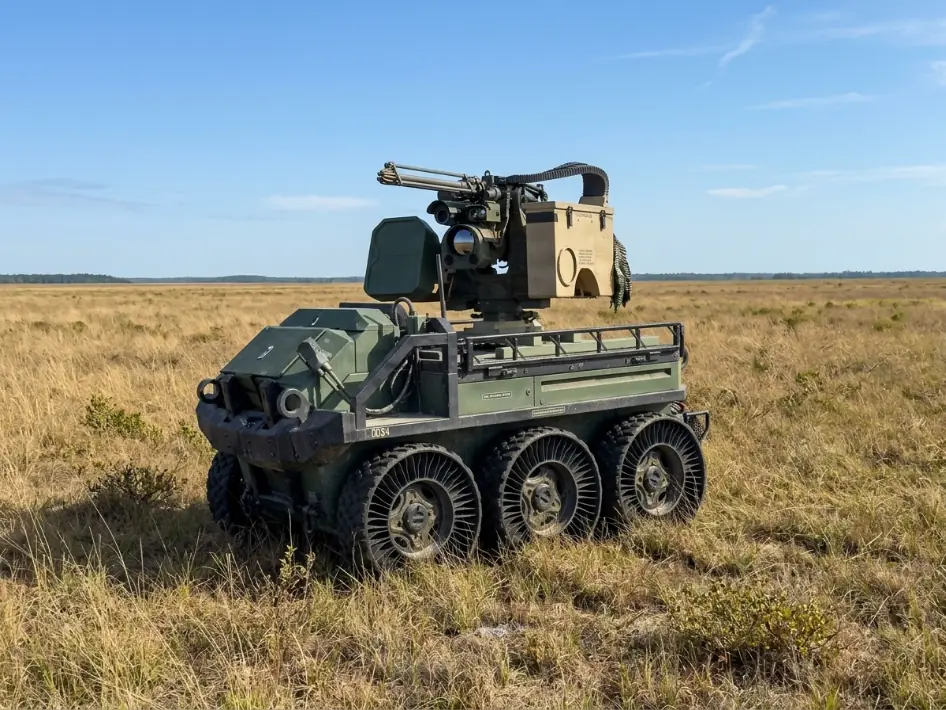
Defense Feeds, Fort Polk, Louisiana – U.S. Army Tests Hunter Wolf UGV with Armed Support Capability on April 13, 2026. The released image signals a fundamental shift in how American forces will fight and sustain themselves. The 101st Airborne Division was captured using the Hunter Wolf unmanned ground vehicle during a combat simulation exercise at the Joint Readiness Training Center.
However, this wasn’t a routine logistics test. The vehicle appeared equipped with a remotely operated .50-caliber machine gun and EchoShield radar—a configuration that transforms the Hunter Wolf UGV armed integration from simple cargo transport into an active combat asset.
The Hunter Wolf represents how the U.S. Army is bringing unmanned systems into frontline operations where soldiers have traditionally operated. As modern battlefields grow more lethal, any capability that lets units move supplies and establish security with reduced human exposure carries strategic weight. The Hunter Wolf does exactly that.
From Logistics to Lethality
The Hunter Wolf was selected for the Army’s Small Multipurpose Equipment Transport program specifically because it reduces the physical burden on troops while expanding operational reach. The vehicle demonstrated dual capability: it could transport ammunition, water, batteries, communications gear, and critical supplies while simultaneously mounting a weapon system and radar for observation and defense.
That’s the genius of the Hunter Wolf UGV armed integration. A unit commander can push supplies and firepower farther forward without exposing soldiers to direct fire. The vehicle moves ahead of formation, delivers sustainment across wider dispersion patterns, and maintains local security—all unmanned.
When threats emerge, the remotely operated .50-caliber provides immediate defensive response while troops remain under cover. The EchoShield radar component adds another dimension. It provides early warning against airborne threats, particularly drones approaching supply lines or defensive positions.

The Broader Battlefield Picture
What the 101st Airborne was testing at Fort Polk reflects a larger strategic reality: the future of American warfare is manned-unmanned teaming. Air drones have already transformed surveillance and strike operations.
Now, unmanned ground systems are following the same trajectory. The Hunter Wolf embodies this transition—it’s not just a machine to carry loads. It’s a platform designed to operate as part of a wider combat architecture where unmanned systems extend the reach, endurance, and survivability of U.S. forces.
Future operations will likely see Hunter Wolf UGV armed integration performing multiple roles simultaneously. These vehicles will move ahead of troops to scout routes and secure logistics corridors. They’ll watch key terrain, support distributed units operating independently, and help commanders maintain momentum under fire.
With mounted weapons and sensors, they contribute to broader battlefield awareness while reducing the exposure profile of dismounted infantry. This approach aligns perfectly with how the U.S. Army expects to fight in contested theaters. Modern doctrine emphasizes dispersion, rapid movement, lower signatures, and resilient sustainment networks.
Unmanned ground vehicles fit naturally into that model. They reduce dependence on manned convoys for supply movement, distribute logistics across wider areas, and enable small units to operate independently with confidence in their support network.
Learning Through Combat Simulation
The significance of testing Hunter Wolf at JRTC cannot be overstated. This isn’t a theoretical discussion or controlled demonstration. The Joint Readiness Training Center is one of the Army’s most demanding combat training environments. Commanders and soldiers get real feedback under conditions that closely approximate actual warfare. That learning cycle is critical.
As major powers race to integrate autonomous and semi-autonomous systems into land warfare, the U.S. advantage depends on more than acquiring new machines. It depends on learning how to integrate them effectively into real formations, real doctrine, and real battlefield problems.
Every JRTC exercise with Hunter Wolf UGV armed integration teaches commanders what these systems can do, where they add value, and how to combine them with infantry, artillery, air support, and tactical maneuver.
Future American battlefield advantage will not belong to the force that moves fastest or fires farthest alone. It will belong to the force that best combines soldiers, sensors, weapons, and unmanned systems into a coherent combat network. The Hunter Wolf is a crucial node in that network.
In coming years, these vehicles will not simply support operations—they will help define them. A platoon moving through contested terrain will have Hunter Wolf platforms ahead, alongside, and providing overwatch.
The Hunter Wolf UGV armed integration tested by the 101st Airborne is a glimpse of that future. It shows unmanned ground vehicles moving from experimentation toward operational relevance. For the U.S. Army, that’s not just modernization. It’s a shift toward a more robotic, more networked, and more survivable way of fighting.
