

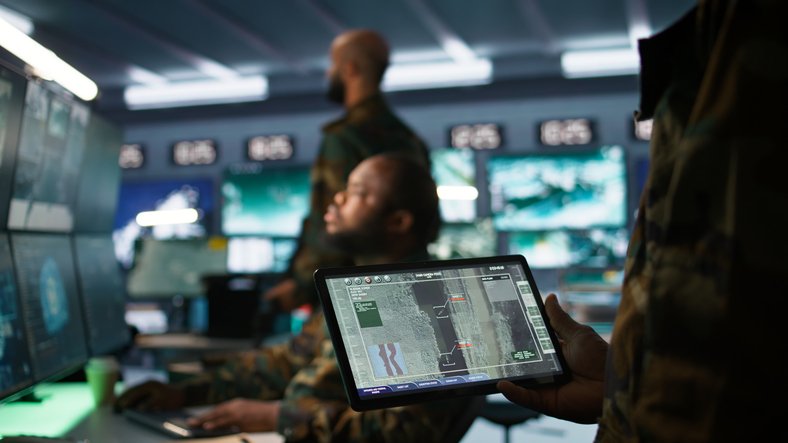
“This accelerator is larger than Task Force Sabre, it’s part of the official organization. We’re building it out as we speak,” Maj. Gen. Robert Kinney said.
When Defense Department officials reviewed the state of AI inside the Defense Intelligence Agency in 2024, they found a problem the government is too familiar with — while numerous AI initiatives were underway, most efforts were siloed, bespoke and impossible to scale across the enterprise.
“We also had an inspector general report at the time that had done an investigation under the hood, as well as where we were at. I went back to [then-DIA Director Lt. Gen. Jeffrey Kruse], and I told him I don’t think we’re aligned correctly and we’re at risk — if we don’t get this right — of driving ourselves into irrelevance in a short period of time,” Maj. Gen. Robert Kinney, DIA’s chief AI officer, said on April 9 during Special Competitive Studies Project’s ai+intelligence conference.
The review’s findings prompted DIA to launch a one-year initiative known as Task Force Sabre to provide the agency with “foundational, enterprise-wide AI capabilities while accelerating adoption.”
The task force consisted of roughly two dozen personnel organized into cross-functional teams focused on capability delivery, governance, planning and programming, partnerships and workforce training.
“One of the things we wanted to prove was that not only that DIA was in business, and it wasn’t just for DIA. We wanted to do this for the nation, for the warfighters, for the people at the edge that are doing the war fighting for us,” Kinney said.
Sabre leveraged Other Transaction Authority, or OTA, an increasingly popular contracting tool across the Defense Department and other agencies used to quickly move innovative technologies into production — something DIA had never used before.
In the past year, the task force has executed six OTAs. In one case, the process moved from request for information to contract award in just 40 days.
“Not only did we want to demonstrate to the building and the organization that we can move quickly, we wanted to demonstrate outward as well,” Kinney said.
“We’re partnered with some other entities that advertise that we can go even more quickly than that, so we’re serious about staying ahead. The thing that I talk to the team about … is I want you to move like somebody’s on your heels and they’re about ready to eat you,” he added.
Building on the lessons from Task Force Sabre, DIA stood up a permanent “hub-and-spoke” organization in March called the Digital Modernization Accelerator, or DMA — also known as the “Maverick Accelerator” — to scale AI across the agency.
“This accelerator is larger than Task Force Sabre, it’s part of the official organization. We’re building it out as we speak. It’s just a few weeks in inception. it’s a little more difficult in some ways because with a task force, we could move out quickly, get around a lot of processes. When you start becoming part of a formal organization, it gets a little more difficult to do some of those things,” Kinney said.
The centralized hub oversees governance, funding and technical expertise, while mission-focused teams across directorates and combatant commands identify and develop use cases aligned with operational needs.
The agency already has several AI capabilities in the pipeline, including “ChatDIA,” its first large language model deployed on the top-secret Joint Worldwide Intelligence Communication System network. The tool has already “saved hundreds of hours,” according to Kinney. “I could say that authoritatively.”
DIA’s next goal is implementing agentic AI. “Our intention is to take the applications we’re building, tie them together and build agents… I would say that we’re moving very rapidly towards the deployment of agents within the classified fabric,” Kinney said.
Copyright
© 2026 Federal News Network. All rights reserved. This website is not intended for users located within the European Economic Area.
