

Defense Feeds, London — Royal Navy satellite data link capability reached a critical milestone when the Maritime Multi Link programme completed Phase 2c Equipment Delivery Date.
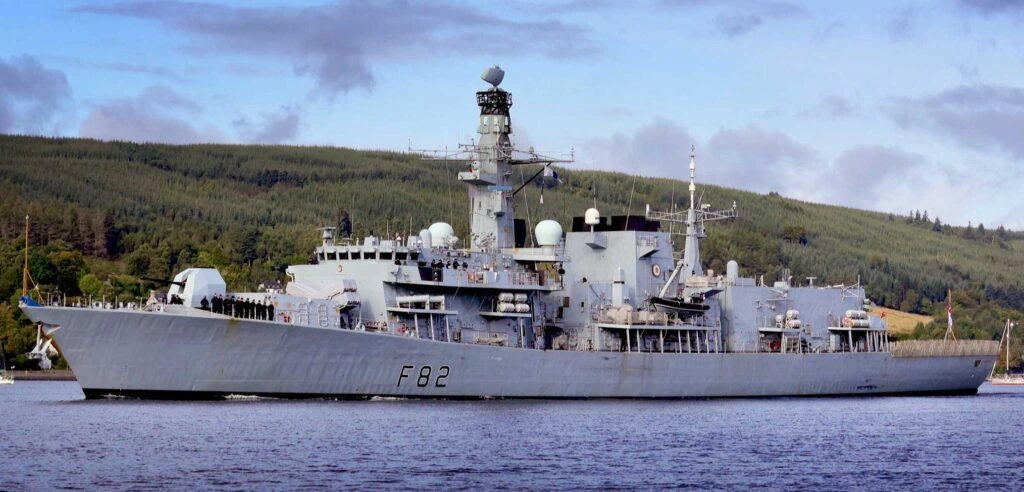
The Ministry of Defence has cleared the way for Satellite Tactical Data Link and Joint Range Extension Applications Protocol capability installation across 13 platforms including Type 23 frigates, Type 45 destroyers, and Queen Elizabeth-class aircraft carriers.
The Royal Navy satellite data link upgrade also includes updates to existing Link 11 and Link 16 message sets supporting modernized tactical communications architecture. This represents a fundamental shift in fleet operational capability by extending beyond traditional line-of-sight communications constraints.
JREAP-C protocol encapsulates tactical data link information traditionally exchanged between platforms within visual range and transmits it across satellite communications networks. This architectural innovation enables warships to share common tactical pictures with other units and command nodes regardless of geographic separation or terrain obstacles.
JREAP-C Protocol and Extended Tactical Range
Royal Navy satellite data link technology leverages the Joint Range Extension Applications Protocol for satellite transmission of tactical information.
The system extends range at which naval platforms can coordinate operations and share real-time intelligence without relying on direct radio links between units. This capability transformation addresses operational constraints that previously limited fleet coordination to visual range or high-frequency radio communications vulnerable to jamming.
Carrier Strike Group 25 aboard HMS Prince of Wales demonstrated the Royal Navy satellite data link operational value through early capability deployment.
The strike group achieved real-time operational picture sharing with command locations far beyond conventional line-of-sight ranges. This deployment transformed how the carrier strike group operated tactically, enabling coordinated actions across dispersed formations while maintaining centralized command authority.
The practical implications reshape naval task group operations during contested environments where electromagnetic security and extended ranges become critical survival factors. Warships maintain tactical coherence without emitting high-power radio signals that would reveal position to adversary detection systems.
The distributed nature of satellite communications provides redundant pathways for tactical information flow, reducing vulnerability to single point failures in communications networks.

Fleet-Wide Integration and Implementation Timeline
Royal Navy satellite data link integration across the surface fleet begins immediately following completion of Phase 2c, marking a major step in modernizing tactical communications.
The Maritime Multi Link programme will roll out the capability across 13 separate platforms, significantly upgrading the Royal Navy’s communications infrastructure. Type 23 frigates gain enhanced anti-submarine warfare coordination, while Type 45 destroyers benefit from improved air-defense coordination through extended tactical picture sharing.
Queen Elizabeth-class aircraft carriers receive the satellite data link as a critical command platform upgrade, enabling more centralized control of dispersed strike group formations.
The programme had to overcome multiple challenges, including delays in equipment contracting and stringent software assurance requirements. These difficulties were compounded by highly congested testing schedules that demanded careful planning and execution.
Strong collaboration played a central role in meeting the programme’s objectives. Close working relationships between the Navy Acquisition Programme Team, the DE&S Situational Awareness Command and Control Delivery Team, and BAE Systems were key to achieving this milestone. Their joint efforts ensured that integration work stayed on track despite technical complexity and schedule pressure.
Programme manager Samantha Thurlby described the delivery of Phase 2c as a significant achievement that required considerable collective effort. A Joint Working Team model, spanning multiple organisations and contractor partnerships, proved essential to delivering the capability on time.
When initial equipment contracts encountered delays, the team adopted alternative procurement approaches, demonstrating flexibility in acquisition strategy and keeping the programme moving forward.
Strategic Implications and Naval Operations
Royal Navy satellite data link capability strengthens fleet coordination during high-intensity conflicts where traditional communications infrastructure may be compromised or destroyed. Enhanced tactical picture sharing enables more effective air defense coordination, anti-submarine warfare operations, and amphibious task force support. The system complements existing naval architecture while enabling future network-centric warfare concepts.
Integration with Link 11 and Link 16 legacy systems ensures backward compatibility with NATO allied navies operating established tactical data link protocols. This standardization supports coalition naval operations requiring interoperability across national forces.
The Royal Navy satellite data link capability positions Britain’s maritime forces for sustained operations in contested environments where adversaries possess sophisticated communications denial capabilities.
Future enhancements may extend Royal Navy satellite data link to additional platform types and support increasing numbers of unmanned systems requiring tactical integration.
The modular architecture enables incremental capability improvements without requiring complete system replacement. British shipbuilding and defense integration expertise demonstrated through this programme establishes precedent for future communications modernization across naval platforms.
