

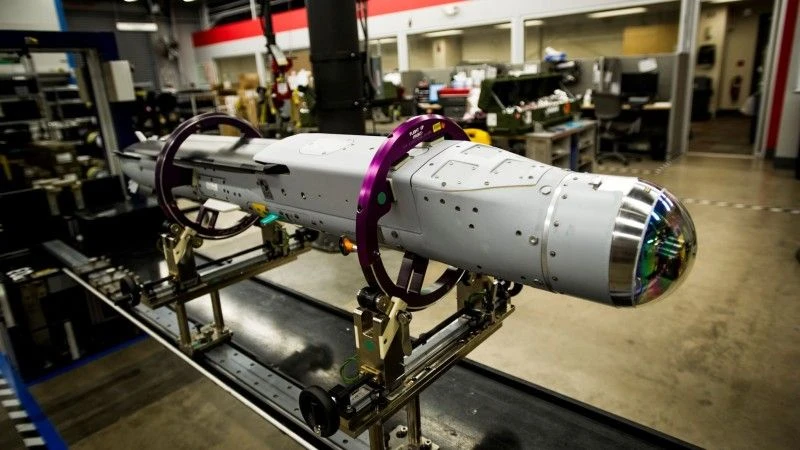
Defense Feeds, Tucson — US StormBreaker production contract worth $708.9 million was awarded to Raytheon for manufacturing advanced precision munitions across multiple allied nations. Eight countries will receive deliveries: South Korea, Italy, Canada, Germany, Norway, Finland, Belgium, and Switzerland.
The agreement covers production through March 2030, cementing this precision weapon’s critical role across America’s global alliance network.
The contract encompasses all up rounds, test equipment, containers, and spare parts for the advanced munition system. Raytheon will manufacture systems at its Tucson, Arizona facility under oversight from the US Air Force Life Cycle Management Center at Eglin Air Force Base, Florida.
This centralized production structure ensures standardization across all recipient nations and maintains reliable supply chains through the end of this decade.
Advanced Precision Capability Across Multiple Platforms
The GBU-53B StormBreaker uses integrated GPS, inertial navigation, and data link communication to engage both stationary and moving targets with exceptional precision. Weighing only 208 pounds and measuring 69 inches long, the munition allows fighter jets to carry substantially more weapons than larger alternatives, extending operational range and mission flexibility.
The effective range exceeds 40 nautical miles, keeping launch platforms safely outside most air defense system effective ranges and providing strategic standoff capability. Current integration focuses on the F-15E Strike Eagle as the primary deployment platform for US and allied air forces.
Development teams are actively working on compatibility with the F/A-18E/F Super Hornet and F-35 Lightning II for broader allied deployment across NATO and Indo-Pacific partners.
Multi-platform integration ensures diverse air forces using different fighter jets can employ standardized StormBreaker systems, significantly simplifying logistics and reducing supply complications across international operations.
The precision guidance system directly reduces unintended civilian impacts during military operations in populated regions. Commanders can achieve tactical objectives with minimal collateral consequences compared to unguided munitions or less accurate weapons systems.
That operational advantage addresses both military effectiveness requirements and humanitarian concerns facing modern air campaigns in civilian areas.

Allied Expansion and Strategic Implications
The eight-nation recipient list reflects NATO’s commitment to interoperable air strike systems and deepening US partnerships across Europe and the Indo-Pacific region.
South Korea receives systems that strengthen the critical US-South Korea security partnership against North Korean threats and regional instability. European recipients span strategically important regions: Germany and Italy for NATO’s central and southern flanks, while Finland and Norway increasingly face heightened Russian military activity along their borders.
This geographic distribution creates a global network of allied nations equipped with standardized precision weapons for coordinated operations. When allied air forces operate together using compatible munitions and integrated command structures, coordination and targeting efficiency improve dramatically across joint operations.
Interoperability at the munitions level cascades into broader tactical advantages during multinational military campaigns and crisis response operations.
The production timeline extending through 2030 reflects Pentagon confidence in sustained, long-term demand for precision air strike capability among allied nations. Prior approvals for Poland, Japan, Romania, and Canada during 2025-2026 support this strategic trajectory and demonstrate growing international interest in advanced munition systems.
Manufacturing and Defense Industrial Base Considerations
Concentrating StormBreaker production at a single Raytheon facility creates significant manufacturing efficiencies while maintaining strict quality control standards throughout the production process.
The Tucson facility produces for both immediate US Air Force requirements and international allied orders simultaneously, maximizing production economies of scale and reducing per-unit costs.
Robust supply chain security becomes absolutely critical since production interruptions would simultaneously affect eight nations’ defense capabilities and operational readiness. The facility represents significant US defense industrial capacity in precision munitions manufacturing and advanced weapons development.
Maintaining stable production through 2030 keeps highly skilled workforce expertise employed in advanced weapons development and ensures continuity of specialized technical knowledge. That workforce capability becomes essential if expanded production emerges in response to increased allied demand or if future systems require StormBreaker-derived technologies and manufacturing expertise.
International coordination adds considerable complexity to production scheduling and component sourcing across allied nations with different supply requirements. Supply chain resilience requires careful planning to prevent disruptions that could impact multiple allied air forces simultaneously during critical periods.
Extended delivery timelines through 2030 demand sustained political commitment and budget prioritization from all recipient nations despite potential domestic economic pressures or competing defense priorities.
