

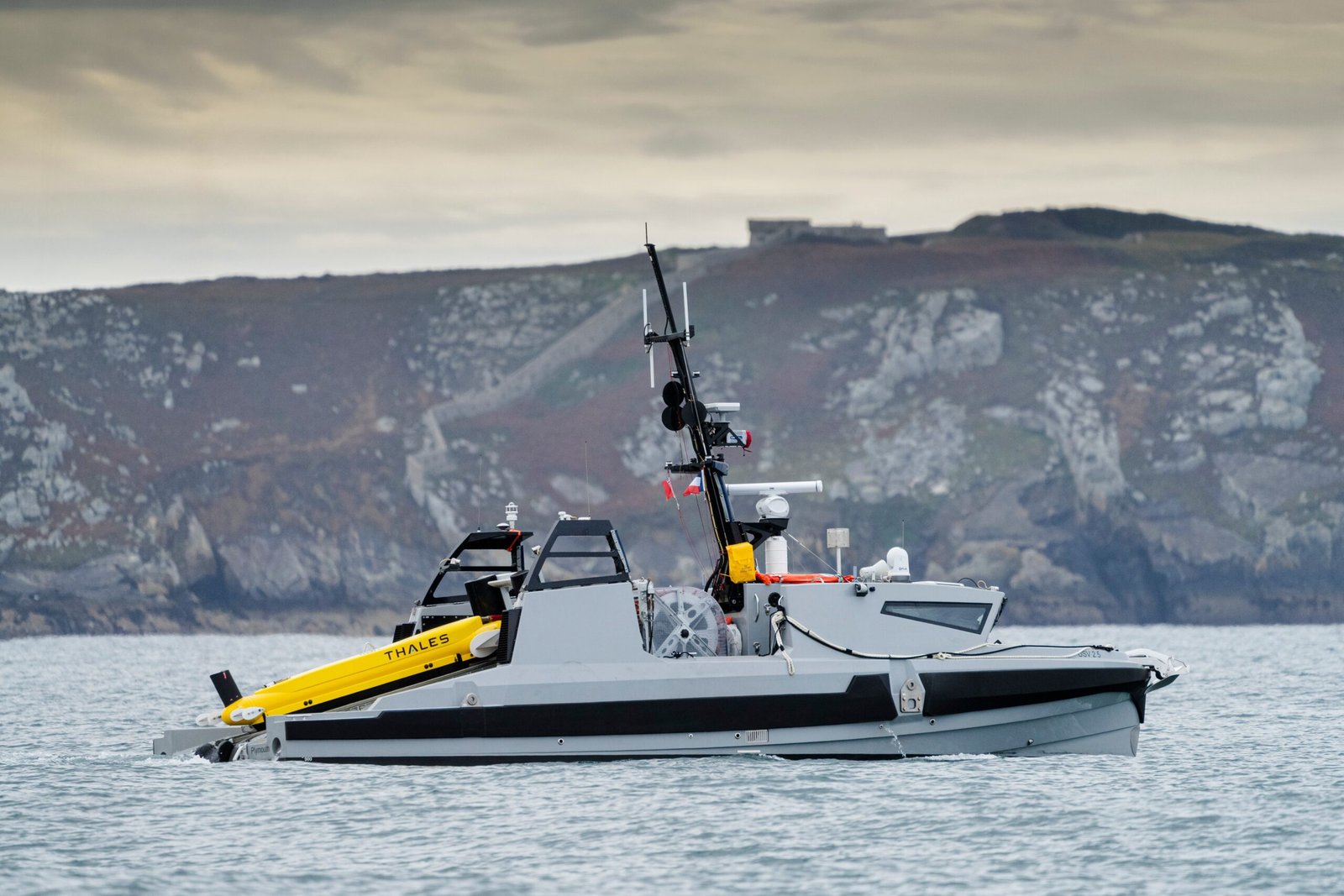
The topic of mine countermeasures (MCM) is receiving more intense attention since Iran closed the Strait of Hormuz in response to the Israeli-US Operation Epic Fury. It is therefore timely, though coincidental, that Thales has released a new expeditionary version of its PathMaster MCM system.
Sébastien Guérémy, Vice President of Underwater Systems at Thales, explained: “As seas become increasingly contested and navies face unexpected threats and challenges, mine countermeasures have become a key discipline to ensure the sovereignty and safety of critical infrastructures and sea lines of communication.”
He said Expeditionary PathMaster “is a turnkey game-changer: modular, scalable and powered by artificial intelligence. We’re bringing navies the digital transformation and dronisation that give them the decisive edge -today and tomorrow.”
Unveiled on 26 March, officials were keen to emphasise that Expeditionary PathMaster makes use of proven subsystems such as Thales’ Mi-Map sonar analysis software and M-Cube mission management system.
Indeed, it is based on a system developed for the French Navy, with Thales already delivering MCM drone systems to both the French Navy and Royal Navy. It was also tested successfully by the Lithuanian Navy, plus Singapore selected PathMaster last year.
Thales delivered the first PathMaster tranche to France in 2021, and three years of testing followed. Benoît Drier de Laforte, Mine Warfare/MCM Advisor to Thales, said this equipment is now in its final test and evaluation phase with the French Navy.

Expeditionary PathMaster also adds cybersecurity elements and the Thales cortAIx artificial intelligence accelerator. The company claims it can process sonar data four times faster than before, with a 99% classification accuracy rate against complex threats.
The new system features an expeditionary portable operations centre (e-POC) so that mine-hunting and minesweeping can be performed anywhere around the world. Whether missions are in harbours or the open sea, the system can be operated from shore, from a rigid-hulled inflatable boat, a minehunter or any other ship platform.
Drier explained: “We want to be able to deliver – with the building blocks now available – systems or part of the system to support these countries in their own journey.” He added: “The size of the toolbox relies more on the choice of the assets you want to put into it – but it offers the ability to build a more affordable toolbox, especially if it is the first step in developing uncrewed systems for the navy.”
It also “allows a unique hybrid mine warfare capacity, which integrates manned and unmanned assets, including third-party assets,” Thales said. This might include autonomous underwater vehicles, remote operated vehicles or manned minehunters.

Eric Chaperon, Naval Advisor to Thales, emphasised that MCM operations are likely to be multilateral in this day and age. “Most of these operations are multinational, which means that they come with a required level of interoperability – and very often a combination of assets, equipment solutions from different generations – which is very complex.”
Discussing MCM operations, Chaperon said, “Most of the time you have to operate with a kind of urgency, because the international community is requesting the reopening of the navigation passage very quickly.” Furthermore, “you must guarantee that this passage will be completely swept”.
Of course, the Strait of Hormuz poses a thorny problem, since it falls within a weapons engagement zone. Iran can fire upon any MCM assets working in the chokepoint, and this is presumably why the US Navy moved MCM platforms such as USS Tulsa and USS Santa Barbara out of the Persian Gulf to Malaysia and Singapore prior to Epic Fury kicking off.
Sea mines have also been used in the Black Sea.
Chaperon told Asian Military Review that there is interest in MCM solutions in Asia (such as from Japan and Singapore) as well as in Europe. “I wouldn’t say the interest in mine countermeasures has been renewed: it has been raised up and we are more conscious of it. Regarding navies, they’ve always been concerned about mine countermeasures.”
There is no order for Expeditionary PathMaster yet, though demonstrations haven been given to navies, including a couple of Asian ones, in recent weeks.
by Gordon Arthur
