

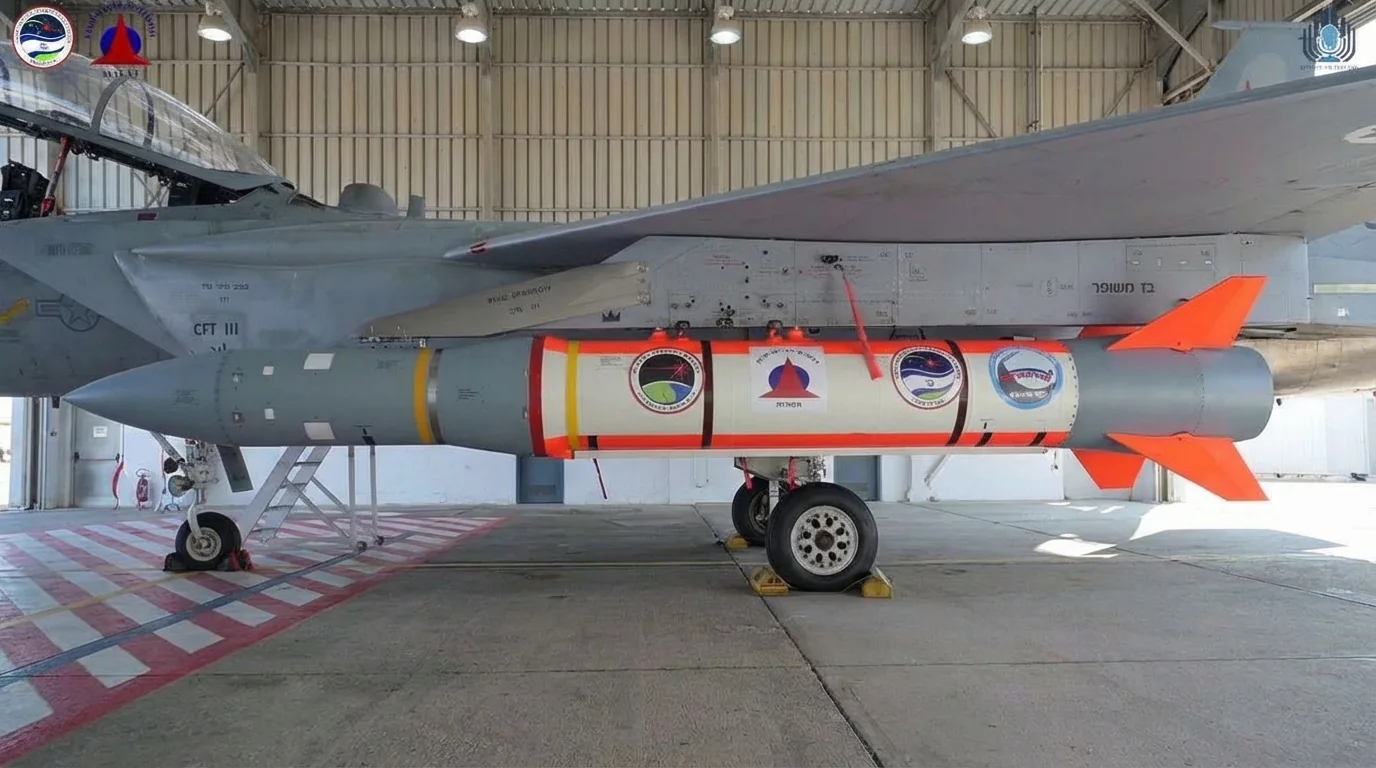
There’s something oddly dramatic about a weapon that begins its journey under the wing of a fighter jet… only to arc upward toward the edge of space before diving back to Earth at blistering speed.
That’s essentially the story of the Blue Sparrow Missile, a system that quietly sits at the intersection of missile-defense testing, aerospace engineering, and modern long-range strike strategy.
In recent years, the phrase “Blue Sparrow missile” has popped up more frequently in defense briefings, military forums, and geopolitical news cycles. And not without reason. This air-launched ballistic missile, developed in Israel, plays a surprisingly versatile role.
On one hand, it’s designed as a target missile to help test advanced interception systems like the Arrow missile defense shield. On the other, its technology hints at something more interesting: a potential stand-off strike weapon capable of traveling thousands of kilometers.
So what exactly makes this missile special?
Unlike traditional ground-launched ballistic missiles, the Blue Sparrow begins its flight from an aircraft, usually a modified fighter jet. That simple change in launch platform dramatically expands operational flexibility. It means the missile can be fired far from the battlefield, from unpredictable angles, and even outside enemy radar coverage.
Think of it like launching a sprint runner halfway down the track instead of at the starting line.
The result is a missile that climbs high, sometimes into near-space altitudes, before plunging back toward its target at extreme speed.
For missile defense engineers, it’s the perfect tool for simulating real ballistic threats. For military planners, it represents a fascinating evolution in air-launched ballistic missile technology.
In this post, we’ll unpack everything about the Blue Sparrow Missile, its origins, specifications, technology, and why it has quietly become one of the most intriguing systems in modern aerospace warfare.
What Is the Blue Sparrow Missile?
At its core, the Blue Sparrow Missile is a bit of a paradox. It looks and behaves like a ballistic missile designed for combat, but its original purpose wasn’t to destroy targets. Instead, it was built to play the role of the enemy.
Developed by Israeli defense contractor Rafael Advanced Defense Systems, the Blue Sparrow was designed as a target missile. In simple terms, it acts as a stand-in for hostile ballistic missiles during missile-defense tests. Systems like Israel’s Arrow interceptor need realistic threats to practice against, and that’s exactly what the Blue Sparrow provides.
But here’s where things get interesting.
Unlike many target missiles launched from the ground, the Blue Sparrow missile is air-launched. A fighter aircraft, typically an F-15, carries it high into the sky before releasing it.

The missile then ignites its rocket motor and begins a steep climb toward the upper atmosphere, mimicking the trajectory of a real ballistic weapon.
From a radar operator’s perspective, it behaves almost exactly like an incoming long-range missile.
That realism is critical. Modern missile defense systems must detect, track, and intercept threats traveling several kilometers per second. A slow or simplified test vehicle wouldn’t provide meaningful data.
The Blue Sparrow solves that problem by replicating the speed, altitude, and flight profile of real-world ballistic threats.
Another subtle advantage? Flexibility. Because the missile launches from an aircraft, engineers can control where and how the simulated threat appears, adjusting trajectories to challenge missile defense systems in new ways.
So while the Blue Sparrow Missile may not have started life as a battlefield weapon, its design reveals something deeper: a highly sophisticated platform capable of replicating, and potentially delivering, the same kind of long-range ballistic strike modern militaries increasingly rely on.
History and Development
The story of the Blue Sparrow Missile begins not with a weapon, but with a problem.
By the early 2000s, missile threats in the Middle East were evolving quickly. Countries were testing longer-range ballistic missiles, and interception technology was racing to keep up.
Israel, already investing heavily in layered missile defense systems like Arrow, faced a challenge: how do you realistically test a missile shield without a realistic missile to shoot down?
That gap led to the creation of the Sparrow missile program.
Instead of relying on outdated test vehicles, Israeli engineers at Rafael Advanced Defense Systems designed a family of missiles that could mimic different types of ballistic threats. Each version would simulate a specific category of enemy missile, from short-range battlefield rockets to medium-range ballistic systems.

The Blue Sparrow emerged as the program’s middleweight.
It was designed to imitate medium-range ballistic missiles, roughly similar to systems that might travel hundreds or thousands of kilometers.
During a test, the missile launches from a fighter aircraft, climbs on a ballistic arc, and re-enters the atmosphere just like an operational weapon. Defense radars detect it. Interceptors track it. And ideally, destroy it.
From the outside, the whole exercise looks indistinguishable from a real missile attack.
Launching the Blue Sparrow missile from an aircraft allows test planners to simulate threats from different directions and distances. Instead of firing from a fixed ground location, they can replicate missiles arriving from far beyond the horizon.
In other words, the missile wasn’t simply built to fly.
It was built to trick some of the world’s most advanced defense systems into believing an attack was underway.
Blue Sparrow Missile Specifications
When people first hear about the Blue Sparrow Missile, the natural question is: how powerful is it, really?
Unlike many operational weapons, exact technical details about this system aren’t widely published. That’s deliberate, defense projects tend to keep performance figures vague.
Still, enough information from missile tests and defense analyses has surfaced to paint a fairly clear picture of what the Blue Sparrow can do.

At a glance, the missile sits in the medium-range ballistic category, capable of simulating threats that travel well beyond a typical battlefield. It’s not the largest missile in Israel’s arsenal, but it’s certainly not small either. The system is roughly the length of a city bus and weighs close to two tons when fully fueled.
Another detail worth noting: the missile is built in multiple stages. After launch, its booster propels it upward at tremendous acceleration. Once it reaches the upper atmosphere, a reentry vehicle continues the ballistic path, exactly the kind of profile missile-defense systems are designed to intercept.
Key Technical Characteristics
| Specification | Estimated Value |
| Length | ~6.5 meters |
| Launch Weight | ~1,900 kg |
| Missile Type | Air-launched ballistic target missile |
| Estimated Range | Up to ~2,000 km (simulation profile) |
| Guidance | Inertial navigation with GPS updates |
| Launch Platform | Fighter aircraft (commonly F-15 variants) |
| Manufacturer | Rafael Advanced Defense Systems |
The range figure often surprises people. Even though the Blue Sparrow is primarily used for missile-defense testing, its simulated trajectory can reach distances similar to medium-range ballistic missiles (MRBMs).
That capability matters during defense trials. Interceptor systems must prove they can engage targets traveling at extremely high speeds and descending from altitudes exceeding 100 kilometers.
Another subtle feature is the missile’s radar signature. Engineers designed it to resemble real ballistic missiles on tracking systems. To radar operators, it appears almost indistinguishable from an actual incoming threat.
Which, of course, is exactly the point.
The Blue Sparrow Missile isn’t just about size or range, it’s about realism. Every specification is tuned to ensure that when defense systems engage it, they’re facing something that behaves like the real thing.
How the Blue Sparrow Missile Works
If you watch a Blue Sparrow Missile test on radar screens, the flight path looks almost theatrical. The missile doesn’t just fly forward, it climbs sharply, disappears into the thin edge of the atmosphere, and then plunges back toward Earth at staggering speed.

The entire process unfolds in a sequence of carefully engineered steps.
1. Airborne Launch
The journey begins under the wing of a fighter jet, most often an F-15. The aircraft climbs to high altitude, sometimes more than 10 kilometers above the ground, and releases the missile. For a moment, it simply falls. Then the rocket motor ignites.
Suddenly, gravity isn’t in charge anymore.
2. Booster Acceleration
The booster stage fires with tremendous thrust, pushing the Blue Sparrow missile upward at supersonic speed. Within seconds it is racing toward the upper atmosphere. During this phase, onboard guidance systems stabilize the missile and calculate its ballistic trajectory.
It’s not aiming for a target in the traditional sense, it’s following a mathematical arc.
3. Ballistic Climb
Once the booster burns out, the missile continues climbing due to momentum. At its peak, the missile can reach near-space altitudes above 100 km, similar to the trajectory of many real ballistic weapons.
For missile defense radars, this is the moment of truth. Detection, tracking, and interception systems begin working simultaneously.
4. Reentry Phase
After reaching its highest point, the missile’s payload, or reentry vehicle, begins falling back toward Earth. Gravity pulls it downward while aerodynamic heating builds around the vehicle.
This phase is incredibly fast. Reentry speeds can exceed Mach 8 or Mach 10, depending on the test profile.
This unusual flight path is why some analysts casually call it a “missile from space.”
In reality, the Blue Sparrow Missile is doing something very deliberate, recreating the terrifying physics of a real ballistic missile attack so that interception systems have a genuine challenge to defeat.
Why the Blue Sparrow Missile Is Important
At first glance, the Blue Sparrow Missile might seem like a niche piece of military hardware, a test missile used in controlled exercises. But zoom out a little, and its importance becomes clearer.
In a world where missile technology is advancing rapidly, systems like Blue Sparrow are critical for staying one step ahead.

Missile defense isn’t something you can test casually. Interceptors must react in seconds to targets traveling several kilometers per second. Radars must detect objects hundreds of kilometers away. Guidance computers must calculate trajectories in real time. If any piece of that chain fails, the result could be catastrophic.
That’s where the Blue Sparrow comes in.
By simulating real ballistic missile attacks, it allows engineers to stress-test defense systems under realistic conditions. It’s one thing to run simulations in a computer lab. It’s another to track an object screaming back through the atmosphere at Mach 8 or faster.
Strategic Value of the Blue Sparrow
| Strategic Role | Why It Matters |
| Missile Defense Testing | Provides realistic targets for interceptor systems |
| Threat Simulation | Mimics medium-range ballistic missiles |
| Technology Development | Helps refine radar, tracking, and interception algorithms |
| Strategic Signaling | Demonstrates advanced aerospace capabilities |
Another reason analysts watch the Blue Sparrow missile closely is the broader trend it represents: air-launched ballistic missiles.
Traditionally, ballistic missiles come from fixed launch sites. But launching them from aircraft changes the dynamics of modern warfare. Aircraft are mobile, unpredictable, and capable of launching weapons from unexpected directions.
That flexibility makes defense planning much more complicated.
Even though Blue Sparrow itself is primarily a testing platform, the engineering behind it hints at future weapons concepts. In fact, many defense experts see it as a proof-of-concept for airborne ballistic strike capabilities.
So while it may not be the most famous missile in the world, the Blue Sparrow Missile plays a quiet but crucial role in shaping how nations defend against, and potentially deliver, long-range missile attacks.
