

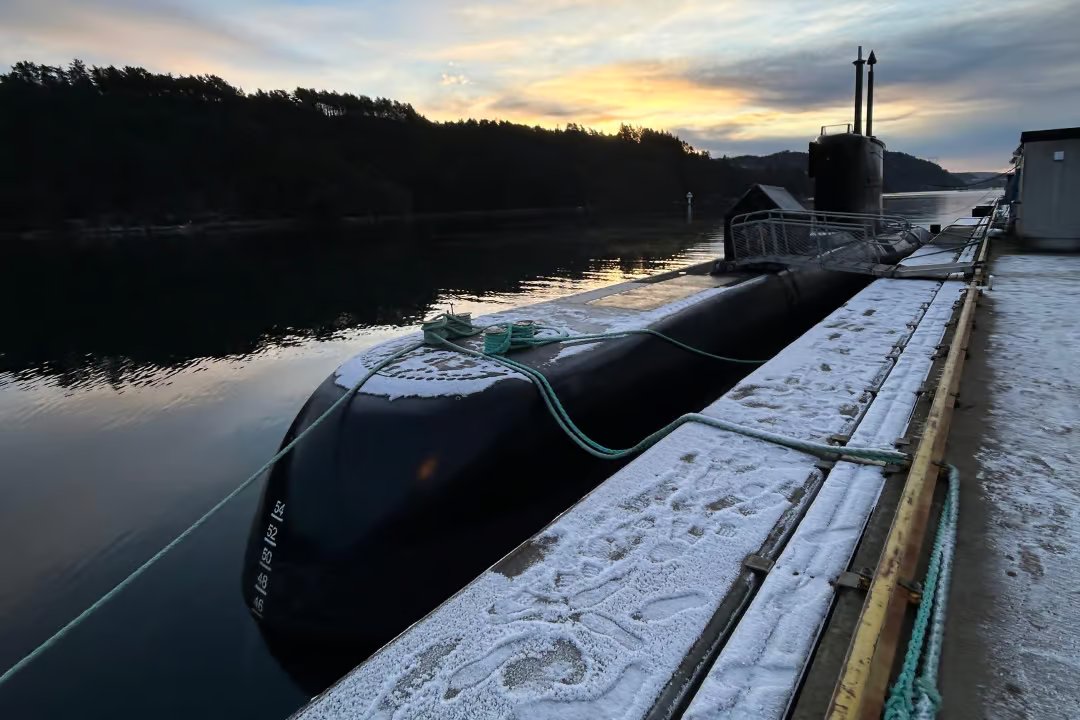

NATO’s ‘Arctic Dolphin’ anti-submarine warfare (ASW) training exercise has begun off Norway’s west coast. The annual event aims to enhance allied interoperability, readiness, and operational effectiveness in Arctic waters for both ASW ‘hunters’ and ‘the hunted’.
Alongside testing crews and capabilities, the exercise – which is running from 2 to 13 February and is hosted by the Royal Norwegian Navy (RNoN) and NATO Allied Maritime Command (MARCOM) – will also be used to certify new submarine commanding officers, MARCOM said in a 4 February statement.
‘Arctic Dolphin’ centres on Standing NATO Maritime Group 1 (SNMG1), which – as NATO’s escort-ship-based, North Atlantic-focused standing naval force – provides the bulk of the alliance’s regular at-sea deterrence and defence in the region. “The participation of NATO’s SNMG1 is particularly important, as it underscores the alliance’s commitment to maintaining a credible and persistent presence in the High North,” Commodore Kyrre Haugen, Commander Norwegian Fleet, said in the MARCOM statement.
Cdre Haugen also highlighted the opportunity for integrated training across multiple NATO allies. RNoN forces are closely integrated into the activity, with the Fridtjof Nansen-class frigate HNoMS Thor Heyerdahl and an Ula-class diesel-electric submarine (SSK) among the host nation forces present. The Norwegian boat is joined underwater by a German Navy Type 212A SSK. The maritime aviation presence includes organic, embarked helicopters and P-8A Poseidon maritime patrol aircraft (MPAs).
SNMG1 is commanded by the Spanish Navy, with the F-100 frigate ESPS Almirante Juan de Borbon as flagship. “‘Arctic Dolphin’ provides an invaluable opportunity for NATO maritime forces to operate together at sea in a realistic and challenging maritime environment to hone our tactical ASW skills,” said Rear Admiral Joaquin Ruiz Escagedo, Commander SNMG1, of the Armada Espanola in the statement.
Rear Adm Ruiz Escagedo is returning to command of SNMG1 for the second time, bringing significant experience of leading the group from the same flagship in 2024.
Regarding submarine training, MARCOM’s statement noted the presence of Royal Canadian Navy and US Navy personnel – students at the RNoN’s submarine school – aboard the Norwegian boat for ‘Arctic Dolphin’. A key exercise objective is to certify new submarine commanders by having them practise evading detection as the ‘hunted’ in the region’s challenging ASW and broader naval operating conditions. “Arctic Dolphin provides high-end, realistic training for both submarine crews and future commanding officers,” Captain Jim Robertsen, head of the RNoN’s submarine service, said. “Conducting submarine operations together with key allies is essential both for certifying commanders and for strengthening interoperability and allied co-operation.”
‘Arctic Dolphin’ is taking place in a region that is strategically vital for NATO, both for long-term allied security and in the context of the current regional instability in the Euro-Atlantic theatre. In this context, securing waters east of the Greenland-Iceland-UK (GIUK) Gap maritime chokepoint provides a basis from which NATO ASW forces can push Russian submarines further north through the Bear Island Gap, into the Barents Sea, and out of missile striking range of central European NATO targets. Strategically significant sea lines of communication (SLOCs) – both on the surface and on the seabed (in the form of critical undersea infrastructure [CUI]) – also dissect the region and must be secured. ASW presence is key for NATO in deterring and defending against regional threats in these contexts.
by Dr. Lee Willett
