

By Giacomo Leccese
On 23 February 2026, the Council of the EU decided to extend the mandate of the EU naval operation EUNAVFOR Aspides, launched in March 2024 to safeguard the sea lines of communication (SLOC) in the Red Sea and protect European commercial vessels from Houthi attacks. Aspides has marked the most demanding naval engagement of the Union to date, moving beyond the low-intensity context that has traditionally characterized EU maritime operations. The choice to operate separately from the U.S.-led Prosperity Guardian coalition also signaled a deliberate effort to assert European strategic autonomy, with distinct assets, rules of engagement, and political objectives. The renewal of the operation, after two years of sustained deployment, therefore provides a valuable opportunity to assess the performance of the mission and to measure it against the stated ambition of the EU to act as a “global maritime security provider.” Regardless of how the situation in the Red Sea and the Houthi threat will evolve in the near future, an analysis of the mission provides the opportunity to examine some general gaps in the organization and efficiency of EU naval operations, as well as some limitations in the combat capabilities of NATO navies to address high-intensity threats at sea and counter potential sea denial actions in strategic chokepoints around the globe.
The name of the mission, Aspides, comes from the Greek word for “shield” (ἀσπίς). In ancient Spartan tradition, a warrior would return from battle either carrying his shield or borne upon it. After two years at sea, will the EU return with its shield in hand, or be carried back upon it? The evidence suggests the latter. Despite some operational and tactical achievements, the mission has struggled to meet its objectives, constrained by limited naval capabilities and a mandate that remained narrow and largely reactive to Houthi actions.
Measuring Success against the Mission Mandate
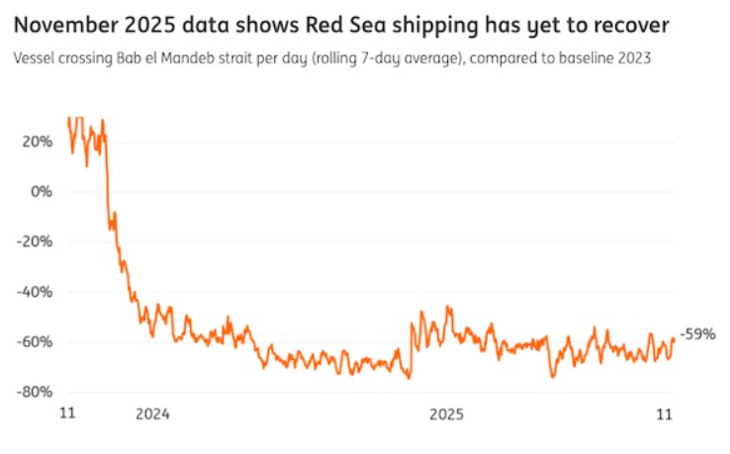
To evaluate the effectiveness of Aspides, it is necessary to measure its outcomes against its mandate. The mission’s objectives were to restore and safeguard freedom of navigation, escort and protect vessels, and enhance maritime situational awareness in the Red Sea. From this perspective, Aspides achieved notable operational and tactical results, yet did not fully accomplish its stated goals, especially those related to the restoration of freedom of navigation and the protection of ships. During the operation, shipping agencies continued to avoid the Suez route, as concerns persisted regarding the safety of merchant vessels. Despite an additional 3,000 nautical miles and approximately ten days of sailing on the Asia-Western Europe route, the shipping industry continued to choose the Cape of Good Hope route, circumnavigating Africa. Even with a modest increase in traffic following the halt in Houthi attacks, the number of ships transiting the Red Sea remained well below the pre-crisis average of 72–75 per day recorded before the onset of Houthi sea denial operations in November 2023. To resume normal traffic in the Red Sea, shipping needs to have “safe enough” conditions, which means more protection. Aspides did not achieve this threshold.
Figure 1: Traffic trends in the Red Sea Route between November 2023 and November 2025. (Source: Hellenic Shipping News)
Concerning the protection of vessels, Aspides provided support to over 1,200 ships, demonstrating the ability of the European warships employed to intercept the various air threats posed by the Houthis. Despite this, the inability of the mission to meet the commercial timelines of the shipping industry prompted some vessels to risk transiting the Red Sea without waiting for escort availability. This led several European vessels to be targeted by Houthi attacks, in some cases suffering severe damage or loss. In this sense, also the objective of escorting and protecting vessels cannot be considered fully achieved, as the escort model failed to meet acceptable standards for responding to the needs of the shipping industry.
Insufficient Assets, Insufficient Protection
A key factor explaining the inability of Aspides to guarantee the required level of protection concerns the scarcity of naval assets at its disposal. Throughout its deployment, the mission maintained an average presence of only three warships, far below the estimated operational need of at least ten naval units supported by air assets. Such a limited presence inevitably constrained the mission’s capacity to ensure regular and comprehensive coverage along a maritime corridor extending for more than 1,200 nautical miles. Under these conditions, Aspides was able to organize only a maximum of four escorted transits each day (typically two northbound and two southbound) in spite of a minimum of eight to ten daily convoy movements indicated by shipping companies to be necessary to restore pre-crisis traffic levels. The mission is based on an escort-on-demand model, in which close protection is provided to vessels upon request and naval units are assigned when available. In this model, the limited number of available warships inevitably creates long waiting times and queues for maritime traders before receiving an escort. In a commercial context where voyage decisions are made weekly, such delays have led many companies to reroute their merchant ships to the Cape Route or to attempt the dangerous passage through the Red Sea without protection. This explains both the failure to resume normal trade flows towards Suez and the attacks suffered by some unprotected European vessels, such as the Greek-operated Eternity C and Magic Seas, as well as the Dutch freighter Minervagracht.
The limited number of available naval assets reveals some significant gaps in European naval power. After the end of the Cold War and during periods of severe fiscal austerity, European navies underwent a significant downsizing. The decline in defense spending and the allocation of resources to the detriment of navies, given the importance of counterinsurgency operations in the early 2000s, reduced the number of naval units.
Despite this, European fleets have expanded their theater of operations beyond the usual seas surrounding the continent, as demonstrated by recent engagements in the Indo-Pacific. This deprives the European mission in the Red Sea of useful assets and places further strain on already limited available budgets. Furthermore, European fleets have been reshaped to focus on low-intensity operations, from crisis management to the fight against illegal trafficking, search and rescue, counter-piracy, and disaster relief. In this context, European navies lost 32% of their main surface combatants (frigates and destroyers) between 1999 and 2018, and Europe’s combat power at sea is considered to be half of what it was during the height of the Cold War. This decline is particularly impactful in the case of Aspides. Unlike other recent European naval operations, such as EUNAVFOR Atalanta, countering the Houthis requires high-end capabilities, with warships capable of providing air defense against threats such as anti-ship ballistic and cruise missiles, unmanned aerial vehicles (UAVs), in addition to unmanned surface vessels (USVs).
After years of downscaling, European navies retain only a limited number of frigates and destroyers designed for air defense. These warships are comparatively lightly armed and lack the necessary number of Battle Force Missiles (BFM) and corresponding vertical launch system (VLS) cells to conduct and sustain high-end naval operations effectively. In this context, not only are there only a few usable ships for Aspides, but these vessels also have a limited operational tempo. Indeed, in a high-intensity environment like the one presented by the Houthis, the limited number of VLS cells compared to US and Asian warships forces European units to return to a nearby base to reload their interceptor missile magazines more frequently. Added to this already limited capacity are several problems with onboard systems malfunctions, which some experts believe are due to the cost-saving construction that characterizes European warships. Several naval units destined for Aspides, such as the German frigate Hessen and the Belgian frigate Louis Marie, experienced problems with their onboard missile systems, which affected their availability for protection missions.
Mandate Limitations and the Cost Asymmetry of Protection
These limitations highlight that Aspides, and European navies more broadly, are materially unable to guarantee the level of protection required to restore normal trade flows in the Red Sea in the event of prolonged and intense Houthi sea denial operations. Beyond the difficulty of covering such a vast area and meeting a high demand for protection with limited assets, European forces face the challenge of countering a persistent missile and drone threat. The major issue is not the difficulty of intercepting them, but rather the cost of doing so. As Cranny-Evans and Kaushal note, and as already demonstrated during the Tanker War of the 1980s, “securing shipping requires a disproportionately resource-intensive effort on the part of the defender relative to the attacker when the latter has the advantage of proximity.”
In addition to the aforementioned need for replenishing VLS cells rotating to a friendly reloading facility, European naval units deployed must expend disproportionately expensive interceptors to engage relatively cheap targets. For example, in the initial stage of the operation, French frigates launched dozens of Aster interceptor missiles, costing €1-1.5 million each, against drones costing just a few thousand dollars. This economic imbalance is compounded by the strain such operations place on limited interceptor missile production capacity and stockpiles.
European navies have resorted to various tactical measures to reduce this asymmetric disadvantage, but these do not allow for completely solving the problem. One of the most used alternatives was the use of guns on deck or helicopters to shoot down enemy drones. However, as explained by Italian Navy officers, even though this solution allows for a drastic reduction in costs and does not deplete interceptor missiles stockpiles, it has two drawbacks: first, guns have a shorter range than missiles, so the drone is neutralized much closer to the ship, reducing reaction time and increasing risks; second, when used near merchant vessels for their protection, stray projectiles risk hitting them.
Another solution employed against UAVs has been the use of non-kinetic measures, such as jamming to disrupt the link with the operator and GNSS. An example of this was the use of the Centauros anti-drone system by the Greek Navy. Even in this case, however, these countermeasures were not completely resolutive. Like guns on deck and on helicopters, electronic warfare (EW) remains much less effective against other types of airborne threats, such as anti-ship ballistic missiles (ASBMs). In this sense, the primary defense remained tied to the use of expensive Aster interceptor missiles, as demonstrated by the engagements of the French Navy.
In this context of persistent asymmetric disadvantage, the only sustainable solution would have been to deter Houthi attacks or to limit their operational capabilities. However, Aspides’ exclusively defensive mandate has constituted a significant limitation in this sense. In Operations Poseidon Archer and Rough Rider (2024–2025), the United States and the United Kingdom conducted repeated airstrikes on Houthi missile sites and storage facilities in an effort to degrade their offensive capacity.
The effectiveness of these operations remains contested. Some analysts argue that their impact was limited, given the Houthis’ ability to relocate or conceal assets underground. Others, such as Knights, emphasize that the operational tempo between successive attacks in the Red Sea increased considerably after the strikes, suggesting a temporary reduction in capability.
Whatever their true effect, such operations were never a viable option for the European Union, being fundamentally incompatible with Aspides’ mandate and political objectives. Indeed, the decision to establish Aspides and not join the US-led Prosperity Guardian coalition stemmed from the preference of several EU members to avoid participation in kinetic actions in Yemen, both to prevent further escalation in the region and to avoid straining relations with Iran. Yet Aspides’ exclusively defensive and therefore reactive posture has left the mission particularly exposed to prolonged sea denial campaigns, without degrading enemy capabilities, a situation that is neither sustainable nor productive in the long term.
Addressing the Limits of Aspides: Rationalization, Coordination, and Prevention
Countering air and surface threats in coastal waters and confined basins has clearly proven a particularly difficult challenge, not only for the EU. Other operations in the Red Sea, such as Prosperity Guardian, have also failed to ensure the resumption of normal maritime traffic and have encountered similar difficulties in sustaining prolonged high-end militia threats. Both the U.S. and Royal Navy have faced the combined effects of depleted interceptor stockpiles and the cost asymmetry of defending against cheap threats, along with constraints in the number of ships available to meet operational requirements. The EU, however, unlike these two actors, in choosing to maintain an exclusively defensive approach, could have placed greater emphasis on the sustainability and effectiveness of Aspides by adopting the measures that are discussed henceforth.
The limited number of available air defense vessels is an issue difficult to overcome in the short term. European navies have begun a modernization process, commissioning new warships to restore some lost capabilities, but it will take years for these vessels to enter into operation, as many are expected around 2030. However, one of the main problems highlighted by Aspides was the inability to optimize the limited assets available. Of the 21 nations participating in the mission, only a few have contributed combat vessels (Italy, France, Greece, Belgium, and the Netherlands), and only Italy, France, and Greece have deployed assets continuously since the start of the operation. Like previous EU-led operations such as Atalanta, as well as ad hoc coalitions among European states such as Operation Agenor in the Strait of Hormuz, Aspides confirms the recurring pattern of an unbalanced commitment, especially towards the countries with the greatest interests at stake. It is no coincidence that the ports most affected by the Red Sea crisis were precisely those of Greece, Italy, and France, the main contributors to the mission.
Even the overlap between different operations with European participants in the same waters contributes to straining already limited European naval capacities. For example, several EU members, such as Denmark, Finland, Greece, and the Netherlands, participate in the Prosperity Guardian coalition, providing public, logistical or active military support. This forces some European warships to rotate and reduce their participation in Aspides to contribute to other missions. The decision to launch Aspides and not expand the existing EUNAVFOR Atalanta operating in nearby waters further contributed to a dispersion of resources.
Given the difficulty of materially and economically sustaining a prolonged threat from the coast, the EU also missed several opportunities that would have allowed it to reduce the Houthis’ offensive capabilities, even without kinetic operations on Yemeni soil. Despite the ability to produce much of their arsenal locally, the Houthis remained heavily dependent on Iranian supplies for most of the weapons used in their attacks in the Red Sea. In particular, it appears highly likely that the militia imported components or ready-made weapons in the case of short- and medium-range anti-ship ballistic missiles, anti-ship cruise missiles, and Waid drones, the most sophisticated long-range UAVs used in maritime attacks. These weapons require components and know-how not available to the militia for local production. The Houthis were therefore dependent on Iranian supplies by sea or by land on the Yemen-Omani border. As Knights evidenced, this reliance, which constitutes one of the main weaknesses of the militia, was not exploited by the naval forces engaged in the Red Sea.
The EU could have reduced the offensive capabilities of the Houthis by blocking Iranian weapons and components, both by intervening directly to intercept shipping by sea, but above all by supporting the Yemeni coast guard and border forces with capacity-building initiatives and economic and material backing. In this sense, the EU has provided partial support to the coast guard, but local experts considered the level of aid “far below what is required.” Yemeni forces have demonstrated on several occasions their ability to intercept Iranian supplies if properly equipped and assisted. For its part, the EU has shown on other occasions, such as the fight against piracy in Somalia, how it is particularly adept at capacity-building initiatives and supporting local forces. Consistently backing the Yemeni Guard Coast would have allowed the EU to degrade the capabilities of the Houthis without risking regional escalation and worsening relations with Iran. It would have also allowed the EU to enhance its reputation as a maritime security actor, working cooperatively with regional actors.

Conclusion
Beyond the specific case of the Houthis and the Red Sea, the analysis points to broader lessons. It underscores the need to improve the efficiency of EU naval operations, particularly in high-intensity contexts, while also highlighting implications for NATO as it prepares to confront the practical challenges of sustaining protracted operations in littoral waters against a well-armed, land-based opponent.
In the short and medium term, to address its limited high-end naval capabilities, the EU is called upon to better rationalize resources and improve burden-sharing. On the rationalization side, the overlapping of numerous missions involving multiple European navies in the same area of operations should be avoided because it reduces the already very limited number of warships available for each mission. From the burden-sharing perspective, once again, the particular interests of member states have constituted the main lever of contribution, leaving the level of commitment of some countries with useful naval capabilities very low, such as Germany, or inexistent, such as Spain. Increasing the level of engagement of these members is essential to increasing the number of large surface combatants available.
Even the exclusively reactive posture of Aspides has proven unsustainable given the asymmetric disadvantage of Western navies in the face of Houthi threats. In such cases, against adversaries heavily dependent on external arms supplies, the EU should combine its preference for de-escalation with its expertise in low-end capabilities, attempting to support local actors in degrading the enemy’s offensive arsenal.
Finally, the logistical and economic challenges posed by the Red Sea engagement provide an incentive to invest in specific capabilities in anticipation of possible future similar conflicts in littoral waters involving NATO. First, the need for new measures to ensure the continued availability of interceptor missiles has emerged. In this regard, the first attempts to recharge VLS at sea by the French and US navies are noteworthy. Second, the need to reduce the asymmetric cost disadvantage in the face of low-cost threats, such as drones, has been evidenced clearly. Particular attention must be given to appropriate countermeasures, such as EW and directed-energy weapons, capable of reducing defense costs.
Aspides would probably return home “on the shield” at this time, but the mission, with its difficulties, provides an opportunity to improve the European naval power.
Giacomo Leccese is an External Researcher at the Center for International and Strategic Studies (CISS) at LUISS University of Rome. He also serves as a Subject Matter Expert for the course of Strategic Studies at the Department of Political Science of the same university. His main interests concern maritime security, both in its surface and submarine dimensions, European defense, and the security dynamics in the MENA region.
Featured image: EU Extends Red Sea Maritime Security Operation Through 2026, Expands Intelligence Sharing. Source: gCaptain.
Discover more from Center for International Maritime Security
Subscribe to get the latest posts sent to your email.
