


Since The Hackett Group’s acquisition of Spend Matters last summer, the biggest change for me has been the amount of time I spend with buy-side clients who are making procurement tech selection decisions. Most of the inquiries we receive are about the intake and orchestration market, which is understandable given its growth.
I’ve learned a lot about how organizations make decisions and how to best advise them along the way. But across all these conversations, the most common takeaway for me is that with orchestration, it’s what’s on the inside that counts. People understand this, but it can be difficult to fully explain. Allow me to try.
I have written about this before, but in a nutshell, I am referring to the fact that every best-of-breed intake and orchestration solution looks good in a demo. To some extent, this is simply because legacy software is not always as easy on the eyes, so a sleek and modern UX can seem like a panacea at first.
| Sidenote: This is also where the build vs. buy debate is especially relevant to intake and orchestration. Building a modern intake solution is, relatively speaking, not that challenging. What is truly challenging is building the underlying orchestration, integrations, data management, etc., and this is why it is almost always more prudent to buy rather than build, at least for this particular market. |
The procurement leaders I speak with are well aware that the platforms beneath these solutions can differ. Their issue is that it can be very difficult to ascertain these differences, especially when they are somewhat narrative-driven. This is usually where I come in, as our SolutionMap process allows us analysts to better understand the nature of different platforms and their specific strengths and weaknesses.
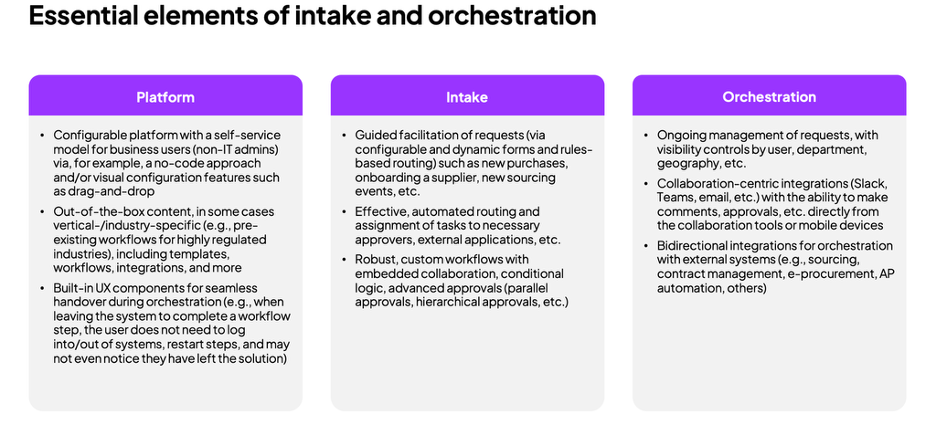
As you can see in this visual, the platform is what enables everything in an intake and orchestration solution to work properly. A functional orchestration tool needs a strong platform, as orchestration itself is largely based on the unification of people (via workflows) and tech (via integrations). As such, all of the orchestration providers in SolutionMap (and several more) have strong platforms.
However, there are still nuances within platforms that can swing tech selection decisions. For example, some standout abilities from orchestration providers that participate in SolutionMap include:
- Zip and Tonkean excel at deep integrations, as they each have native iPaaS (integration platform as a service) layers that allow for customization, which other systems cannot always match.
- ORO Labs, Omnea and ServiceNow each use AI in inventive ways by combining it with historical data and relevant context, such as via process-specific agents, risk management, etc.
- In the era of agents, it is especially important that orchestration providers have flexible platforms that allow for more than just the simple pushing and pulling of data, and these three providers are strong examples of this.
- Opstream has differentiated data modeling capabilities, particularly with respect to automated mapping and maintenance of data from integrations and the ability to directly create custom data fields in those integrated systems.
- ConvergentIS (Rio)’s platform allows users to leverage micro-apps, which are essentially more repeatable and scalable versions of AI agents, in that they allow for the completion of a single function in an automated and user-friendly way.
- Focal Point began as more of a procurement performance management platform, so its orchestration focus is complemented by strong capabilities around project and team management.
- Tropic and Spendflo each offer price benchmarks and negotiation playbooks around SaaS spend, so these capabilities are carried over into relevant intake processes.
Ultimately, each tech selection is unique, and the advice that I give to clients is largely based on organization-specific needs. However, it is still useful to map platform capabilities to those needs, and our SolutionMap process helps us maintain deep market knowledge. Please feel free to reach out if you are in a similar position!
