

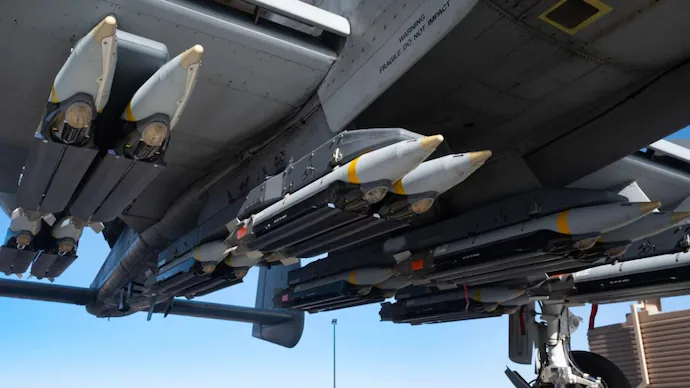
Picture a fighter jet cruising at 30,000 feet. Instead of carrying a handful of massive bombs, it’s loaded with dozens of compact precision weapons, each capable of striking a separate target miles away. That shift in modern air warfare is largely thanks to the GBU-39 Small Diameter Bomb, better known simply as the GBU-39 SDB.
At first glance, the GBU-39 doesn’t look intimidating. It’s relatively small, about 285 pounds, far lighter than traditional 1,000- or 2,000-pound bombs used for decades. But don’t let the size fool you.
The real magic lies in precision, efficiency, and range. Designed as part of the U.S. military’s Small Diameter Bomb (SDB) program, this weapon allows aircraft to hit multiple targets in a single sortie while minimizing unintended damage on the ground.
So while the GBU-39 might be smaller than traditional bombs, it represents something bigger, a shift toward precision warfare, where accuracy matters more than raw explosive power.
And that raises an interesting question: what exactly makes the GBU-39 so effective? The answer starts with understanding the weapon itself.
What Is the GBU-39 Small Diameter Bomb?
To understand why the GBU-39 Small Diameter Bomb matters, it helps to rewind a bit, back to the early 2000s, when military planners started noticing a problem. Modern fighter jets were incredibly capable, but their bomb loads were… oddly inefficient.
Traditional precision bombs often weighed 500 to 2,000 pounds each. That meant a fighter might carry only a limited number of targets per mission. If an aircraft encountered eight separate enemy positions, it might only have enough weapons for half of them. Not ideal in fast-moving combat scenarios.
Enter the Small Diameter Bomb program, a project led by the United States Department of Defense and developed largely by Boeing. The goal? Build a weapon that was smaller, smarter, and far more efficient.
The result was the GBU-39, a 250-pound class precision-guided glide bomb designed for accuracy rather than sheer blast power.
Instead of relying on brute force, the weapon uses GPS-aided inertial navigation to guide itself precisely to a target. Once released from an aircraft, small folding wings deploy, allowing the bomb to glide dozens of miles toward its destination.
But perhaps the most important design philosophy behind the GBU-39 is efficiency.
Aircraft equipped with special launch racks can carry four bombs in the space normally occupied by one traditional weapon. Multiply that across multiple pylons and suddenly a single aircraft can engage dozens of targets in one mission.
In other words, the GBU-39 wasn’t just built to destroy targets, it was built to reshape how airpower works.
GBU-39 SDB Technical Specifications
Weapons designers often say that the real story of a system lives in its specifications. In the case of the GBU-39 Small Diameter Bomb, those numbers reveal why such a compact weapon has become a cornerstone of modern precision strike operations.
The GBU-39 belongs to the “250-pound class” of bombs, but its total weight is slightly higher due to the guidance kit, deployable wings, and hardened casing. At roughly 285 pounds (129 kg), it’s dramatically lighter than traditional 1,000- or 2,000-pound bombs used by aircraft for decades.

Yet the small footprint hides some clever engineering. Once released from an aircraft, spring-loaded wings deploy from the bomb’s body, transforming the falling weapon into a long-range glide munition capable of traveling dozens of miles before impact.
Here’s a closer look at the core specs.
| Specification | Value |
| Total weight | ~285 lb (129 kg) |
| Length | ~70.8 inches (1.8 m) |
| Body diameter | ~7.5 inches |
| Wingspan (deployed) | ~59 inches (1.5 m) |
| Class | 250-lb precision glide bomb |
Warhead and Penetration
Unlike large blast bombs designed to flatten wide areas, the GBU-39 focuses on precision penetration. Its hardened steel casing allows it to punch through reinforced concrete, hardened shelters, and buried targets before detonating.
The warhead contains roughly 36 pounds of high explosive, optimized for focused blast and fragmentation after penetration. This makes the weapon especially effective against:
- Command bunkers
- Aircraft shelters
- Ammunition depots
- Hardened infrastructure
Guidance and Accuracy
The bomb relies on a GPS-aided Inertial Navigation System (INS), which allows it to navigate even when satellite signals are briefly interrupted.
Under normal conditions, accuracy is remarkable, often achieving a Circular Error Probable (CEP) of around 5–8 meters.
For a weapon launched from miles away, that’s essentially pinpoint accuracy.
GBU-39 Range and Performance
If you only looked at the size of the GBU-39 Small Diameter Bomb, you might assume it behaves like a conventional bomb, drop it, gravity does the rest. Straight down. End of story.
But the GBU-39 plays a completely different game.
Once released from an aircraft, a pair of folded wings snap open from the weapon’s mid-section. In a split second, the bomb stops behaving like a falling object and starts acting more like a compact glide aircraft. That transformation is the key to its standout performance.

Under optimal conditions, think high-altitude release from a fast-moving jet, the GBU-39 can glide up to about 60 nautical miles (roughly 110 km) toward its target. That distance gives pilots a serious tactical advantage: they can strike targets while remaining far outside many air-defense systems.
Typical Performance Characteristics
| Performance Metric | Approximate Value |
| Maximum glide range | ~60 nautical miles (110 km) |
| Typical release altitude | 20,000–40,000 ft |
| Guidance system | GPS-aided INS |
| Impact accuracy (CEP) | ~5–8 meters |
| Operational role | Precision strike against fixed targets |
In practice, range depends on a few variables, release altitude, aircraft speed, and flight profile. A high, fast launch from a jet like the F-15E Strike Eagle can extend the glide path significantly. Lower altitude launches shorten the range but still maintain excellent precision.
The bomb’s guidance system constantly adjusts its glide path during flight, steering itself toward programmed coordinates. Pilots can even release multiple GBU-39 bombs at different angles, each steering independently toward separate targets.
Imagine a single aircraft releasing a cluster of these weapons, and every one of them quietly gliding toward a different objective miles away.
It’s almost eerie when you think about it.
And that efficiency becomes even clearer when we look at which aircraft can actually carry the GBU-39, and how many of them they can bring to a fight.
Aircraft Compatible With the GBU-39
One of the quiet revolutions behind the GBU-39 Small Diameter Bomb isn’t just its accuracy, it’s how dramatically it changes aircraft loadouts.
In older strike missions, a fighter might carry a handful of large bombs. Maybe six. Maybe eight. Once those were gone, the aircraft had to head home.

The GBU-39, however, flipped that equation on its head by making it possible to carry many more precision weapons in the same space.
The trick lies in a specialized rack system called the BRU-61/A, essentially a smart launcher designed specifically for Small Diameter Bombs.
Instead of holding one large weapon, each rack can carry four GBU-39 bombs. Multiply that across several pylons and suddenly a single aircraft can engage dozens of targets in one sortie.
Aircraft That Can Carry the GBU-39
Several modern combat aircraft have integrated the GBU-39 into their weapons systems:
| Aircraft | Typical Use of GBU-39 |
| F-15E Strike Eagle | Precision strikes on infrastructure and bunkers |
| F-16 Fighting Falcon | High-volume precision targeting |
| F-22 Raptor | Internal carriage for stealth strike |
| F-35 Lightning II | Precision strikes in contested airspace |
Strategic bombers can carry even larger numbers.
| Bomber Aircraft | Capability |
| B-1B Lancer | Can carry dozens of SDBs in internal bays |
| B-2 Spirit | Precision stealth strike capability |
| B-52 Stratofortress | Massive payload capacity for multiple SDB racks |
Here’s where things get interesting. A single B-1B Lancer, loaded with SDB racks, can potentially carry over 100 precision bombs, each one programmable for a different target.
That’s not just firepower. That’s precision saturation.
And as the GBU-39 matured, engineers didn’t stop there. New variants began appearing, each designed to tackle more complex battlefield challenges.
Variants of the GBU-39 Small Diameter Bomb
The original GBU-39 Small Diameter Bomb was designed with a clear mission: strike fixed targets with high precision while allowing aircraft to carry far more weapons than before.
But modern battlefields rarely sit still. Vehicles move. Targets relocate. Urban environments demand extreme accuracy.
So over time, the Small Diameter Bomb family expanded into several specialized variants, each built to solve a different tactical puzzle.
SDB I (GBU-39/B)
The baseline version, commonly called SDB I, remains the most widely deployed.
It relies on a GPS-aided inertial navigation system to guide the weapon to fixed coordinates programmed before release. Once launched, the bomb autonomously glides to its target with remarkable accuracy.
Typical targets include:
- Hardened bunkers
- Ammunition storage sites
- Aircraft shelters
- Infrastructure such as bridges or command facilities
Even though the explosive payload is relatively small, the penetrating steel casing allows the bomb to punch through reinforced structures before detonating.

Laser Small Diameter Bomb
Battlefield planners eventually wanted something more flexible, specifically, a weapon that could hit moving targets. The answer was the Laser Small Diameter Bomb, which adds semi-active laser guidance to the original GPS navigation.
That means a ground unit, drone, or aircraft can “paint” a target with a laser designator, allowing the bomb to adjust its course in real time.
In practice, this opens the door to striking:
- Moving vehicles
- Mobile missile launchers
- Fast-changing tactical targets
Focused Lethality Munition (FLM)
Perhaps the most unusual variant is the Focused Lethality Munition, a specialized low-collateral-damage version developed by Boeing.
Instead of a traditional metal casing, the FLM uses a carbon-fiber composite body packed with dense tungsten particles. The design dramatically reduces outward fragmentation, meaning the destructive effect stays tightly contained around the target.
In dense urban areas, that level of control can make a critical difference.
And speaking of real-world use, the GBU-39 hasn’t just remained a technical curiosity. It has been deployed in multiple conflicts, shaping modern precision warfare.
Combat Use and Operational History
The GBU-39 Small Diameter Bomb wasn’t designed for theory, it was built for real combat. And since entering operational service in the mid-2000s, it has quietly become one of the most frequently used precision glide bombs in modern air campaigns.
The weapon first saw combat use around 2006, deployed by the F-15E Strike Eagle during operations conducted by the United States Air Force in the Middle East.
Pilots quickly discovered something interesting: the bomb’s small size allowed them to carry far more targets per mission, while the precision guidance kept collateral damage remarkably low.
That combination turned the GBU-39 into a go-to weapon for urban and infrastructure strikes.
Over the years, the bomb has appeared in several modern military operations.
| Conflict / Operation | Role of the GBU-39 |
| Afghanistan War | Precision strikes on fortified insurgent positions |
| Iraq War | Attacks on command bunkers and urban targets |
| Anti-ISIS operations | High-accuracy strikes in dense cities |
| Middle East operations | Targeted infrastructure strikes |
| Ukraine conflict | Precision long-range strikes (various delivery methods) |
In urban warfare, where military targets often sit uncomfortably close to civilian structures, the GBU-39’s smaller warhead and precise navigation offer a major advantage. Instead of leveling an entire block, the weapon can destroy a specific building, bunker, or facility.
Read also: GBU-28 Bunker Buster: America’s Precision Deep-Penetration Bomb
Another benefit is multi-target capability. A bomber like the B-1B Lancer can release dozens of these bombs in a single sortie, each programmed to hit a separate coordinate.
Imagine a scenario where one aircraft neutralizes 20 or more targets in one pass. That’s not hypothetical, it’s exactly the sort of mission profile the GBU-39 was designed for.
But engineers didn’t stop with air-launched strikes. Soon, the weapon would gain a surprising new capability: being fired from the ground like a missile.
Limitations and Challenges
For all its strengths, the GBU-39 Small Diameter Bomb isn’t a magic solution. Like every military system ever built, it has trade-offs, some technical, others tactical.
The first limitation is explosive yield. The GBU-39 carries roughly 36 pounds of high explosive, which is far smaller than the payload inside larger bombs such as a 2,000-pound bunker buster. That means certain extremely hardened targets, deep underground facilities, for example, may require heavier weapons or multiple strikes.
In simple terms: the GBU-39 is a scalpel, not a sledgehammer.
Key Operational Limitations
| Limitation | Operational Impact |
| Smaller warhead | Less destructive power against deeply buried targets |
| GPS dependence | Potential vulnerability to electronic warfare |
| Primarily fixed-target weapon | Less effective against moving targets (without laser guidance) |
| Glide trajectory | Can be influenced by release conditions |
Another challenge comes from the bomb’s reliance on satellite navigation. The weapon uses GPS as part of its guidance system, which raises concerns about electronic warfare environments where signals could be jammed or disrupted.
Military engineers anticipated this, so the bomb also includes an Inertial Navigation System (INS) that allows it to continue navigating even if GPS signals temporarily drop out. Still, in a heavily contested electronic battlefield, accuracy could potentially degrade.
There’s also the matter of target type. The baseline GBU-39 was designed primarily for stationary targets, things like bunkers, storage depots, and infrastructure. That’s why newer variants added laser guidance to handle moving vehicles or rapidly changing targets.
Finally, glide weapons depend on release conditions. Factors like aircraft speed, altitude, and weather can influence how far the bomb travels and how efficiently it reaches its target.
None of these issues make the weapon ineffective, but they do explain why militaries still maintain a mix of different bomb types for different missions.
