

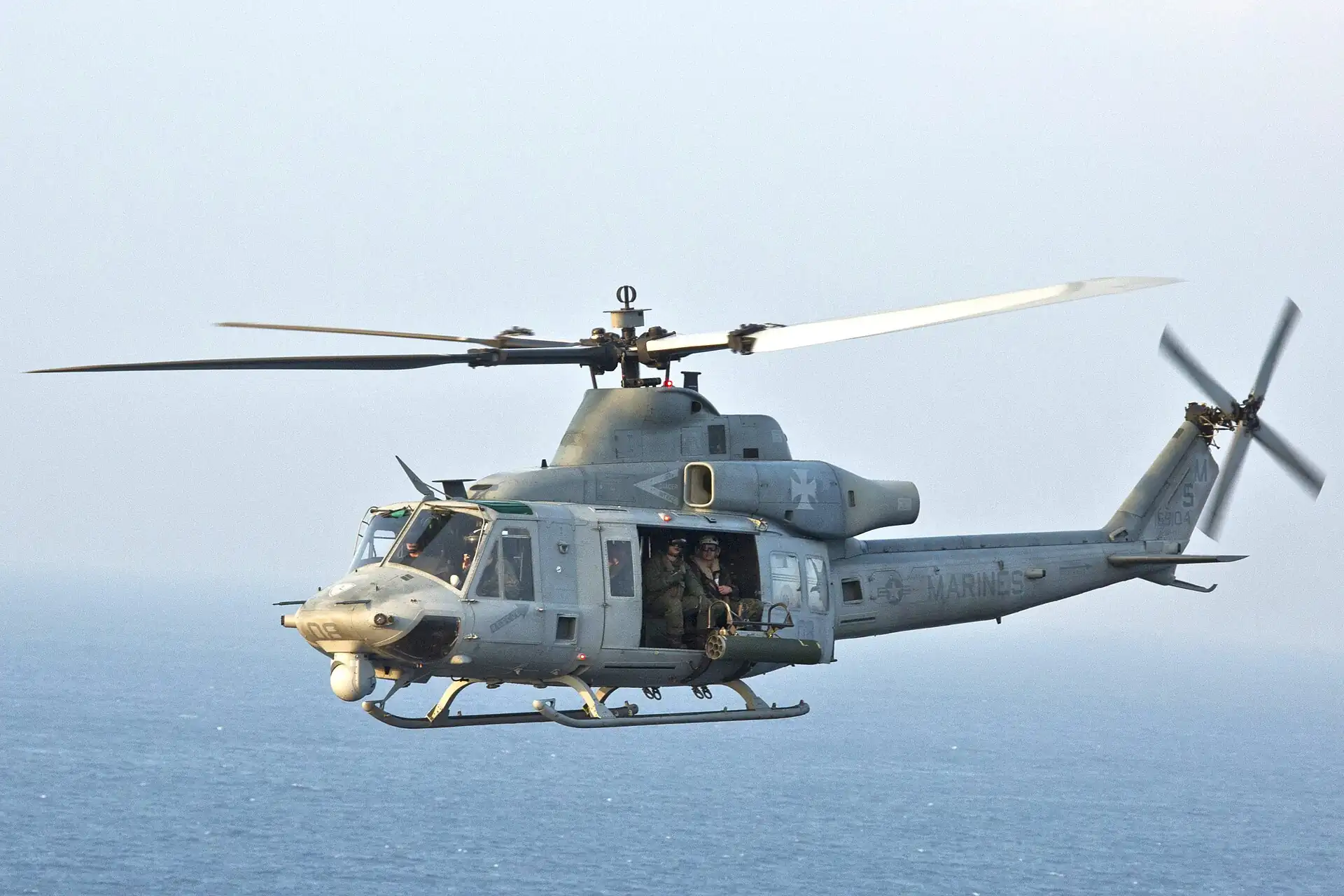
If you’ve ever heard the deep, chopping rhythm of a Huey helicopter, you know it doesn’t just fly, it announces itself. That sound carried through Vietnam, humanitarian missions, and decades of U.S. military operations. But today’s battlefield isn’t the jungle of 1968. It’s digital, fast, networked, and unforgiving.
That’s where the UH-1Y Venom enters the story.
At first glance, it looks like the familiar Huey silhouette. But don’t let that profile fool you. The Bell UH-1Y Venom helicopter is less a simple upgrade and more a full rebirth, redesigned to survive modern threats, lift heavier loads, and coordinate seamlessly with advanced attack platforms like the AH-1Z Viper.
Built by Bell Textron for the United States Marine Corps, the UH-1Y Venom replaces the aging UH-1N Twin Huey fleet. But “replacement” is almost too mild a word.
Compared to its predecessor, the Venom delivers roughly 125% greater payload capacity, improved speed (around 304 km/h max), a digital glass cockpit, and a four-blade composite rotor system that dramatically increases lift and durability.
Yet the numbers only tell part of the story.
The UH-1Y isn’t just a troop taxi. It’s a command hub, a gunship escort, a medical lifeline, and a battlefield coordinator, sometimes all in the same sortie. In modern expeditionary warfare, where Marines may deploy from ship to shore within hours, that flexibility is gold.
In this post, you’ll discover what makes the UH-1Y Venom a cornerstone of Marine aviation, from its specs and weapons systems to its real-world combat value.
What is the UH-1Y Venom?
The UH-1Y Venom is what happens when a legendary helicopter refuses to fade quietly into history. Instead of retiring the Huey line, engineers essentially re-engineered its DNA for modern warfare. The result? A twin-engine, medium-lift utility helicopter that looks familiar, but performs on an entirely different level.

At its core, the UH-1Y Venom helicopter is a battlefield multitool. It carries Marines into combat zones, provides suppressive fire, evacuates wounded personnel, and even serves as an airborne command center. One aircraft, multiple roles. That versatility is why Marine Corps planners consider it indispensable.
What makes the UH-1Y Venom specs especially impressive isn’t just raw performance; it’s adaptability. For example, it can escort transport helicopters one day, then pivot into casualty evacuation the next. Its modular weapon mounts and digital avionics allow crews to reconfigure the aircraft quickly, depending on mission demands.
Think of it less like a single-purpose machine and more like a flying platform. A backbone aircraft.
Another major advantage is its shared design with the AH-1Z Viper. About 85% of components are common between the two helicopters, which simplifies maintenance, logistics, and training.
For deployed units operating far from supply hubs, that commonality can mean the difference between flying, and being grounded.
In short, the UH-1Y Venom isn’t just a modern Huey. It’s a battlefield system designed for speed, coordination, and survival.
Bell UH-1Y Venom Development and History
The story of the UH-1Y Venom begins with a problem the United States Marine Corps couldn’t ignore anymore. Their trusted UH‑1N Twin Huey helicopters were aging, some airframes had been flying since the Nixon administration. They were reliable, yes, but modern combat had changed. Heavier body armor, advanced electronics, and longer mission ranges demanded more power, more lift, more everything.

So in 1996, the Marines launched what became known as the H-1 Upgrade Program. Initially, the plan sounded simple: upgrade existing Hueys with new engines and avionics. But engineers quickly realized the truth, incremental fixes wouldn’t be enough. Too many structural limitations. Too many compromises.
That’s when Bell Textron essentially hit reset.
Although the Venom shares the Huey’s iconic shape, roughly 90% of the aircraft was redesigned or replaced. The fuselage was strengthened. The rotor system expanded from two blades to four. The transmission, engines, and avionics were all modernized. It wasn’t just an upgrade, it was a transformation hiding in familiar clothing.
The UH-1Y first flew in 2001, but reaching combat readiness took years of testing, refinement, and real-world evaluation. By 2008, the Venom officially entered operational service. And almost immediately, crews noticed the difference.

Pilots reported smoother handling, faster climb rates, and far more responsive controls. Maintenance crews appreciated the simplified logistics, especially because many parts were shared with the AH-1Z attack helicopter.
In a way, the UH-1Y Venom represents continuity. It preserves the Huey’s battlefield spirit, but equips it for a century Huey designers never imagined.
Bell UH-1Y Venom Specifications
Numbers alone don’t win wars, but they tell you exactly what an aircraft can survive, carry, and accomplish. And when you look closely at the UH-1Y Venom specs, you begin to understand why Marine aviators trust it with missions that leave little room for error.
Let’s break down the core technical data that defines the UH-1Y Venom helicopter:
| Specification | UH-1Y Venom |
| Crew | 4 (2 pilots, crew chief, gunner) |
| Troop Capacity | 8 combat-equipped Marines |
| Length | 17.8 meters |
| Rotor Diameter | 14.6 meters |
| Max Takeoff Weight | 8,390 kg |
| Engines | 2 × GE T700-GE-401C turboshaft |
| Maximum Speed | 304 km/h |
| Cruise Speed | 293 km/h |
| Combat Radius | ~240 km |
| Range | ~420 km |
| Service Ceiling | 6,100 meters |
Now here’s where it gets interesting.
The twin General Electric T700 engines produce roughly 1,828 shaft horsepower each. Combined, that gives the Venom over 3,600 horsepower, allowing it to lift heavier loads in hot climates, high altitudes, or both, conditions where older helicopters struggled badly.
But raw engine power is only part of the equation.
The Venom’s four-blade composite rotor system increases lift efficiency by about 30% compared to older two-blade Hueys. That means smoother flight, less vibration, and more usable payload. For crews flying long missions, that reduced vibration isn’t just comfort, it reduces fatigue and extends aircraft lifespan.

Another underrated advantage is fuel efficiency. Despite carrying more weight and equipment, the UH-1Y can travel farther and remain airborne longer than its predecessor. That extra endurance gives commanders more flexibility when operating from ships or remote forward bases.
In simple terms, the UH-1Y Venom isn’t just faster or stronger. It’s smarter, more efficient, and designed to operate where older helicopters simply couldn’t.
Armament and Weapons Systems
At first glance, the UH-1Y Venom looks like a transport helicopter. But that impression fades quickly once you see what it can carry on its stub wings and door mounts. This aircraft isn’t just built to move Marines, it’s built to protect them, aggressively if necessary.
Unlike dedicated attack helicopters, the UH-1Y Venom helicopter uses a modular weapon system. Crews can configure it for different missions, sometimes within hours. Escort duty? Load rockets and Gatling guns. Troop insertion in hostile territory? Add heavy machine guns for suppressive fire.
Here’s a breakdown of its primary weapons:
| Weapon Type | System | Purpose |
| Machine Guns | M240 7.62mm | Defensive suppressive fire |
| Heavy Machine Guns | GAU-21 .50 caliber | Anti-personnel, light vehicles |
| Gatling Gun | GAU-17/A 7.62mm | High-rate suppressive fire |
| Rocket System | Hydra 70 rockets | Area suppression, light armor |
| Precision Rockets | APKWS laser-guided rockets | Precision strike capability |
The GAU-17/A Gatling gun deserves special mention. It can fire up to 3,000 rounds per minute, creating an almost continuous stream of fire. In practical terms, that allows the Venom to suppress enemy positions while Marines land or extract under pressure.
Then there’s the APKWS system, laser-guided rockets that transform unguided rockets into precision weapons. This allows the UH-1Y to strike targets with remarkable accuracy, reducing collateral damage. It’s a major shift from the older “spray and pray” era of helicopter combat.

What makes the Venom truly effective isn’t just firepower, it’s flexibility. It can escort transport helicopters like the CH-53E Super Stallion, support ground troops, or defend itself while performing medical evacuations.
In essence, the UH-1Y Venom isn’t helpless in dangerous airspace. It arrives ready to fight.
Key Features and Technology of The Venom Helicopter
If the original Huey was analog, raw, mechanical, and loud, the UH-1Y Venom is unmistakably digital. Underneath its familiar shape lies a completely modern aircraft, designed for information-driven warfare where awareness can mean survival.
The biggest leap forward is the Venom’s glass cockpit. Instead of dozens of individual gauges scattered across the instrument panel, pilots use multifunction digital displays.

These screens combine navigation, engine data, targeting, and threat warnings into one clear interface. It sounds simple, but the impact is massive: pilots spend less time scanning instruments and more time focusing on the mission outside the window.
And in combat aviation, seconds matter.
The aircraft also features a fully integrated avionics suite, including:
| System | Function |
| Digital moving map | Real-time terrain and navigation |
| Forward-looking infrared (FLIR) | Night and low-visibility operations |
| GPS and inertial navigation | Precise positioning without signal reliance |
| Secure communications | Encrypted coordination with ground and air units |
| Threat warning systems | Alerts for incoming radar or missile threats |
But perhaps the most transformative upgrade is the four-blade composite rotor system. Older Hueys used two metal blades, which produced heavy vibration and limited lift capacity.
The Venom’s composite blades are lighter, stronger, and more efficient. Pilots often describe the difference as going from driving an old pickup truck to a modern performance vehicle, smoother, more responsive, and easier to control under stress.
Another critical feature is survivability. The UH-1Y includes crashworthy seats, energy-absorbing landing gear, and armored components that protect vital systems. Even the fuel tanks are designed to resist explosions if damaged.
All these upgrades serve one purpose: keeping the aircraft flying, the crew alive, and the mission on track, even when conditions turn hostile fast.
Bell UH-1Y Venom Roles and Missions
What makes the UH-1Y Venom so valuable isn’t just its speed or weapons, it’s how many different jobs it can perform, often within the same day. Marine Corps planners don’t see it as a single-purpose helicopter. They see it as a flexible airborne tool that adapts to whatever the battlefield demands.
One of its most common roles is assault support. In simple terms, that means transporting Marines directly into combat zones.
The UH-1Y can carry up to eight fully equipped troops, plus crew, weapons, and mission gear. And because it’s faster and more powerful than older Hueys, it can get in and out quickly, reducing exposure to enemy fire.
But troop transport is just the beginning.
The Venom also plays a critical role in armed escort missions. When larger transport helicopters like the MV-22B Osprey carry Marines or supplies, the UH-1Y often flies alongside them, providing defensive fire support. Its machine guns and rockets deter enemy threats and protect more vulnerable aircraft.
Another essential mission is medical evacuation, often called MEDEVAC. Inside the cabin, crews can install stretchers and medical equipment to evacuate wounded personnel.
The helicopter’s speed and stability allow injured Marines to reach field hospitals faster, sometimes within the so-called “golden hour,” the critical period when treatment is most effective.
The UH-1Y also serves as an airborne command and control platform. Its advanced communications systems allow commanders to coordinate ground forces, aircraft, and naval units in real time. Think of it as a flying relay station that keeps everyone connected.
From combat insertion to casualty evacuation, the UH-1Y Venom performs missions that directly shape battlefield outcomes. It doesn’t just support operations, it enables them.
