

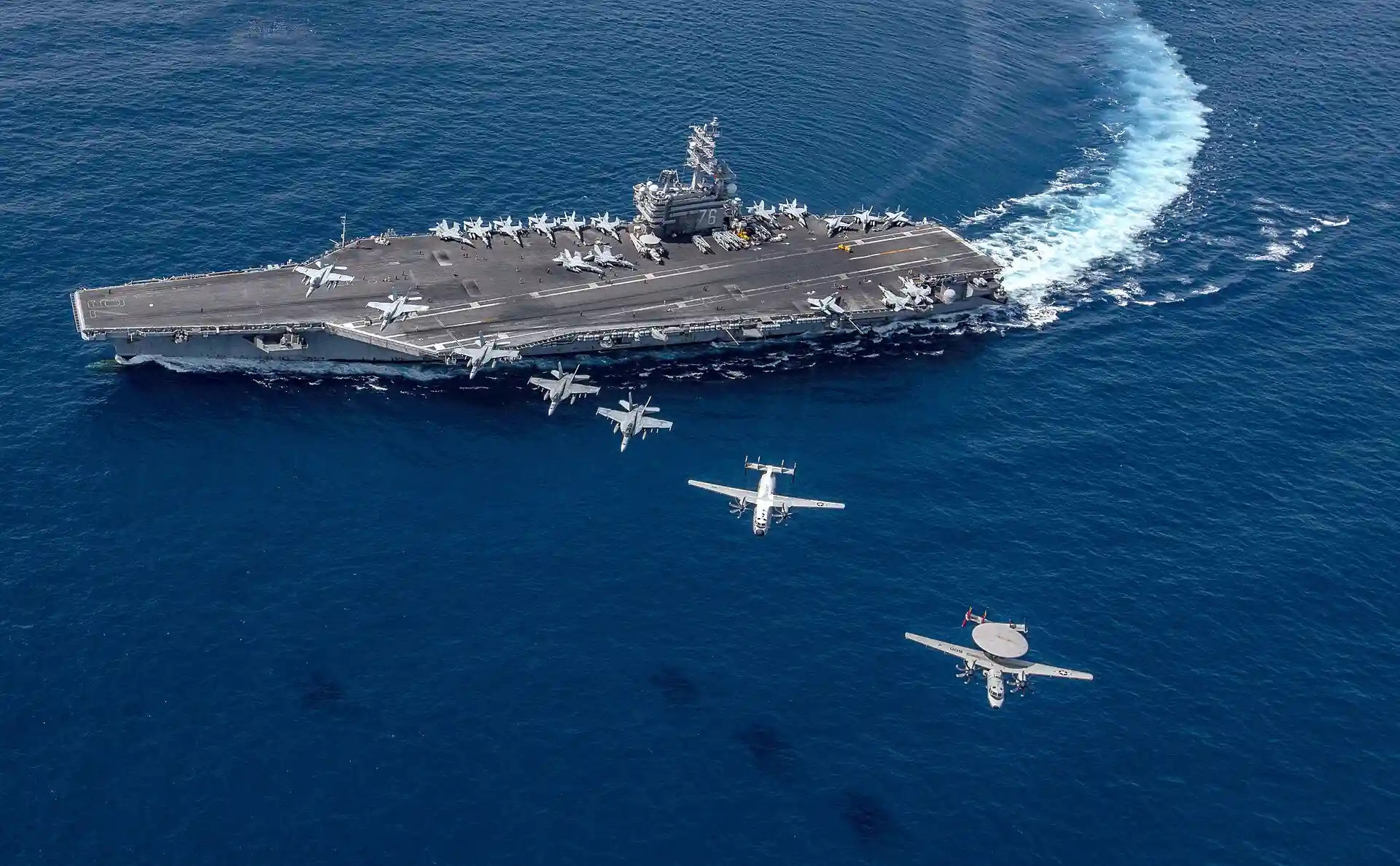
You don’t truly grasp the scale of modern naval power until you stand beneath the shadow of the USS Ronald Reagan. It’s not just a ship, it’s basically a floating city that moves with purpose.
Imagine a structure taller than a 20-story building, longer than three football fields, and powered not by fuel you refill weekly, but by nuclear reactors designed to last decades. That alone changes how you think about what’s possible at sea.
The USS Ronald Reagan (CVN-76) is one of the United States Navy’s most capable Nimitz-class aircraft carriers, and it represents far more than steel, cables, and jet fuel. It’s a mobile airbase capable of launching over 60 aircraft anywhere in the world, often without warning.
In practical terms, that means a single carrier can project air power across thousands of miles, no foreign runway required. That flexibility is exactly why aircraft carriers remain central to U.S. global strategy.
Named after Ronald Reagan, the ship carries a legacy rooted in Cold War resolve and modern geopolitical reality. Commissioned in 2003, it has spent much of its operational life in the Indo-Pacific region, quietly shaping events simply by being present. Presence, in naval terms, is its own form of influence.
But what makes this carrier especially fascinating isn’t just its size or firepower; it’s how it operates as a living ecosystem.
Over 5,000 sailors live, work, eat, and sleep aboard. They run airports, hospitals, power plants, and logistics hubs, all without touching land for months.
And here’s the real question worth exploring: how does a single ship manage to carry so much responsibility, and why does it still matter more than ever today?
The History Behind USS Ronald Reagan
When the USS Ronald Reagan was commissioned on July 12, 2003, it made history in a subtle but meaningful way. It became the first U.S. aircraft carrier named after a living former president. That detail alone stirred conversation. Some saw it as symbolic; others, political. Either way, it cemented the ship’s identity before it ever left port.
Built at Newport News Shipbuilding in Virginia, the only shipyard in the United States capable of constructing nuclear-powered carriers, the vessel took nearly six years to complete.

Construction began in 1998, and by the time it entered service, the price tag had climbed to roughly $4.5 billion. That figure reflects more than raw materials; it represents decades of engineering refinement within the Nimitz-class design.
Read also: USS George H.W. Bush (CVN-77): Capabilities You Must Know
Unlike many warships that quietly enter service, the USS Ronald Reagan began its career with momentum. Within two years of commissioning, it was already supporting combat operations in the Persian Gulf.
Over time, it would become a central component of U.S. naval strategy in the Pacific, eventually serving as the forward-deployed carrier in Japan, an assignment that places it at the geographic heart of modern geopolitical tension.

What’s often overlooked is how quickly carriers become operational workhorses. There’s no long honeymoon period. Within months of sea trials, air wings are qualifying pilots, conducting carrier landings, and integrating into fleet exercises.
Ships age, yes, but their stories accumulate faster than their rust. And in the case of the USS Ronald Reagan, that story has unfolded across some of the most strategically sensitive waters on Earth.
What Makes USS Ronald Reagan So Powerful
Numbers alone don’t tell the full story, but in the case of the USS Ronald Reagan, they come close. This ship operates at a scale that’s difficult to visualize unless you break it down piece by piece. Its flight deck stretches roughly 333 meters (1,092 feet), which means three full soccer fields could sit end-to-end with room to spare.
And beneath that deck lies a maze of hangars, fuel lines, weapons storage, and living quarters, all engineered to support continuous air operations.
At full load, the USS Ronald Reagan displaces about 100,000 tons. That weight isn’t just bulk, it provides stability. Even in rough seas, the carrier remains steady enough for fighter jets to land on a runway that’s constantly moving. That alone is a triumph of naval engineering.
The nuclear propulsion system is where things get especially interesting. Two pressurized water reactors generate steam, which powers four massive turbines connected to four propeller shafts.
Together, they produce approximately 260,000 shaft horsepower. The result is speeds exceeding 30 knots (about 56 km/h), remarkable for a vessel this large.
USS Ronald Reagan Specifications Table
| Category | Specification |
| Ship Class | Nimitz-class aircraft carrier |
| Hull Number | CVN-76 |
| Length | 1,092 ft (333 m) |
| Beam (flight deck width) | 252 ft (77 m) |
| Displacement | ~100,000 tons (full load) |
| Propulsion | 2 nuclear reactors, 4 turbines |
| Speed | 30+ knots |
| Crew | ~3,000 ship crew + 2,000 air wing |
| Aircraft Capacity | 60–75 aircraft |
| Operational Range | Essentially unlimited (20+ years reactor fuel) |
But here’s the part people rarely think about: the ship’s real strength isn’t its engines or armor. It’s its ability to launch and recover aircraft nonstop.
Every 20–30 seconds during peak operations, another jet can be launched using steam-powered catapults.
In effect, the USS Ronald Reagan isn’t just a ship, it’s a mobile airport that never closes.
Where USS Ronald Reagan Has Made Its Mark
If ships could collect passport stamps, the USS Ronald Reagan would need a second booklet.
Since entering service in 2003, this aircraft carrier has operated across the Pacific, the Middle East, and the Indian Ocean, sometimes quietly, sometimes under intense global scrutiny.
Early in its career, it supported combat missions tied to operations in Iraq and Afghanistan. But its most defining chapter began in 2015, when it replaced the USS George Washington as the forward-deployed carrier in Japan.
Forward-deployed. That phrase sounds technical, but it carries strategic weight. Stationed in Yokosuka, Japan, the USS Ronald Reagan became the centerpiece of the U.S. Navy’s 7th Fleet presence in the Indo-Pacific.

Instead of sailing from California and taking weeks to arrive in Asia, it was already there, minutes or hours from potential flashpoints.
And that proximity matters.
Over the years, the carrier has participated in major joint exercises with allies like Japan, South Korea, and Australia. It has conducted freedom of navigation operations in contested waters. It has responded to regional tensions involving North Korea’s missile tests.
In 2011, during Operation Tomodachi, it provided humanitarian assistance after Japan’s devastating earthquake and tsunami, delivering supplies and support when infrastructure on land had collapsed.
A few deployment highlights:
| Year | Operation / Event | Region |
| 2006 | Combat support operations | Persian Gulf |
| 2011 | Operation Tomodachi (disaster relief) | Japan |
| 2015 | Forward deployment to Yokosuka | Japan |
| 2017–2023 | Indo-Pacific deterrence patrols | Western Pacific |
Recently, the carrier transitioned back to the United States for maintenance and overhaul, another routine but critical phase in a carrier’s 50-year lifecycle.
What’s fascinating is how much of its influence comes from simply being present. A 100,000-ton symbol anchored offshore changes calculations. It shifts diplomacy. It alters strategy. Sometimes, the most powerful move is just showing up, and staying.
Why USS Ronald Reagan Matters More Than Ever
To understand the true purpose of the USS Ronald Reagan, you have to think beyond combat. Its greatest strength isn’t firing weapons, it’s preventing wars from starting in the first place. That may sound paradoxical, but it’s central to modern naval strategy.
Aircraft carriers function as mobile deterrents. When the USS Ronald Reagan enters a region, it brings an entire air force with it.
Fighter jets like the F/A-18 Super Hornet, early warning aircraft, electronic warfare platforms, each one extending surveillance and strike capability hundreds of miles beyond the ship itself. This creates what military planners call a “protective bubble” around allied territories and shipping lanes.

Most of its missions fall into three broad categories:
1. Deterrence and Power Projection
The carrier regularly patrols the Indo-Pacific, one of the most strategically sensitive regions in the world. Its presence reassures allies and signals readiness to respond to crises. Even without firing a single shot, its aircraft can monitor airspace, track vessels, and gather intelligence in real time.
2. Rapid Crisis Response
Unlike land-based forces, the USS Ronald Reagan doesn’t require host nation approval to operate. It moves freely in international waters. That mobility allows it to respond to emerging threats faster than almost any other military asset.
For example, during periods of heightened tension on the Korean Peninsula, the carrier’s air wing conducted patrol flights to reinforce regional stability. It wasn’t about aggression, it was about readiness.
3. Humanitarian and Disaster Relief
Surprisingly, carriers often serve as emergency response platforms. With onboard hospitals, desalination systems producing hundreds of thousands of gallons of fresh water daily, and cargo aircraft delivering aid, the USS Ronald Reagan can function as a self-contained disaster relief hub.
Mission Capability Snapshot:
| Capability | Operational Impact |
| Aircraft sorties per day | 120+ during sustained operations |
| Fresh water production | ~400,000 gallons per day |
| Medical facilities | Full surgical hospital onboard |
| Radar coverage | Hundreds of miles |
In many ways, the USS Ronald Reagan acts less like a ship, and more like a floating strategic insurance policy.
Homeport and Operational Base: From Yokosuka to Bremerton
Where a carrier is based isn’t just a logistical detail, it’s a strategic decision.
For nearly eight years, the USS Ronald Reagan was forward-deployed to Yokosuka, Japan. That assignment made it the only permanently stationed U.S. aircraft carrier outside the continental United States. Living overseas changes everything for a crew.
Sailors weren’t just deploying to Asia, they were already there. Families settled in Japanese communities. Kids attended international schools. The carrier became part of the local rhythm.
Yokosuka’s proximity to key maritime corridors in the East China Sea and South China Sea meant the USS Ronald Reagan could get underway quickly.
In naval terms, response time shrank dramatically. Instead of crossing the Pacific from California, a voyage that can take nearly two weeks, the carrier could be on station in days.
But forward deployment also accelerates wear and tear. Operating year-round in a high-tempo region demands rigorous maintenance cycles.

In 2024, the USS Ronald Reagan returned to the United States and shifted homeport to Naval Base Kitsap in Bremerton, Washington. This move marked the beginning of a scheduled maintenance period and refit, standard procedure in a carrier’s roughly 50-year service life.
Here’s a quick comparison of its major homeports:
| Period | Homeport | Strategic Purpose |
| 2003–2015 | San Diego, CA | Pacific fleet operations |
| 2015–2024 | Yokosuka, Japan | Forward-deployed Indo-Pacific presence |
| 2024–Present | Bremerton, WA | Maintenance & modernization |
A carrier’s homeport influences deployment cycles, crew morale, and readiness levels. It’s not just geography, it’s strategy wrapped in logistics.
And as the USS Ronald Reagan transitions into maintenance and upgrades, it’s not slowing down. It’s resetting. Preparing for the next decades of service.
Final Thoughts: The Enduring Power of USS Ronald Reagan
The USS Ronald Reagan isn’t just a massive aircraft carrier, it’s a moving symbol of how the United States projects stability, influence, and, when necessary, force. Steel and reactors matter, yes. But what truly defines this ship is the combination of technology and people working in constant rhythm.
Over two decades of service, it has operated in some of the world’s most sensitive regions, responded to disasters, reassured allies, and quietly shaped global strategy without ever dominating headlines for the wrong reasons. That’s not accidental. It’s the product of disciplined crews, relentless training, and a design built for endurance.
As it enters maintenance and modernization cycles, the USS Ronald Reagan isn’t nearing irrelevance, it’s recalibrating. Carriers are long-game assets. Fifty years of service means multiple geopolitical eras, shifting alliances, evolving threats.
And through it all, one thing remains constant: when this 100,000-ton airfield moves across the horizon, people notice.
