

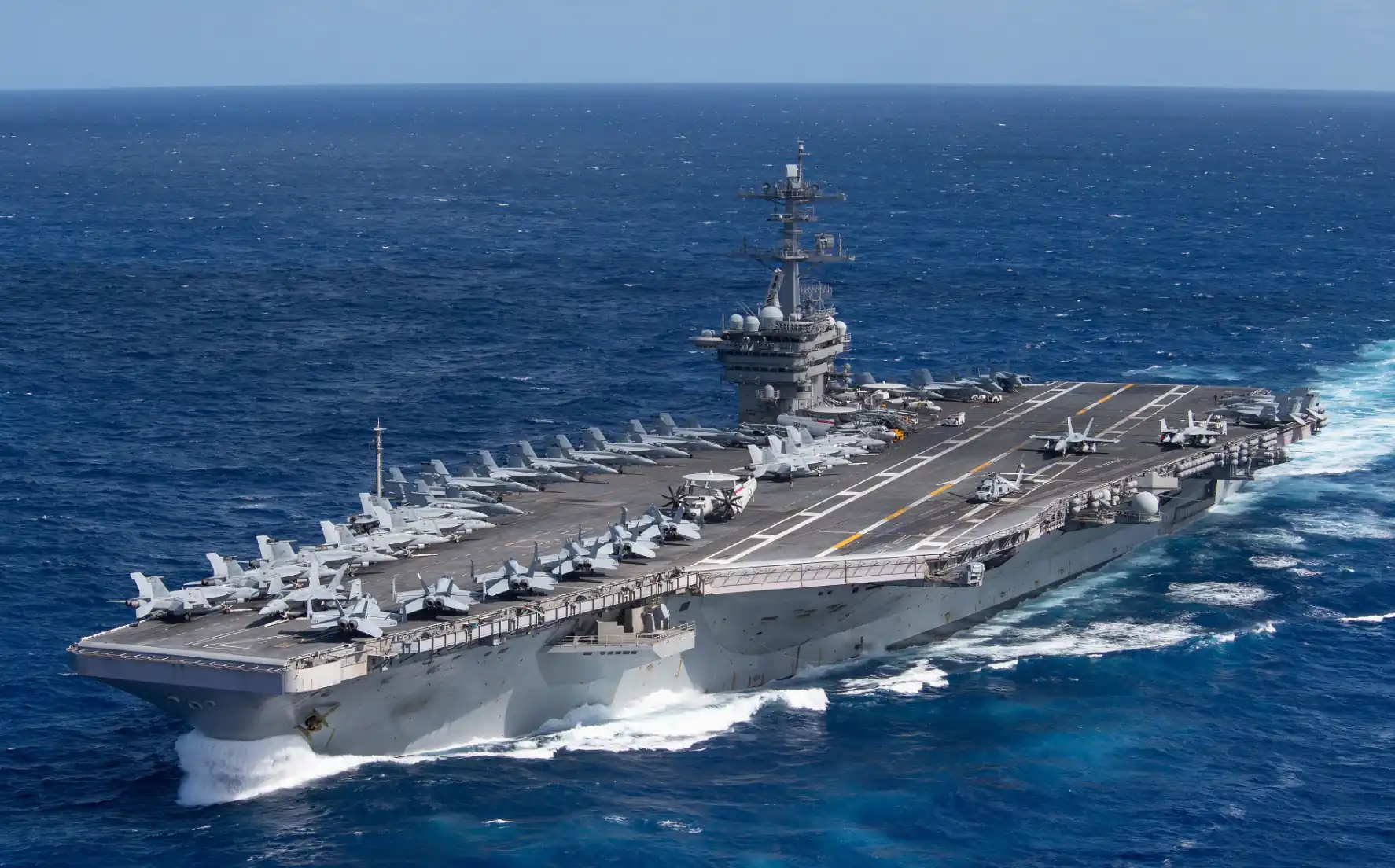
Out on the open ocean, where the horizon blurs into nothing and the sky feels endless, there’s a city that moves. Not metaphorically. Literally. Steel, nuclear-powered, humming with life. That city is the USS Theodore Roosevelt (CVN-71).
At first glance, it’s just another aircraft carrier. Massive, sure. Impressive, obviously. But spend a moment looking closer, and it becomes something else entirely, a floating ecosystem of strategy, technology, and human endurance.
Nearly 5,000 people live and work onboard. Jets scream off its deck every few minutes during peak operations. And beneath it all? Two nuclear reactors quietly powering the whole thing without needing to refuel for decades.
Named after Theodore Roosevelt, a man famous for the phrase “speak softly and carry a big stick”, this carrier doesn’t just carry that philosophy. It embodies it.
Here’s what makes the USS Theodore Roosevelt fascinating: it’s not just a weapon. It’s a signal. When it shows up off a coastline, people notice. Allies feel reassured. Rivals… think twice.
In this post, you’re not just going to learn specs and dates. You’ll get a sense of how this ship fits into the bigger picture, how it operates, why it matters, and what life is actually like on board.
Because once you understand CVN-71, you start to understand something bigger: how modern naval power really works.
Key Specifications of USS Theodore Roosevelt (CVN-71)
Numbers don’t always tell the full story, but in the case of the USS Theodore Roosevelt (CVN-71), they come pretty close.
This isn’t just a large ship; it’s one of those rare machines where scale becomes part of its identity. You don’t just measure it, you experience it.
Here’s a snapshot that puts things into perspective:
| Feature | Details |
| Ship Class | Nimitz-class aircraft carrier |
| Commissioned | 1986 |
| Length | ~1,092 feet (333 meters) |
| Displacement | ~100,000 tons (fully loaded) |
| Propulsion | 2 nuclear reactors |
| Speed | 30+ knots (≈56 km/h) |
| Crew | ~5,000 personnel |
| Aircraft Capacity | 60–75 aircraft |
A thousand feet long. That’s roughly three football fields laid end to end… and then some. Walking from bow to stern isn’t a quick stroll, it’s a commitment.
What really sets it apart, though, isn’t just size, it’s independence. Those twin nuclear reactors mean the ship can operate for decades without refueling. No gas stops, no logistical leash. It can stay at sea for months, limited more by food supplies than fuel. That kind of autonomy changes how it’s used, it becomes less of a ship and more of a mobile strategic base.
And then there’s the flight deck, which feels like organized chaos if you watch it long enough. Jets line up, engines roaring, and within seconds one is gone, launched into the sky, while another rolls into position. During intense operations, launches can happen every half minute. Blink and you’ve missed something.
A small but telling detail: this carrier was the first of its kind built using modular construction, where large sections were assembled separately and then joined together. It sped up production significantly, kind of like building a skyscraper in chunks before stacking it all into place.
Read also: USS Abraham Lincoln (CVN-72): Capabilities, Missions, and Tech
So yes, the specs are impressive. But taken together, they reveal something more interesting: a ship designed not just to move, but to sustain, project, and persist almost anywhere on Earth.
Construction & Design of USS Theodore Roosevelt
The story of the USS Theodore Roosevelt (CVN-71) didn’t begin in the ocean, it began in pieces.
Steel sections the size of apartment blocks, assembled separately, then stitched together with a kind of industrial precision that feels almost surgical.
At the time, this approach, modular construction, was still relatively new for ships of this scale. Risky? A bit. Revolutionary? Absolutely.
Construction kicked off in the early 1980s at Newport News Shipbuilding, one of the few places on Earth capable of handling something this ambitious.

Instead of building the carrier from the keel up in one continuous process, workers built massive modules independently, engine rooms, living quarters, flight deck sections, then brought them together like a colossal three-dimensional puzzle. The payoff? Time. The Navy shaved well over a year off the build compared to earlier carriers.
There’s something quietly fascinating about that. A warship named after Theodore Roosevelt, a man who championed efficiency and strength, ended up being built in a way that reflected both.
Design-wise, CVN-71 follows the DNA of the Nimitz class, but with subtle refinements.
The angled flight deck, for example, isn’t just for aesthetics; it allows aircraft to land and launch almost simultaneously. That’s a big deal. It means the carrier doesn’t have to pause operations; it breathes continuously, like a living system.

Inside, the ship is layered, hangar bays below, control towers above, nuclear reactors deep in its core. It’s less like a vessel and more like a vertical city turned sideways.
And then there’s durability. Everything about its design assumes stress, rough seas, high-tempo combat, long deployments. Nothing is delicate. Even comfort, where it exists, feels secondary.
In a strange way, the USS Theodore Roosevelt wasn’t just built to sail. It was built to endure
Operational History of USS Theodore Roosevelt
If the USS Theodore Roosevelt (CVN-71) could talk, it probably wouldn’t start with its launch day or the applause at commissioning. It would start with its first real test, because that’s where ships like this earn their reputation.
Not long after entering service in 1986, CVN-71 found itself in the thick of global tension. By the time the early 1990s rolled around, it was already playing a central role in the Gulf War.
During Operations Desert Shield and Desert Storm, aircraft from its deck flew thousands of sorties. Imagine that pace for a second, jets launching day and night, pilots cycling through missions with barely a pause. The ship didn’t just participate; it sustained the tempo.

Then came the 1990s, a decade that often gets described as “post-Cold War calm,” though Roosevelt’s schedule suggests otherwise. It supported NATO operations over the Balkans, enforcing no-fly zones and conducting strike missions during conflicts in Bosnia and Kosovo.
These weren’t headline-grabbing wars in the same way, but they demanded precision, persistence, and political sensitivity. A different kind of pressure.
After 2001, everything shifted. The carrier became part of the long arc of the War on Terror, launching missions into Afghanistan and later supporting operations in Iraq.
What’s interesting here is how the role evolved. It wasn’t just about overwhelming force anymore, it was about sustained presence. Being there, consistently, quietly shaping outcomes.
Over the decades, deployments have taken it across the Mediterranean, the Persian Gulf, and the Indo-Pacific. Patterns emerge: arrive, operate, adapt, move on. Again and again.
And somewhere in that repetition, something changes. The USS Theodore Roosevelt stops being just a ship with a mission log, and becomes a kind of constant. A moving piece of history that never quite stands still.
Missions & Capabilities of USS Theodore Roosevelt
It’s tempting to think of the USS Theodore Roosevelt (CVN-71) as just a launchpad for fighter jets, but that’s like calling a smartphone “just a calling device.” Technically true, wildly incomplete.
At its core, this carrier is built for layered capability. Air warfare is the obvious one, fighter jets roaring off the deck, striking targets hundreds of miles away. But behind that dramatic image sits a carefully choreographed system.
Early-warning aircraft scan the skies. Electronic warfare planes jam enemy radar. Helicopters sweep the seas for submarines. It’s less a single punch and more a full orchestra playing in sync.
What’s interesting is how flexible that system is. One week, the air wing might be configured for high-intensity combat. The next, it shifts toward surveillance and deterrence, watching, tracking, quietly influencing behavior without firing a shot. Same ship, different posture.

There’s also the matter of reach. With nuclear propulsion, CVN-71 doesn’t depend on nearby bases. It can operate far offshore, launching missions deep inland. That distance creates options, political, strategic, even psychological. You’re present, but not exposed.
And then there’s sea control. The carrier doesn’t operate alone; it’s the centerpiece of a larger strike group, destroyers, cruisers, submarines. Together, they secure vast stretches of ocean, keeping shipping lanes open and threats at bay. It’s a moving bubble of influence.
In a way, the USS Theodore Roosevelt functions like a multitool, combat platform, surveillance hub, diplomatic signal. Not always loud, not always visible, but always capable.
And that versatility? That’s where its real power lies.
Life Onboard USS Theodore Roosevelt
Step inside the USS Theodore Roosevelt (CVN-71) and something shifts.
The outside world, waves, wind, endless blue, fades into the background. What you find instead is a dense, humming micro-city where nearly 5,000 people eat, sleep, work, argue, laugh… and repeat it all the next day.
Space is tight. Not in a dramatic, claustrophobic way, but in a constant, low-level reminder that privacy is a luxury. Sailors sleep in stacked racks (think bunk beds, but closer), often in rooms packed with dozens of others. You learn quickly how to exist in shared space. Headphones become gold. So does silence, rare, fleeting silence.
Food, oddly enough, becomes a big deal. The ship serves thousands of meals a day, and menus matter more than you’d expect. A good meal can lift morale; a bad one… well, everyone notices. There’s even a kind of informal rating system among crew members. No official scorecards, just opinions, loudly shared.

Then there’s the work. Flight deck crews operate in what looks like chaos, jets blasting, engines screaming, signals flashing, but every movement is deliberate. Color-coded uniforms mark roles: yellow for directors, green for maintenance, red for ordnance. It’s a visual language, fast and efficient.
Time itself feels different onboard. Days blur. Night shifts, rotating schedules, it’s easy to lose track. You measure time in watch rotations, not sunsets.
And yet, routines form. Friendships too. Small rituals, coffee before shift, quick jokes in tight corridors, start to matter.
Because in the middle of all that steel and machinery, life onboard isn’t just about operations.
It’s about people figuring out how to live together… in the middle of the ocean.
USS Theodore Roosevelt Today
So where is the USS Theodore Roosevelt (CVN-71) now, after decades of deployments, upgrades, and the occasional storm, both literal and political?
Still active. Still relevant. Still very much in the game.
Homeported in San Diego, the carrier operates as part of the U.S. Navy’s forward presence strategy, which is a polite way of saying: be where it matters, before it matters. In today’s landscape, especially across the Indo-Pacific, that presence carries weight. Not loud, not always headline-grabbing, but unmistakable.

What’s interesting is how the Roosevelt has evolved without losing its core identity. It’s not the newest carrier in the fleet, but it’s far from outdated.
Continuous maintenance cycles and system upgrades have kept it aligned with modern warfare demands. That includes integrating newer aircraft, improving radar and communication systems, and refining its ability to operate in increasingly complex environments.
There’s a quiet adaptability here. The kind you don’t notice unless you’re looking for it.
And despite its age, approaching four decades, it still performs at a level that keeps it in rotation with newer ships. That says something. Not just about engineering, but about how these carriers are designed in the first place: built to last, but also built to evolve.
If earlier sections of its story were about proving itself, this phase feels different. More measured. More strategic.
The USS Theodore Roosevelt isn’t trying to make a name anymore.
It already has one, and now it’s focused on maintaining it, one deployment at a time.
